Warwick, the Kingmaker
1891
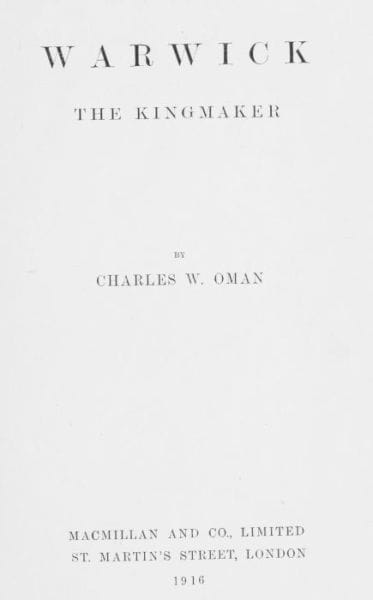
Warwick, the Kingmaker
1891
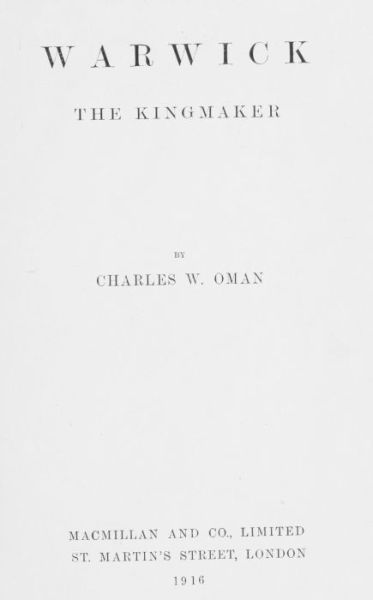
Published in 1891, 'Warwick, the Kingmaker' by Charles Oman provides a detailed biography of Richard Neville, the Earl of Warwick, a key figure during the Wars of the Roses. The book explores Warwick's significant yet often overlooked contributions to the political landscape of 15th-century England, highlighting his familial connections and the shifting power dynamics of the time. Oman's work is notable for its scholarly approach to the complexities of the era, including the decline of Lancastrian rule and the moral decay within the baronage.
Editions
X-Ray
Known as 'the Kingmaker,' he was the most powerful English nobleman of his time, instrumental in placing Edward IV on the throne before later turning against him. A skilled military commander, diplomat, and administrator who commanded extraordinary popular loyalty.
King of England, initially dependent on Warwick's support but later asserting independence. Handsome, capable in war, but prone to luxury and making decisions based on personal desires rather than political wisdom.
Warwick's father, a prudent and experienced politician who guided the Yorkist cause. Executed after the Battle of Wakefield, his death deeply motivated Warwick's subsequent actions.
The Lancastrian king, pious and well-intentioned but weak and prone to mental illness. A puppet in the hands of stronger personalities throughout the civil wars.
About Warwick, the Kingmaker
Chapter Summaries
- 1
- Introduces the historical context of 15th-century England's moral and political decay. Oman argues that Warwick deserves more attention than he has received from historians, despite the scarcity of contemporary sources.
- 2
- Traces the rise of the Neville family from minor Durham lords to great magnates through strategic marriages. Details how the family accumulated vast estates across northern England over several generations.
- 3
- Chronicles the career of Warwick's father, from his marriage to Alice Montacute through his service on the Scottish Border to his role in early Yorkist politics.
Key Themes
- Power and Loyalty
- The complex relationships between feudal loyalty, personal ambition, and political necessity. Warwick's career exemplifies how loyalty could be both a strength and a weakness in medieval politics.
- The Price of Ambition
- Warwick's relentless pursuit of political influence ultimately leads to his downfall. His inability to accept a subordinate role after years of dominance proves fatal.
- Feudalism vs. Centralized Monarchy
- The tension between traditional feudal power structures and emerging royal authority. Warwick represents the last great feudal magnate challenging royal prerogative.
Characters
- Richard Neville, Earl of Warwick(protagonist)
- Known as 'the Kingmaker,' he was the most powerful English nobleman of his time, instrumental in placing Edward IV on the throne before later turning against him. A skilled military commander, diplomat, and administrator who commanded extraordinary popular loyalty.
- Edward IV(major)
- King of England, initially dependent on Warwick's support but later asserting independence. Handsome, capable in war, but prone to luxury and making decisions based on personal desires rather than political wisdom.
- Richard Neville, Earl of Salisbury(major)
- Warwick's father, a prudent and experienced politician who guided the Yorkist cause. Executed after the Battle of Wakefield, his death deeply motivated Warwick's subsequent actions.
- Henry VI(major)
- The Lancastrian king, pious and well-intentioned but weak and prone to mental illness. A puppet in the hands of stronger personalities throughout the civil wars.
- Margaret of Anjou(antagonist)
- Henry VI's queen, a formidable and ruthless politician who became Warwick's greatest enemy. Intelligent and determined, she fought tirelessly to preserve her son's inheritance.
- George, Duke of Clarence(major)
- Edward IV's brother, ambitious and treacherous. Married Warwick's daughter Isabel but repeatedly betrayed his allies for personal advantage.
Link to this book
Add a free, dofollow link to Lex on your blog, forum, syllabus, or reading list.

<a href="https://lex-books.com/book/warwick-the-kingmaker-c70af09a-0e1a-4ab5-b9b0-ed0b4585bb1d"><img src="https://lex-books.com/badges/read-on-lex.svg" alt="Read Warwick, the Kingmaker by Charles Oman free on Lex" width="160" height="40"></a>[](https://lex-books.com/book/warwick-the-kingmaker-c70af09a-0e1a-4ab5-b9b0-ed0b4585bb1d)[url=https://lex-books.com/book/warwick-the-kingmaker-c70af09a-0e1a-4ab5-b9b0-ed0b4585bb1d][img]https://lex-books.com/badges/read-on-lex.svg[/img][/url]Read Warwick, the Kingmaker by Charles Oman free on Lex: https://lex-books.com/book/warwick-the-kingmaker-c70af09a-0e1a-4ab5-b9b0-ed0b4585bb1dCite this book
Reading this edition for a paper or guide? Copy a citation.
Oman, Charles. Warwick, the Kingmaker. Lex, lex-books.com/book/warwick-the-kingmaker-c70af09a-0e1a-4ab5-b9b0-ed0b4585bb1d.Oman, C. (1891). Warwick, the Kingmaker. Lex. https://lex-books.com/book/warwick-the-kingmaker-c70af09a-0e1a-4ab5-b9b0-ed0b4585bb1dOman, Charles. Warwick, the Kingmaker. Lex. https://lex-books.com/book/warwick-the-kingmaker-c70af09a-0e1a-4ab5-b9b0-ed0b4585bb1d.