Étude Médico-Légale: Psychopathia Sexualisavec Recherches Spéciales Sur L'inversion Sexuelle
1931
Étude Médico-Légale: Psychopathia Sexualisavec Recherches Spéciales Sur L'inversion Sexuelle
1931
Translated by Sigismond Csapo
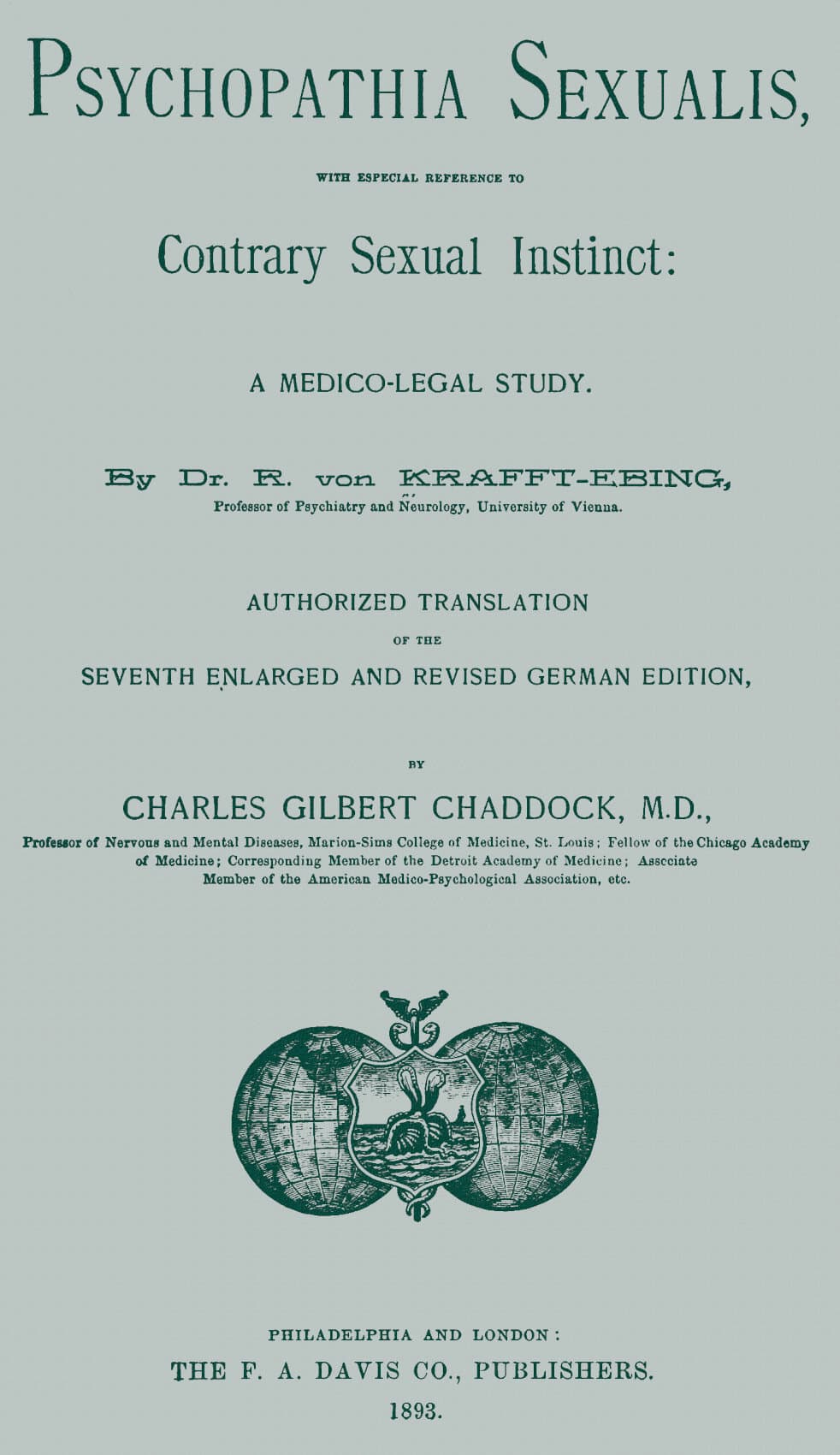
Psychopathia Sexualis was the book that named desire. Richard von Krafft-Ebing, a Viennese psychiatrist, set out in 1886 to catalogue the full spectrum of human sexual variation through a clinical lens. What emerged was something unprecedented: a taxonomic treatise on sexual behavior that would become foundational for psychology while simultaneously captivating a voracious Victorian readership hungry for forbidden knowledge. Krafft-Ebing coined terms that endure today, including sadism, masochism, fetishism, and homosexuality, transforming how society understood the boundaries of normalcy and deviation. Yet the book's power lay in its dual nature. For psychiatrists, it offered a systematic framework. For the sexually transgressive, it was clandestine literature, its clinical prose masking case studies of such explicit detail that Victorian readers devoured it as pornography. The work influenced Sigmund Freud, who sat beside Krafft-Ebing at the University of Vienna, and seduced artists like Gustav Klimt and Egon Schiele, writers like Marcel Proust and Arthur Schnitzler, and philosophers including Georges Bataille. Twelve editions in twelve languages during the author's lifetime testified to its explosive reach. It remains a disturbing artifact: a window into Victorian society's simultaneous obsession with and terror of sexuality, and a reminder that the line between clinical science and forbidden literature has always been thinner than we pretend.
Editions
X-Ray
“All my joys resemble more a momentary intoxication than the real gold of happiness. It was all but an illusion.””
— R. von Krafft-Ebing
“The thought of a comedy with paid prostitutes always seemed so silly and purposeless, for a person hired by me could never take the place of my imagination of a 'cruel mistress'.””
— R. von Krafft-Ebing
“I have also fantasised myself to be his female slave, but this does not suffice, for after all every woman can be the slave of her husband.””
— R. von Krafft-Ebing
“He soon recognized the fact that the stimulus proceeded from the idea to be in the power of a woman rather than from the act of violence itself.””
— R. von Krafft-Ebing
“Nature has made a mistake in the choice of my sexuality and I must do a life-long penance for it, for the moral power to suffer the unavoidable with dignity is lost.””
— R. von Krafft-Ebing
“All our hope rests upon the possibility of a change of the laws which concern it, so that only rape or the comission of public offence, when this can be proved at the same time, shall be punishable.””
— R. von Krafft-Ebing
“There are men who have themselves whipped simply to increase their sexual pleasure. These, in contrast with true masochists, regard flagellation as a means to an end.””
— R. von Krafft-Ebing
“Thus masochism and sadism appear as the fundamental forms of psychosexual perversion, which may make their appearance at any point in the domain of sexual aberration.””
— R. von Krafft-Ebing
“He loved to eat rats and cats.””
— R. von Krafft-Ebing
Link to this book
Add a free, dofollow link to Lex on your blog, forum, syllabus, or reading list.

<a href="https://lex-books.com/book/tude-m-dico-l-gale-psychopathia-sexualisavec-recherches-sp-ciales-sur-l-inversio-d94d0581-f51a-4d3d-b3d4-93c074d8adf7"><img src="https://lex-books.com/badges/read-on-lex.svg" alt="Read Étude Médico-Légale: Psychopathia Sexualisavec Recherches Spéciales Sur L'inversion Sexuelle by R. von Krafft-Ebing free on Lex" width="160" height="40"></a>[](https://lex-books.com/book/tude-m-dico-l-gale-psychopathia-sexualisavec-recherches-sp-ciales-sur-l-inversio-d94d0581-f51a-4d3d-b3d4-93c074d8adf7)[url=https://lex-books.com/book/tude-m-dico-l-gale-psychopathia-sexualisavec-recherches-sp-ciales-sur-l-inversio-d94d0581-f51a-4d3d-b3d4-93c074d8adf7][img]https://lex-books.com/badges/read-on-lex.svg[/img][/url]Read Étude Médico-Légale: Psychopathia Sexualisavec Recherches Spéciales Sur L'inversion Sexuelle by R. von Krafft-Ebing free on Lex: https://lex-books.com/book/tude-m-dico-l-gale-psychopathia-sexualisavec-recherches-sp-ciales-sur-l-inversio-d94d0581-f51a-4d3d-b3d4-93c074d8adf7Cite this book
Reading this edition for a paper or guide? Copy a citation.
Krafft-Ebing, R. von. Étude Médico-Légale: Psychopathia Sexualisavec Recherches Spéciales Sur L'inversion Sexuelle. Lex, lex-books.com/book/tude-m-dico-l-gale-psychopathia-sexualisavec-recherches-sp-ciales-sur-l-inversio-d94d0581-f51a-4d3d-b3d4-93c074d8adf7.Krafft-Ebing, R. V. (1931). Étude Médico-Légale: Psychopathia Sexualisavec Recherches Spéciales Sur L'inversion Sexuelle. Lex. https://lex-books.com/book/tude-m-dico-l-gale-psychopathia-sexualisavec-recherches-sp-ciales-sur-l-inversio-d94d0581-f51a-4d3d-b3d4-93c074d8adf7Krafft-Ebing, R. von. Étude Médico-Légale: Psychopathia Sexualisavec Recherches Spéciales Sur L'inversion Sexuelle. Lex. https://lex-books.com/book/tude-m-dico-l-gale-psychopathia-sexualisavec-recherches-sp-ciales-sur-l-inversio-d94d0581-f51a-4d3d-b3d4-93c074d8adf7.