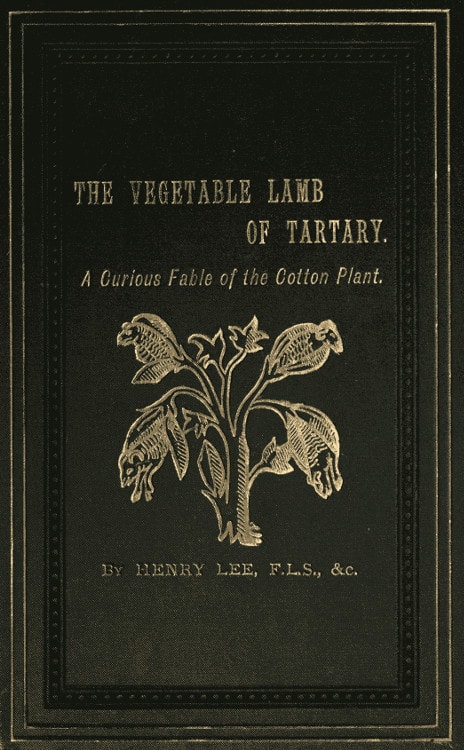
The Vegetable Lamb of Tartary: A Curious Fable of the Cotton Plant.to Which Is Added a Sketch of the History of Cotton and the Cotton Trade
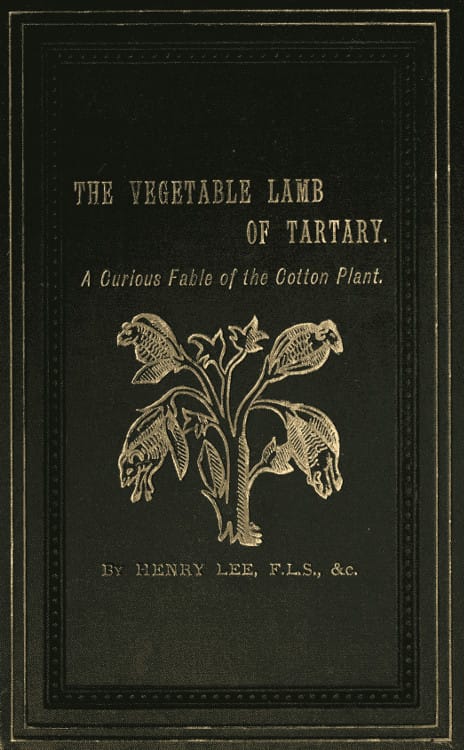
The Vegetable Lamb of Tartary: A Curious Fable of the Cotton Plant.to Which Is Added a Sketch of the History of Cotton and the Cotton Trade
Here is a book to make you question everything you thought you knew about how myths are born. Henry Lee, a Victorian naturalist with an insatiable curiosity, unravels one of the medieval world's most delightful fabrications: the Vegetable Lamb of Tartary, a creature that was half-plant, half-lamb, and grew cotton as its fruit. Medieval Europeans swore this beast existed, tethered to the earth by its stem, grazing on nearby grass until it starved. Lee digs through centuries of rewritten accounts, tracking how a simple botanical truth about cotton got mangled into something wondrous and monstrous. But this isn't mere myth-busting. Lee has a larger argument: every legend, he insists, begins with a real fact, twisted beyond recognition by credulous repetition. The second half of the book shifts to the actual history of cotton, the global trade that built empires, and the plant that sparked a thousand fables. It's a charming, eccentric work, part detective story, part economic history, written with the quiet conviction that truth, however buried, can always be dug up again.
Editions
X-Ray
The author and naturalist who investigates the myth of the Vegetable Lamb. A Fellow of the Linnean, Geological, and Zoological Societies, he applies scientific methodology to debunk medieval legends.
14th-century English knight and traveler who first brought the Vegetable Lamb story to English attention. His account of the mysterious plant-animal became foundational to the legend.
French botanist who wrote extensively about the Barometz in 1605, firmly believing in its existence as a true zoophyte. His work perpetuated the myth among learned men.
Austrian diplomat and ambassador who collected detailed accounts of the Vegetable Lamb from Russian sources. His reports added credibility to the legend in 16th-century Europe.
About The Vegetable Lamb of Tartary: A Curious Fable of the Cotton Plant.to Which Is Added a Sketch of the History of Cotton and the Cotton Trade
Chapter Summaries
- 1
- Lee presents the medieval legend of the Vegetable Lamb and traces its development through various historical accounts. He then argues that the accepted explanation involving Chinese fern-root toys is inadequate, proposing instead that the myth originated from early descriptions of cotton plants.
- 2
- Lee provides a comprehensive history of cotton cultivation and trade, showing how this valuable plant spread from India through ancient trade networks. He demonstrates how cotton's introduction to Europe follows the same routes that would have carried the original stories about 'wool-bearing trees.'
Key Themes
- Scientific Method vs. Medieval Credulity
- Lee demonstrates how rigorous investigation can uncover truth beneath layers of superstition and misinterpretation. He shows how medieval scholars accepted fantastic explanations rather than seeking natural causes.
- The Evolution of Myths
- The book traces how a simple truth about cotton plants transformed through retelling into an elaborate fiction about plant-animals. Lee shows how myths develop through misunderstanding and embellishment over time.
- The Power of Trade and Cultural Exchange
- The spread of cotton knowledge follows ancient trade routes, showing how commercial exchange carries not just goods but stories and ideas. The Vegetable Lamb myth reflects the wonder of discovering new materials.
Characters
- Henry Lee(protagonist)
- The author and naturalist who investigates the myth of the Vegetable Lamb. A Fellow of the Linnean, Geological, and Zoological Societies, he applies scientific methodology to debunk medieval legends.
- Sir John Mandeville(major)
- 14th-century English knight and traveler who first brought the Vegetable Lamb story to English attention. His account of the mysterious plant-animal became foundational to the legend.
- Claude Duret(major)
- French botanist who wrote extensively about the Barometz in 1605, firmly believing in its existence as a true zoophyte. His work perpetuated the myth among learned men.
- Sigismund von Herberstein(major)
- Austrian diplomat and ambassador who collected detailed accounts of the Vegetable Lamb from Russian sources. His reports added credibility to the legend in 16th-century Europe.
- Sir Hans Sloane(major)
- Prominent naturalist who presented a Chinese fern-root specimen to the Royal Society as the 'true' Vegetable Lamb. His identification became the accepted explanation for centuries.
- Dr. John Philip Breyn(major)
- German physician who independently confirmed Sloane's identification of the Vegetable Lamb as an artificial Chinese creation made from fern roots.
Link to this book
Add a free, dofollow link to Lex on your blog, forum, syllabus, or reading list.

<a href="https://lex-books.com/book/the-vegetable-lamb-of-tartary-a-curious-fable-of-the-cotton-plant-to-which-is-ad-47b9fe92-e14f-483b-9760-356de54f355c"><img src="https://lex-books.com/badges/read-on-lex.svg" alt="Read The Vegetable Lamb of Tartary: A Curious Fable of the Cotton Plant.to Which Is Added a Sketch of the History of Cotton and the Cotton Trade by Henry Lee free on Lex" width="160" height="40"></a>[](https://lex-books.com/book/the-vegetable-lamb-of-tartary-a-curious-fable-of-the-cotton-plant-to-which-is-ad-47b9fe92-e14f-483b-9760-356de54f355c)[url=https://lex-books.com/book/the-vegetable-lamb-of-tartary-a-curious-fable-of-the-cotton-plant-to-which-is-ad-47b9fe92-e14f-483b-9760-356de54f355c][img]https://lex-books.com/badges/read-on-lex.svg[/img][/url]Read The Vegetable Lamb of Tartary: A Curious Fable of the Cotton Plant.to Which Is Added a Sketch of the History of Cotton and the Cotton Trade by Henry Lee free on Lex: https://lex-books.com/book/the-vegetable-lamb-of-tartary-a-curious-fable-of-the-cotton-plant-to-which-is-ad-47b9fe92-e14f-483b-9760-356de54f355cCite this book
Reading this edition for a paper or guide? Copy a citation.
Lee, Henry. The Vegetable Lamb of Tartary: A Curious Fable of the Cotton Plant.to Which Is Added a Sketch of the History of Cotton and the Cotton Trade. Lex, lex-books.com/book/the-vegetable-lamb-of-tartary-a-curious-fable-of-the-cotton-plant-to-which-is-ad-47b9fe92-e14f-483b-9760-356de54f355c.Lee, H. (n.d.). The Vegetable Lamb of Tartary: A Curious Fable of the Cotton Plant.to Which Is Added a Sketch of the History of Cotton and the Cotton Trade. Lex. https://lex-books.com/book/the-vegetable-lamb-of-tartary-a-curious-fable-of-the-cotton-plant-to-which-is-ad-47b9fe92-e14f-483b-9760-356de54f355cLee, Henry. The Vegetable Lamb of Tartary: A Curious Fable of the Cotton Plant.to Which Is Added a Sketch of the History of Cotton and the Cotton Trade. Lex. https://lex-books.com/book/the-vegetable-lamb-of-tartary-a-curious-fable-of-the-cotton-plant-to-which-is-ad-47b9fe92-e14f-483b-9760-356de54f355c.