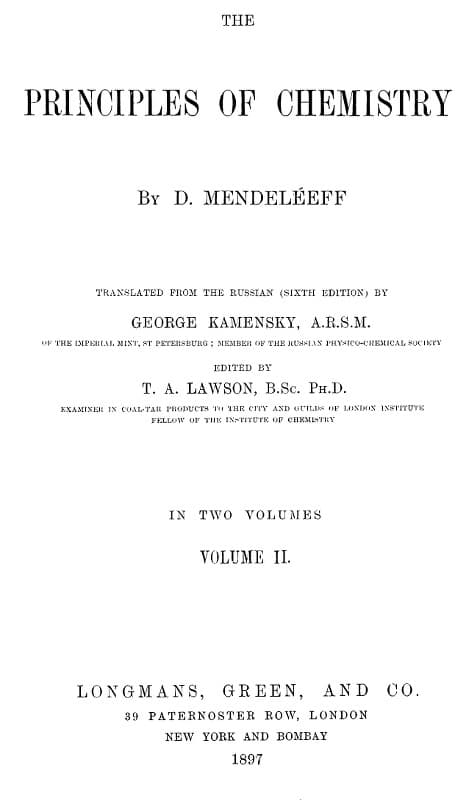
The Principles of Chemistry, Volume I
1868
The Principles of Chemistry, Volume I
1868
Translated by George Kamensky
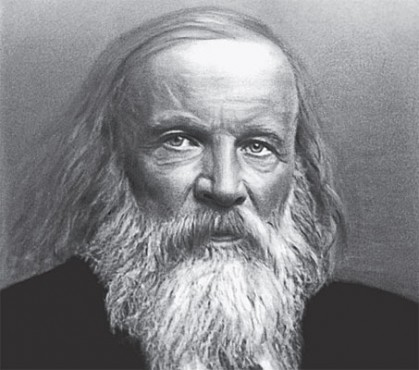
In 1869, a Russian chemist arranged his elements by atomic weight and saw something no one had seen before: a pattern. The result was the periodic table, and this book is where Mendeleev first unveiled his periodic law to the world. But this is not a dry reference work. It is a working scientist's notebook, philosophical treatise, and passionate argument for chemistry as a unified science rather than a collection of isolated facts. Mendeleev believed the elements were not random curiosities but a system waiting to be decoded, and his writing carries the urgency of a man who has just glimpsed the architecture of matter itself. Volume I lays the groundwork: the relationship between atomic weights and elemental properties, the justification for leaving gaps where undiscovered elements must exist, and a sweeping vision of what chemistry could become. Reading it now feels like watching a genius think in real time, wrestling with data, making bold guesses, and occasionally pausing to marvel at what the universe is hiding. For anyone curious about how we learned to read the periodic table, there is no better place to start.
Editions
Link to this book
Add a free, dofollow link to Lex on your blog, forum, syllabus, or reading list.

<a href="https://lex-books.com/book/the-principles-of-chemistry-volume-i-351e5cad-19e4-4ad2-be6e-595451b663e9"><img src="https://lex-books.com/badges/read-on-lex.svg" alt="Read The Principles of Chemistry, Volume I by Dmitry Ivanovich Mendeleyev free on Lex" width="160" height="40"></a>[](https://lex-books.com/book/the-principles-of-chemistry-volume-i-351e5cad-19e4-4ad2-be6e-595451b663e9)[url=https://lex-books.com/book/the-principles-of-chemistry-volume-i-351e5cad-19e4-4ad2-be6e-595451b663e9][img]https://lex-books.com/badges/read-on-lex.svg[/img][/url]Read The Principles of Chemistry, Volume I by Dmitry Ivanovich Mendeleyev free on Lex: https://lex-books.com/book/the-principles-of-chemistry-volume-i-351e5cad-19e4-4ad2-be6e-595451b663e9Cite this book
Reading this edition for a paper or guide? Copy a citation.
Mendeleyev, Dmitry Ivanovich. The Principles of Chemistry, Volume I. Lex, lex-books.com/book/the-principles-of-chemistry-volume-i-351e5cad-19e4-4ad2-be6e-595451b663e9.Mendeleyev, D. I. (1868). The Principles of Chemistry, Volume I. Lex. https://lex-books.com/book/the-principles-of-chemistry-volume-i-351e5cad-19e4-4ad2-be6e-595451b663e9Mendeleyev, Dmitry Ivanovich. The Principles of Chemistry, Volume I. Lex. https://lex-books.com/book/the-principles-of-chemistry-volume-i-351e5cad-19e4-4ad2-be6e-595451b663e9.