The Organism as a Whole, from a Physicochemical Viewpoint
1916
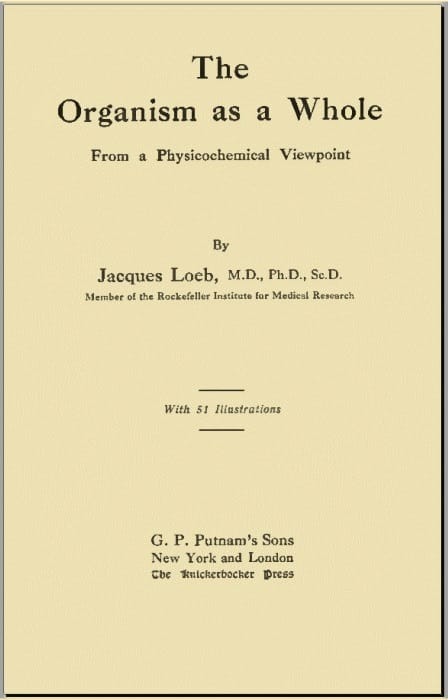
The Organism as a Whole, from a Physicochemical Viewpoint
1916
In this groundbreaking 1916 treatise, pioneering biologist Jacques Loeb mounts a passionate argument for understanding life through the lens of physics and chemistry alone. At a moment when biology teetered between ancient vitalistic beliefs and the new reductionist science, Loeb demanded that organisms be studied as unified physicochemical systems rather than mysterious vessels of mysterious 'vital forces.' He focuses particularly on the cytoplasm of the egg, demonstrating that this cellular substance contains the fundamental structures guiding development independent of Mendelian hereditary factors. The book pulses with intellectual urgency: Loeb saw his era's biologists as standing at a crossroads, and he refused to let them choose the path of mysticism over measurable, reproducible science. This is not merely a historical document but a window into one of biology's most consequential intellectual battles, a fight that shaped everything from genetics to modern molecular biology.
Editions
Link to this book
Add a free, dofollow link to Lex on your blog, forum, syllabus, or reading list.

<a href="https://lex-books.com/book/the-organism-as-a-whole-from-a-physicochemical-viewpoint-6102c38c-d663-420d-9a6f-a00cc3625481"><img src="https://lex-books.com/badges/read-on-lex.svg" alt="Read The Organism as a Whole, from a Physicochemical Viewpoint by Jacques Loeb free on Lex" width="160" height="40"></a>[](https://lex-books.com/book/the-organism-as-a-whole-from-a-physicochemical-viewpoint-6102c38c-d663-420d-9a6f-a00cc3625481)[url=https://lex-books.com/book/the-organism-as-a-whole-from-a-physicochemical-viewpoint-6102c38c-d663-420d-9a6f-a00cc3625481][img]https://lex-books.com/badges/read-on-lex.svg[/img][/url]Read The Organism as a Whole, from a Physicochemical Viewpoint by Jacques Loeb free on Lex: https://lex-books.com/book/the-organism-as-a-whole-from-a-physicochemical-viewpoint-6102c38c-d663-420d-9a6f-a00cc3625481Cite this book
Reading this edition for a paper or guide? Copy a citation.
Loeb, Jacques. The Organism as a Whole, from a Physicochemical Viewpoint. Lex, lex-books.com/book/the-organism-as-a-whole-from-a-physicochemical-viewpoint-6102c38c-d663-420d-9a6f-a00cc3625481.Loeb, J. (1916). The Organism as a Whole, from a Physicochemical Viewpoint. Lex. https://lex-books.com/book/the-organism-as-a-whole-from-a-physicochemical-viewpoint-6102c38c-d663-420d-9a6f-a00cc3625481Loeb, Jacques. The Organism as a Whole, from a Physicochemical Viewpoint. Lex. https://lex-books.com/book/the-organism-as-a-whole-from-a-physicochemical-viewpoint-6102c38c-d663-420d-9a6f-a00cc3625481.