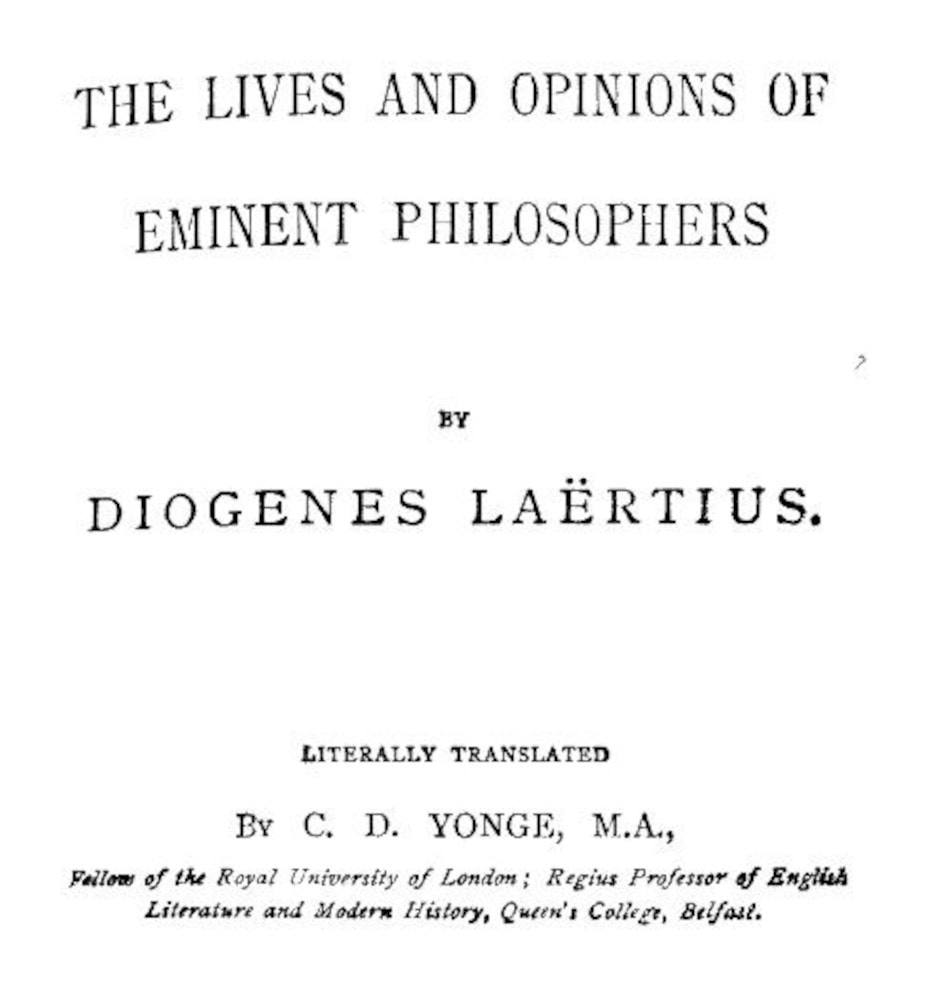
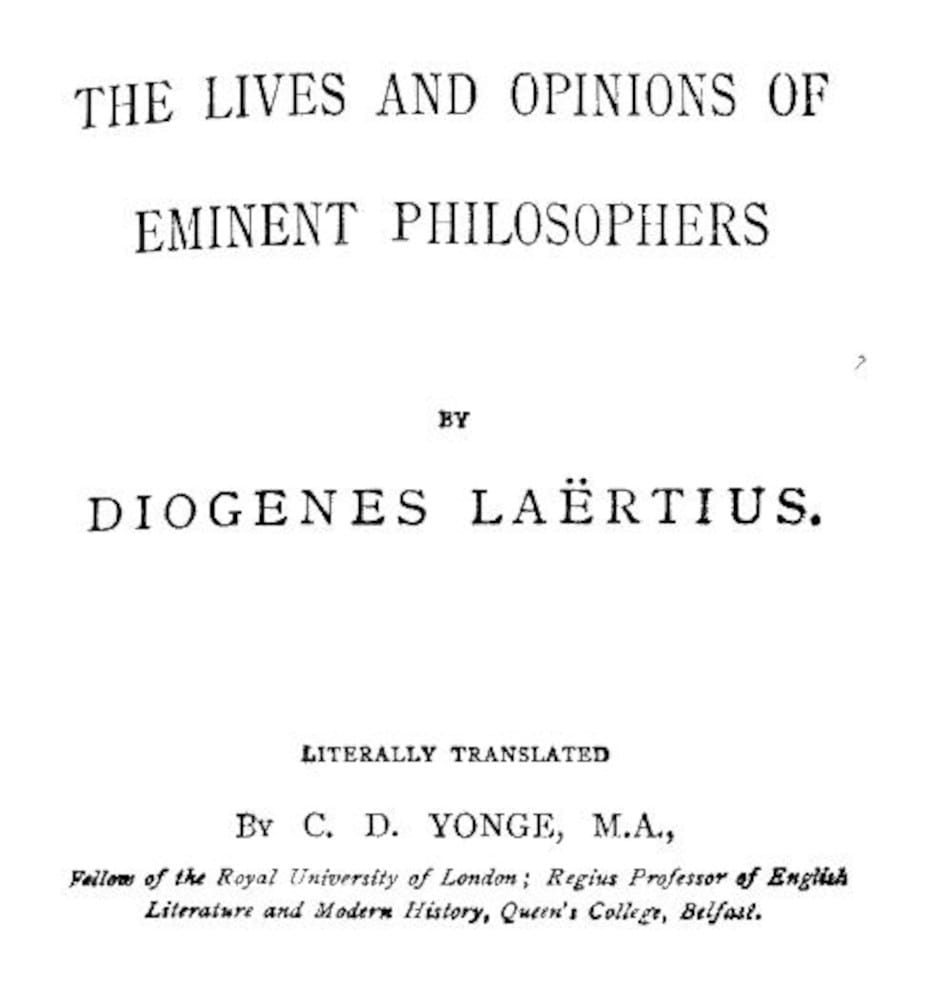
The Lives and Opinions of Eminent Philosophers
1915
The Lives and Opinions of Eminent Philosophers
1915
Translated by Charles Duke Yonge
Written in the late second century AD, this is our most voluminous surviving portrait gallery of ancient philosophy. Diogenes Laertius gathered everything he could find about the great thinkers of Greece and the Hellenistic world, preserving anecdotes, apocryphal tales, and fragments of lost works that would otherwise have vanished. Here you will find the serious philosophy, yes, but also the gossip: Plato's complicated love life, Diogenes the Cynic's legendary cheek, Epicurus's unusual dietary habits, and the various dramatic ways philosophers chose to die. The ten books move from Thales and the pre-Socratics through Socrates, Plato, and Aristotle, then branch into the Stoics, Epicureans, Skeptics, and other schools of the Hellenistic period. It is uncritical, often fantastical, and occasionally contradictory. But it is also irreplaceable: much of what we know about ancient philosophy comes directly or indirectly from this work. For anyone curious about where Western thought began, this is the place to meet those thinkers as their own contemporaries knew them, eccentricities and all.
Editions
X-Ray
“I am a citizen of the world.””
— Diogenes Laertius
“One day a man invited him into a richly furnished house, saying 'be careful not to spit on the floor.' Diogenes, who needed to spit, spat in his face, exclaiming that it was the only dirty place he could find where spitting was permitted.””
— Diogenes Laertius
“And at last, becoming a complete misanthrope, he used to live, spending his time in walking about the mountains; feeding on grasses and plants, and in consequence of these habits, he was attacked by the dropsy, and so then he returned to the city, and asked the physicians, in a riddle, whether they were able to produce a drought after wet weather. And as they did not understand him, he shut himself up in a stable for oxen, and covered himself with cow-dung, hoping to cause the wet to evaporate from him, by the warmth that this produced. And as he did himself no go good in this way, he died, having lived seventy years;””
— Diogenes Laertius
“Yoksunluktan ileri gelen acıyı ortadan kaldıran yalın tatlar da zengin bir sofrayla aynı hazzı verir. (Epikuros)””
— Diogenes Laertius
“A man once said to him, that his friends laid plots against him; “What then,” said he, “are you to do, if you must look upon both your friends and enemies in the same light?” On one occasion he was asked, what was the most excellent thing among men; and he said, “Freedom of speech.””
— Diogenes Laertius
“Aristotle was the son of Nicomachus and Phæstias, a citizen of Stagira; and Nicomachus was descended from Nicomachus, the son of Machaon, the son of Æsculapius, as Hermippus tells us in his treatise on Aristotle; and he lived with Amyntas, the king of the Macedonians, as both a physician and a friend. II. He was the most eminent of all the pupils of Plato; he had a lisping voice, as is asserted by Timotheus the Athenian, in his work on Lives. He had also very thin legs, they say, and small eyes; but he used to indulge in very conspicuous dress, and rings, and used to dress his hair carefully.””
— Diogenes Laertius
“XXIV. But Molon, who had a great dislike to Plato, says “There is not so much to wonder at in Dionysius being at Corinth, as in Plato’s being in Sicily.” Xenophon, too, does not appear to have been very friendlily disposed towards him: and accordingly they have, as if in rivalry of one another, both written books with the same title, the Banquet, the Defence of Socrates, Moral Reminiscences. Then, too, the one wrote the Cyropædia and the other a book on Politics; and Plato in his Laws says, that the Cyropædia is a mere romance, for that Cyrus was not such a person as he is described in that book. And though they both speak so much of Socrates, neither of them ever mentions the other, except that Xenophon once speaks of Plato in the third book of his Reminiscences.””
— Diogenes Laertius
“Tengo cuanto aprendí y medité y en santas lecciones me dieron las Musas; otras muchas riquezas tragolas el humo””
— Diogenes Laertius
“Decía que «las palabras son imagen de las obras. Rey, el de mayores fuerzas. Las leyes, como las telarañas; pues éstas enredan lo leve y de poca fuerza, pero lo mayor las rompe y se escapa.””
— Diogenes Laertius
Link to this book
Add a free, dofollow link to Lex on your blog, forum, syllabus, or reading list.

<a href="https://lex-books.com/book/the-lives-and-opinions-of-eminent-philosophers-940dd1b2-0b29-4015-a37f-a3f662b0f54b"><img src="https://lex-books.com/badges/read-on-lex.svg" alt="Read The Lives and Opinions of Eminent Philosophers by Diogenes Laertius free on Lex" width="160" height="40"></a>[](https://lex-books.com/book/the-lives-and-opinions-of-eminent-philosophers-940dd1b2-0b29-4015-a37f-a3f662b0f54b)[url=https://lex-books.com/book/the-lives-and-opinions-of-eminent-philosophers-940dd1b2-0b29-4015-a37f-a3f662b0f54b][img]https://lex-books.com/badges/read-on-lex.svg[/img][/url]Read The Lives and Opinions of Eminent Philosophers by Diogenes Laertius free on Lex: https://lex-books.com/book/the-lives-and-opinions-of-eminent-philosophers-940dd1b2-0b29-4015-a37f-a3f662b0f54bCite this book
Reading this edition for a paper or guide? Copy a citation.
Laertius, Diogenes. The Lives and Opinions of Eminent Philosophers. Lex, lex-books.com/book/the-lives-and-opinions-of-eminent-philosophers-940dd1b2-0b29-4015-a37f-a3f662b0f54b.Laertius, D. (1915). The Lives and Opinions of Eminent Philosophers. Lex. https://lex-books.com/book/the-lives-and-opinions-of-eminent-philosophers-940dd1b2-0b29-4015-a37f-a3f662b0f54bLaertius, Diogenes. The Lives and Opinions of Eminent Philosophers. Lex. https://lex-books.com/book/the-lives-and-opinions-of-eminent-philosophers-940dd1b2-0b29-4015-a37f-a3f662b0f54b.