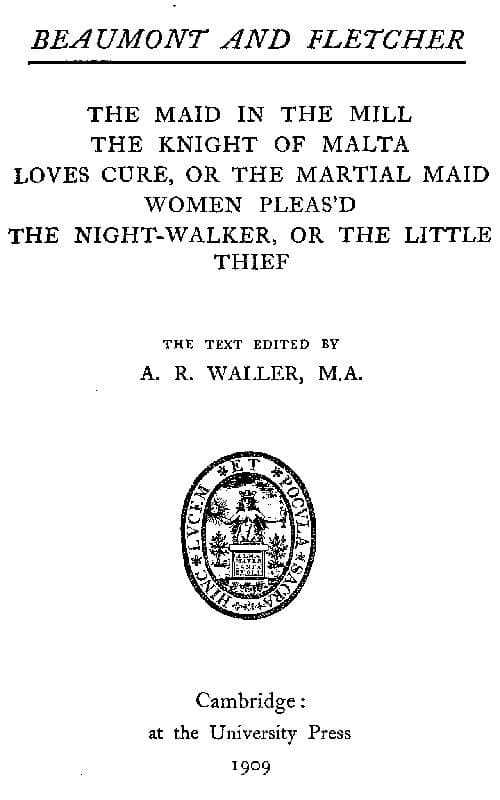
The Laws of Candy: Beaumont & Fletcher's Works (3 of 10)
1647
The Laws of Candy is a Jacobean tragi-comedy that ventures into unfamiliar territory: a fictional kingdom where the laws themselves govern gratitude and consequence. The play opens with a fracturing family and a fracturing empire. General Cassilanes, hero of Candy, returns from victory against Venice only to find his son Antinous has stolen the glory with his own recent conquests. What begins as a father's wounded pride spirals into political machinations involving the ambitious Venetian lord Gonzalo and the imperious Princess Erota, whom Antinous loves. Beaumont constructs a world where honor is currency, loyalty is weaponized, and the laws of Candy promise terrible retribution for ingratitude. Critics have not been kind to this work, calling it 'tiresome' and acknowledging its structural flaws. Yet it remains a fascinating artifact: a window into what 17th-century audiences found compelling, and a case study in the blurred boundaries between tragedy and comedy that defined the Jacobean stage. For readers interested in early modern drama, it offers a peculiar, imperfect glimpse into the theatrical machinery of Beaumont and Fletcher's world.
Editions
Link to this book
Add a free, dofollow link to Lex on your blog, forum, syllabus, or reading list.

<a href="https://lex-books.com/book/the-laws-of-candy-beaumont-fletcher-s-works-3-of-10-20835a96-e706-4886-ab87-05e5d8c9b376"><img src="https://lex-books.com/badges/read-on-lex.svg" alt="Read The Laws of Candy: Beaumont & Fletcher's Works (3 of 10) by Francis Beaumont free on Lex" width="160" height="40"></a>[](https://lex-books.com/book/the-laws-of-candy-beaumont-fletcher-s-works-3-of-10-20835a96-e706-4886-ab87-05e5d8c9b376)[url=https://lex-books.com/book/the-laws-of-candy-beaumont-fletcher-s-works-3-of-10-20835a96-e706-4886-ab87-05e5d8c9b376][img]https://lex-books.com/badges/read-on-lex.svg[/img][/url]Read The Laws of Candy: Beaumont & Fletcher's Works (3 of 10) by Francis Beaumont free on Lex: https://lex-books.com/book/the-laws-of-candy-beaumont-fletcher-s-works-3-of-10-20835a96-e706-4886-ab87-05e5d8c9b376Cite this book
Reading this edition for a paper or guide? Copy a citation.
Beaumont, Francis. The Laws of Candy: Beaumont & Fletcher's Works (3 of 10). Lex, lex-books.com/book/the-laws-of-candy-beaumont-fletcher-s-works-3-of-10-20835a96-e706-4886-ab87-05e5d8c9b376.Beaumont, F. (1647). The Laws of Candy: Beaumont & Fletcher's Works (3 of 10). Lex. https://lex-books.com/book/the-laws-of-candy-beaumont-fletcher-s-works-3-of-10-20835a96-e706-4886-ab87-05e5d8c9b376Beaumont, Francis. The Laws of Candy: Beaumont & Fletcher's Works (3 of 10). Lex. https://lex-books.com/book/the-laws-of-candy-beaumont-fletcher-s-works-3-of-10-20835a96-e706-4886-ab87-05e5d8c9b376.