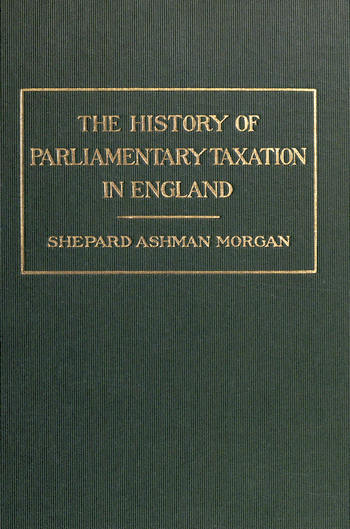
The History of Parliamentary Taxation in England
1911
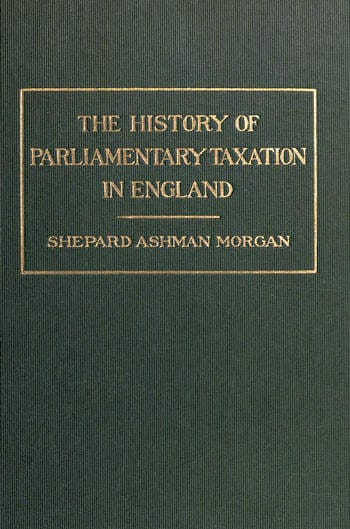
The History of Parliamentary Taxation in England
1911
The History of Parliamentary Taxation in England, written by Shepard Ashman Morgan and first published in 1911, examines the evolution of taxation in England from the Anglo-Saxon period through significant historical milestones such as the Norman Conquest and the Magna Carta. The book details the transition from royal authority to parliamentary control over taxation, highlighting early taxation concepts based on loyalty and voluntary contributions. It provides a comprehensive overview of how taxation became integral to governance, influencing the development of parliamentary taxation in subsequent centuries.
Editions
X-Ray
The author of this academic work on English parliamentary taxation. A Williams College graduate who won the David A. Wells Prize for this essay in 1907.
David A. Wells Professor of Political Science at Williams College who assigned the essay topic and mentored Morgan. Died in 1908 before the work's completion.
J. Leland Miller Professor of American History at Williams College who helped edit Morgan's work after Nelson's death. Provided valuable advice for publication.
English king (1199-1216) whose excessive taxation and abuse of scutage led to the baronial rebellion and Magna Carta. Described as 'the thinnest figure that ever sat upon the English throne.'
About The History of Parliamentary Taxation in England
Chapter Summaries
- Preface
- Theodore Clarke Smith explains the David A. Wells Prize Essay series and the circumstances of this work's creation. He notes that Henry Loomis Nelson assigned the topic but died before completion, leaving Smith to edit the final manuscript.
- Introduction
- Morgan establishes his thesis that self-taxation is essential to self-government, citing Hall's Chronicle on Henry VIII. He defines his scope as focusing on the tax and the authority by which it was laid, tracing the shift from royal to parliamentary control.
- I
- Examines early Germanic and Anglo-Saxon taxation concepts, showing how voluntary contributions to chiefs evolved into royal revenues. The Danegeld of 991 represents the first extraordinary tax, levied with Witenagemot consent to pay off Danish invaders.
Key Themes
- Evolution of Constitutional Government
- The book traces how English government evolved from Germanic tribal customs through Norman absolutism to parliamentary democracy. Morgan emphasizes the organic, evolutionary nature of constitutional development rather than revolutionary change.
- Taxation and Liberty
- The central thesis that control over taxation is fundamental to political freedom. Morgan argues that 'the liberty of a nation can be gauged most readily by the power of the people over the public purse.'
- Representative Government
- The development of representation from feudal personal relationships to modern democratic principles. The book shows how the inclusion of knights, burgesses, and clergy created the foundation for the House of Commons.
Characters
- Shepard Ashman Morgan(protagonist)
- The author of this academic work on English parliamentary taxation. A Williams College graduate who won the David A. Wells Prize for this essay in 1907.
- Henry Loomis Nelson(major)
- David A. Wells Professor of Political Science at Williams College who assigned the essay topic and mentored Morgan. Died in 1908 before the work's completion.
- Theodore Clarke Smith(major)
- J. Leland Miller Professor of American History at Williams College who helped edit Morgan's work after Nelson's death. Provided valuable advice for publication.
- King John(major)
- English king (1199-1216) whose excessive taxation and abuse of scutage led to the baronial rebellion and Magna Carta. Described as 'the thinnest figure that ever sat upon the English throne.'
- Edward I(major)
- English king (1272-1307) known as 'the great Edward' who established the Model Parliament in 1295. Described as one of the greatest figures to grace the English throne.
- Simon de Montfort(major)
- Earl of Leicester who created the first Parliament including burgesses in 1265. Known as the 'Creator of the House of Commons' though his motives were primarily political.
Link to this book
Add a free, dofollow link to Lex on your blog, forum, syllabus, or reading list.

<a href="https://lex-books.com/book/the-history-of-parliamentary-taxation-in-england-f140ac04-6c56-490f-b29c-ce98d9ae8570"><img src="https://lex-books.com/badges/read-on-lex.svg" alt="Read The History of Parliamentary Taxation in England by Shepard Ashman Morgan free on Lex" width="160" height="40"></a>[](https://lex-books.com/book/the-history-of-parliamentary-taxation-in-england-f140ac04-6c56-490f-b29c-ce98d9ae8570)[url=https://lex-books.com/book/the-history-of-parliamentary-taxation-in-england-f140ac04-6c56-490f-b29c-ce98d9ae8570][img]https://lex-books.com/badges/read-on-lex.svg[/img][/url]Read The History of Parliamentary Taxation in England by Shepard Ashman Morgan free on Lex: https://lex-books.com/book/the-history-of-parliamentary-taxation-in-england-f140ac04-6c56-490f-b29c-ce98d9ae8570Cite this book
Reading this edition for a paper or guide? Copy a citation.
Morgan, Shepard Ashman. The History of Parliamentary Taxation in England. Lex, lex-books.com/book/the-history-of-parliamentary-taxation-in-england-f140ac04-6c56-490f-b29c-ce98d9ae8570.Morgan, S. A. (1911). The History of Parliamentary Taxation in England. Lex. https://lex-books.com/book/the-history-of-parliamentary-taxation-in-england-f140ac04-6c56-490f-b29c-ce98d9ae8570Morgan, Shepard Ashman. The History of Parliamentary Taxation in England. Lex. https://lex-books.com/book/the-history-of-parliamentary-taxation-in-england-f140ac04-6c56-490f-b29c-ce98d9ae8570.