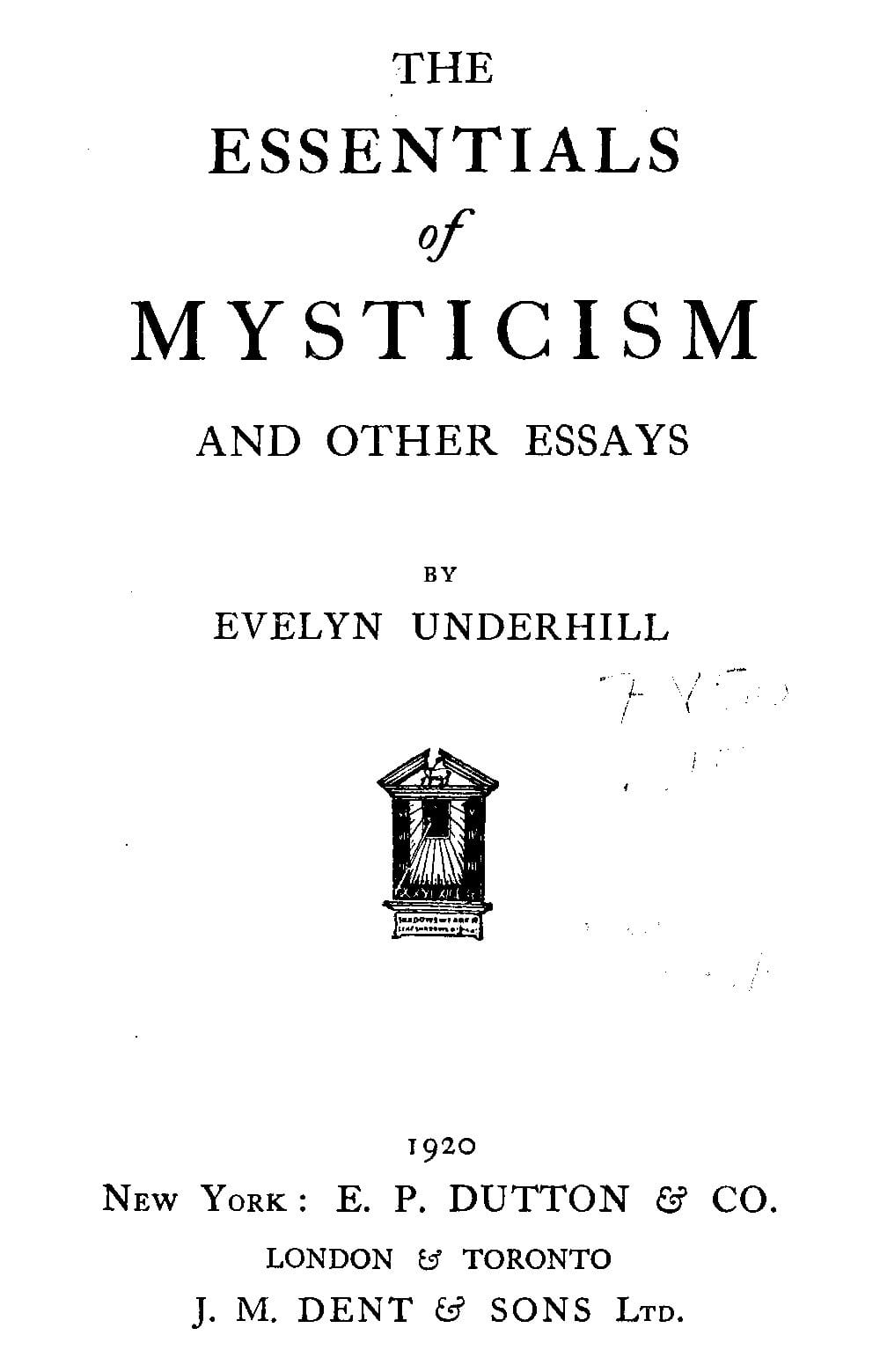
The Essentials of Mysticism, and Other Essays
1920
Evelyn Underhill wrote for readers who sensed there was more to reality than the material world could show. In these essays, she distills a lifetime of reflection on mysticism not as exotic aberration but as the deepest expression of human consciousness. She asks what actually happens in genuine mystical experience, how it differs from religious fancy or psychological oddity, and why it has shaped some of history's most luminous minds. Underhill insists that at the heart of mysticism lies a profound consciousness of the divine, a direct encounter that transforms the soul. She navigates the tension between historical forms and eternal truths, showing how mystical experience transcends any single tradition while acknowledging her own Christian framework. These pages offer not speculation but wisdom earned through careful study and genuine spiritual depth. For readers feeling the pull toward the transcendent but repelled by easy answers, Underhill is the guide who takes the terrain seriously.
Editions
X-Ray
“In mysticism that love of truth which we saw as the beginning of all philosophy leaves the merely intellectual sphere, and takes on the assured aspect of a personal passion. Where the philosopher guesses and argues, the mystic lives and looks; and speaks, consequently, the disconcerting language of first-hand experience, not the neat dialectic of the schools. Hence whilst the Absolute of the metaphysicians remains a diagram”
— Evelyn Underhill
“For a lack of attention a thousand forms of loveliness elude us everyday””
— Evelyn Underhill
“The business and method of mysticism is love.””
— Evelyn Underhill
“Three deep cravings of the self, three great expressions of man's restlessness, which only mystic truth can fully satisfy. The first is the craving which makes him a pilgrim and a wanderer. It is the longing to go out from his normal world in search of a lost home, a 'better country'; an Eldorado, a Sarras, a Heavenly Syon. The next is the craving of heart for heart, of the Soul for its perfect mate, which makes him a lover. The third is the craving for inward purity and perfection, which makes him an ascetic, and in the last resort a saint.””
— Evelyn Underhill
“Idealism, though just in its premises, and often daring and honest in their application, is stultified by the exclusive intellectualism of its own methods: by its fatal trust in the squirrel-work of the industrious brain instead of the piercing vision of the desirous heart. It interests man, but does not involve him in its processes: does not catch him up to the new and more real life which it describes. Hence the thing that matters, the living thing, has somehow escaped it; and its observations bear the same relation to reality as the art of the anatomist does to the mystery of birth.””
— Evelyn Underhill
“All men, at one time or another, have fallen in love with the veiled Isis whom they call Truth. With most, this has been a passing passion: they have early seen its hopelessness and turned to more practical things. But others remain all their lives the devout lovers of reality: though the manner of their love, the vision which they make to themselves of the beloved object varies enormously. Some see Truth as Dante saw Beatrice: an adorable yet intangible figure, found in this world yet revealing the next. To others she seems rather an evil but an irresistible enchantress: enticing, demanding payment and betraying her lover at the last. Some have seen her in a test tube, and some in a poet’s dream: some before the altar, others in the slime. The extreme pragmatists have even sought her in the kitchen; declaring that she may best be recognized by her utility. Last stage of all, the philosophic sceptic has comforted an unsuccessful courtship by assuring himself that his mistress is not really there.””
— Evelyn Underhill
“The art of the alchemist, whether spiritual or physical, consists in completing the work of perfection, bringing forth and making dominant, as it were, the “latent goldness” which “lies obscure” in metal or man. The ideal adept of alchemy was therefore an “auxiliary of the Eternal Goodness.” By his search for the “Noble Tincture” which should restore an imperfect world, he became a partner in the business of creation, assisting the Cosmic Plan. Thus the proper art of the Spiritual Alchemist, with whom alone we are here concerned, was the production of the spiritual and only valid tincture or Philosopher’s Stone; the mystic seed of transcendental life which should invade, tinge, and wholly transmute the imperfect self into spiritual gold. That this was no fancy of seventeenth-century allegorists, but an idea familiar to many of the oldest writers upon alchemy”
— Evelyn Underhill
“art is the link between appearance and reality.””
— Evelyn Underhill
“When we are in good health, we all feel very real, solid, and permanent; and this is of all our illusions the most ridiculous, and also the most obviously useful from the point of view of the efficiency and preservation of the race.””
— Evelyn Underhill
Link to this book
Add a free, dofollow link to Lex on your blog, forum, syllabus, or reading list.

<a href="https://lex-books.com/book/the-essentials-of-mysticism-and-other-essays-05ef4d06-287a-4f19-a1fc-21a9088fefd9"><img src="https://lex-books.com/badges/read-on-lex.svg" alt="Read The Essentials of Mysticism, and Other Essays by Evelyn Underhill free on Lex" width="160" height="40"></a>[](https://lex-books.com/book/the-essentials-of-mysticism-and-other-essays-05ef4d06-287a-4f19-a1fc-21a9088fefd9)[url=https://lex-books.com/book/the-essentials-of-mysticism-and-other-essays-05ef4d06-287a-4f19-a1fc-21a9088fefd9][img]https://lex-books.com/badges/read-on-lex.svg[/img][/url]Read The Essentials of Mysticism, and Other Essays by Evelyn Underhill free on Lex: https://lex-books.com/book/the-essentials-of-mysticism-and-other-essays-05ef4d06-287a-4f19-a1fc-21a9088fefd9Cite this book
Reading this edition for a paper or guide? Copy a citation.
Underhill, Evelyn. The Essentials of Mysticism, and Other Essays. Lex, lex-books.com/book/the-essentials-of-mysticism-and-other-essays-05ef4d06-287a-4f19-a1fc-21a9088fefd9.Underhill, E. (1920). The Essentials of Mysticism, and Other Essays. Lex. https://lex-books.com/book/the-essentials-of-mysticism-and-other-essays-05ef4d06-287a-4f19-a1fc-21a9088fefd9Underhill, Evelyn. The Essentials of Mysticism, and Other Essays. Lex. https://lex-books.com/book/the-essentials-of-mysticism-and-other-essays-05ef4d06-287a-4f19-a1fc-21a9088fefd9.
