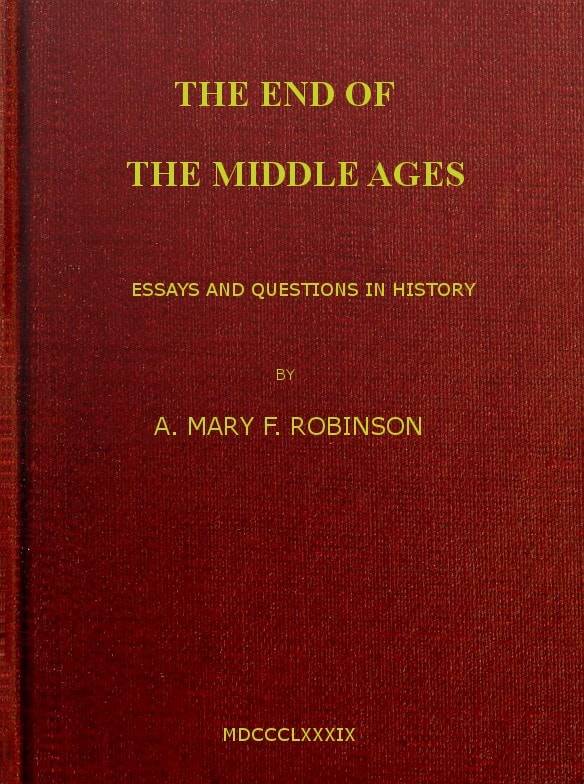
The End of the Middle Ages: Essays and Questions in History
1889
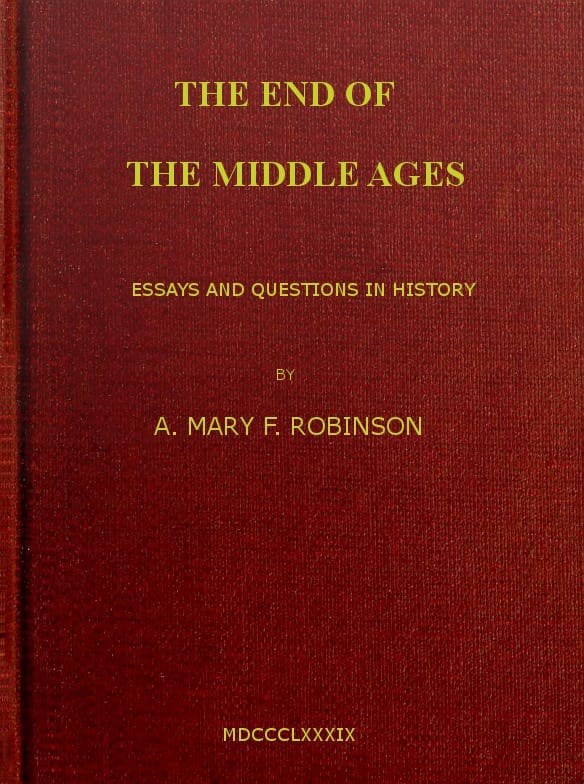
The End of the Middle Ages: Essays and Questions in History
1889
A Victorian historian casts her gaze upon the twilight of the medieval world, assembling a sequence of incisive essays that interrogate how one era dissolves into another. A. Mary F. Robinson examines the institutions, movements, and spiritual unrest that characterized the centuries straddling medieval and modern. She turns particular attention to the Beguines, those laywomen who carved out autonomous religious communities outside official Church structures, and the Weaving Brothers, whose craft-guilds carried undercurrents of dissent. These were not mere historical curiosities but living tensions: movements suppressed yet never entirely extinguished, their ideas smoldering quietly before reigniting in the sixteenth century. Robinson refuses the comfort of clean periodization. She asks whether the Middle Ages truly ended at all, or whether its influences simply transmuted, persisting in altered forms across centuries. Written with the careful scholarship and literary sensibility of its era, this collection offers both rigorous historical inquiry and a quiet challenge to how we periodize the past.
Editions
X-Ray
“WITH THE APPROACH OF THE thirteenth century, the world awoke from its long and dreamless sleep. Then began the age of faith, the miraculous century, starving for lack of bread and nourished upon heavenly roses. St. Louis and St. Elizabeth, Dominic the eloquent and the fiery Bonaventura, Thomas Aquinas and Francis the glorioso poverello di Dio,””
— A. Mary F. Robinson
About The End of the Middle Ages: Essays and Questions in History
Chapter Summaries
- Dedication
- Robinson dedicates her work to her mentor Mr. Symonds, explaining how their studies together at Davos inspired her historical research. She acknowledges the fragmentary nature of her essays while expressing hope to write a complete history of the French in Italy.
- 1
- Traces the rise and fall of the Beguine movement from Lambert le Bègue's founding of the first Beguinage in 1180 through their suppression for heresy. The essay shows how these secular religious communities evolved from charitable organizations to mystical sects that challenged Church authority.
- 2
- Examines the famous convent where Gertrude and Mechtild von Hackeborn lived as mystical saints. Robinson analyzes the psychological and physical effects of extreme mysticism, showing how the pursuit of spiritual perfection led to illness and early death.
Key Themes
- The Decline of Medieval Authority
- Robinson examines how traditional medieval institutions—the Church, feudalism, and imperial power—gradually lost their authority and coherence in the face of new political and spiritual movements.
- Mysticism and Religious Reform
- The book explores how mystical movements like the Beguines represented both spiritual renewal and dangerous heresy, challenging established Church authority while seeking direct communion with God.
- The Corruption of Power
- Throughout the essays, Robinson demonstrates how political and religious power corrupts, from the luxurious Papal court at Avignon to the tyrannical rule of Louis of Orleans.
Characters
- A. Mary F. Robinson (Madame James Darmesteter)(protagonist)
- The author and historian who presents these scholarly essays on medieval history. She demonstrates deep knowledge of primary sources and archival research.
- Mr. Symonds(major)
- Robinson's mentor and guide in historical studies. He introduced her to chronicles and inspired her historical research during their time at Davos.
- Lambert le Bègue(major)
- A stammering priest of Liège who in 1180 founded the first Beguinage, establishing homes for destitute widows and creating a new religious movement.
- Mechtild of Magdeburg(major)
- A noble-born mystic and prophetess who became a Beguine in 1235. She wrote visions and critiques of church corruption, representing the height of Beguine spirituality.
- Gertrude of Helfta(major)
- A learned abbess who entered the convent at age five and became known for her mystical visions and scholarly pursuits. She died of palsy after years of illness.
- Mechtild von Hackeborn(major)
- Gertrude's younger sister, beloved by all in the convent for her kindness and musical abilities. She was more naturally suited to convent life than her scholarly sister.
Link to this book
Add a free, dofollow link to Lex on your blog, forum, syllabus, or reading list.

<a href="https://lex-books.com/book/the-end-of-the-middle-ages-essays-and-questions-in-history-95d6ba1f-cf17-4fb1-b625-ba601e729060"><img src="https://lex-books.com/badges/read-on-lex.svg" alt="Read The End of the Middle Ages: Essays and Questions in History by A. Mary F. Robinson free on Lex" width="160" height="40"></a>[](https://lex-books.com/book/the-end-of-the-middle-ages-essays-and-questions-in-history-95d6ba1f-cf17-4fb1-b625-ba601e729060)[url=https://lex-books.com/book/the-end-of-the-middle-ages-essays-and-questions-in-history-95d6ba1f-cf17-4fb1-b625-ba601e729060][img]https://lex-books.com/badges/read-on-lex.svg[/img][/url]Read The End of the Middle Ages: Essays and Questions in History by A. Mary F. Robinson free on Lex: https://lex-books.com/book/the-end-of-the-middle-ages-essays-and-questions-in-history-95d6ba1f-cf17-4fb1-b625-ba601e729060Cite this book
Reading this edition for a paper or guide? Copy a citation.
Robinson, A. Mary F.. The End of the Middle Ages: Essays and Questions in History. Lex, lex-books.com/book/the-end-of-the-middle-ages-essays-and-questions-in-history-95d6ba1f-cf17-4fb1-b625-ba601e729060.Robinson, A. M. F. (1889). The End of the Middle Ages: Essays and Questions in History. Lex. https://lex-books.com/book/the-end-of-the-middle-ages-essays-and-questions-in-history-95d6ba1f-cf17-4fb1-b625-ba601e729060Robinson, A. Mary F.. The End of the Middle Ages: Essays and Questions in History. Lex. https://lex-books.com/book/the-end-of-the-middle-ages-essays-and-questions-in-history-95d6ba1f-cf17-4fb1-b625-ba601e729060.