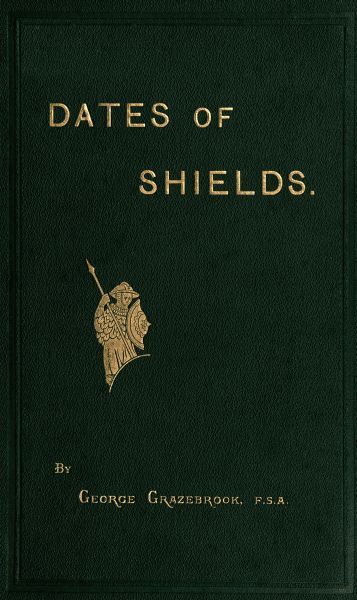
The Dates of Variously-Shaped Shields, with Coincident Dates and Examples
1890
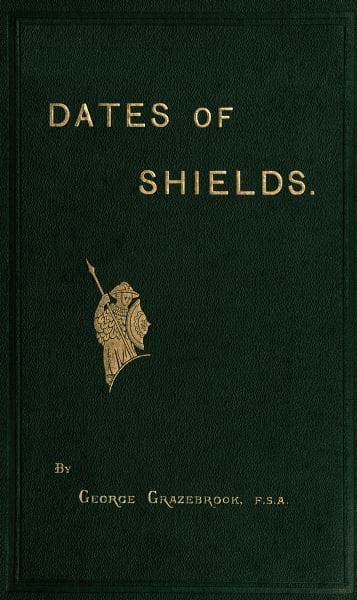
The Dates of Variously-Shaped Shields, with Coincident Dates and Examples
1890
A meticulous Victorian reference work that solves one of heraldry's thorniest problems: how to date a shield by its shape alone. Grazebrook argues that while scholars have catalogued coat armor extensively, they've largely ignored the physical form of the shield itself as historical evidence. He demonstrates that shield geometries shifted meaningfully across centuries, and that seals, effigies, and manuscripts preserve this evolution in subtle but readable ways. The book walks through shield forms from the Norman Conquest through the fifteenth century, explaining how material, curvature, and outline each carry chronological weight. This is not a coffee-table book of pretty shields, but a working tool for anyone who needs to know whether a medieval image dates to 1120 or 1420. Antiquarians, historians, and collectors of heraldic art will find here a framework that transforms visual evidence into dates.
Editions
X-Ray
The author and researcher who undertook this comprehensive study of heraldic shield shapes. A Fellow of the Society of Antiquaries, he presents himself as a careful scholar seeking to establish accurate dating methods for medieval shields.
Fellow of the Society of Antiquaries who created the systematic nomenclature for shield shapes that Grazebrook adopts. His classification system provides the framework for the entire study.
Late expert on seals whose knowledge was never recorded, representing lost scholarship that motivated this work.
Another late seal expert whose unrecorded knowledge represents the scholarly loss that inspired this systematic study.
About The Dates of Variously-Shaped Shields, with Coincident Dates and Examples
Chapter Summaries
- Preface
- Grazebrook introduces his pioneering study and requests constructive criticism from fellow scholars. He laments the loss of expertise with the deaths of seal experts Way and Perceval, and outlines his systematic approach to dating shield shapes.
- Introduction
- Detailed examination of early circular Saxon and Norman shields, their construction, materials, and evolution into the kite-shaped shields of the 11th century. Establishes the principle that shield changes reflected practical military needs.
- 11th Century
- Analysis of the dominant kite-shaped or 'Norman pear' shields, with evidence from the Bayeux Tapestry and royal seals. Notes the strengthened edges and simple Roman capital inscriptions of this period.
Key Themes
- Preservation of Knowledge
- The urgent need to record and systematize scholarly knowledge before it disappears with its holders, as exemplified by the lost expertise of Way and Perceval.
- Scientific Method in Historical Study
- The application of systematic classification and empirical evidence to establish accurate dating methods for historical artifacts.
- Evolution of Form and Function
- How shield shapes evolved from practical military needs to purely decorative heraldic conventions, reflecting broader social and technological changes.
Characters
- George Grazebrook, F.S.A.(protagonist)
- The author and researcher who undertook this comprehensive study of heraldic shield shapes. A Fellow of the Society of Antiquaries, he presents himself as a careful scholar seeking to establish accurate dating methods for medieval shields.
- J. Paul Rylands, F.S.A.(major)
- Fellow of the Society of Antiquaries who created the systematic nomenclature for shield shapes that Grazebrook adopts. His classification system provides the framework for the entire study.
- Albert Way, F.S.A.(minor)
- Late expert on seals whose knowledge was never recorded, representing lost scholarship that motivated this work.
- Charles Spencer Perceval, F.S.A.(minor)
- Another late seal expert whose unrecorded knowledge represents the scholarly loss that inspired this systematic study.
Link to this book
Add a free, dofollow link to Lex on your blog, forum, syllabus, or reading list.

<a href="https://lex-books.com/book/the-dates-of-variously-shaped-shields-with-coincident-dates-and-examples-6935504f-637e-4e2d-bea5-25e074c8dee4"><img src="https://lex-books.com/badges/read-on-lex.svg" alt="Read The Dates of Variously-Shaped Shields, with Coincident Dates and Examples by George Grazebrook free on Lex" width="160" height="40"></a>[](https://lex-books.com/book/the-dates-of-variously-shaped-shields-with-coincident-dates-and-examples-6935504f-637e-4e2d-bea5-25e074c8dee4)[url=https://lex-books.com/book/the-dates-of-variously-shaped-shields-with-coincident-dates-and-examples-6935504f-637e-4e2d-bea5-25e074c8dee4][img]https://lex-books.com/badges/read-on-lex.svg[/img][/url]Read The Dates of Variously-Shaped Shields, with Coincident Dates and Examples by George Grazebrook free on Lex: https://lex-books.com/book/the-dates-of-variously-shaped-shields-with-coincident-dates-and-examples-6935504f-637e-4e2d-bea5-25e074c8dee4Cite this book
Reading this edition for a paper or guide? Copy a citation.
Grazebrook, George. The Dates of Variously-Shaped Shields, with Coincident Dates and Examples. Lex, lex-books.com/book/the-dates-of-variously-shaped-shields-with-coincident-dates-and-examples-6935504f-637e-4e2d-bea5-25e074c8dee4.Grazebrook, G. (1890). The Dates of Variously-Shaped Shields, with Coincident Dates and Examples. Lex. https://lex-books.com/book/the-dates-of-variously-shaped-shields-with-coincident-dates-and-examples-6935504f-637e-4e2d-bea5-25e074c8dee4Grazebrook, George. The Dates of Variously-Shaped Shields, with Coincident Dates and Examples. Lex. https://lex-books.com/book/the-dates-of-variously-shaped-shields-with-coincident-dates-and-examples-6935504f-637e-4e2d-bea5-25e074c8dee4.