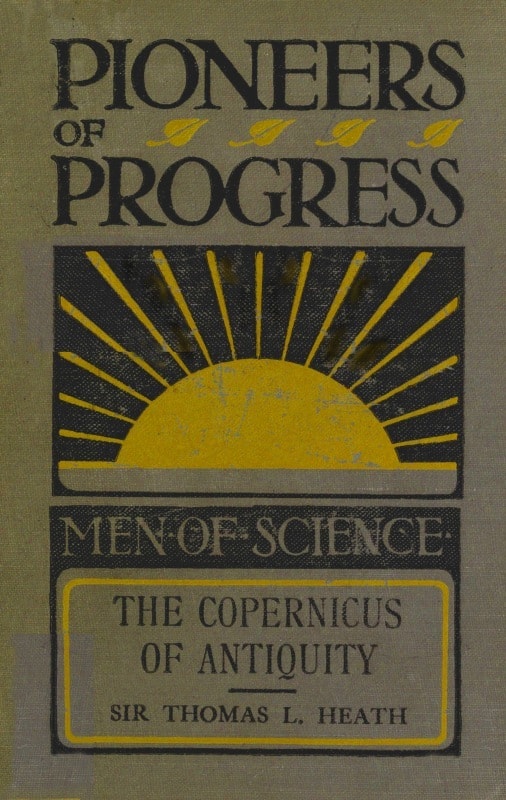
The Copernicus of Antiquity (aristarchus of Samos)
1920
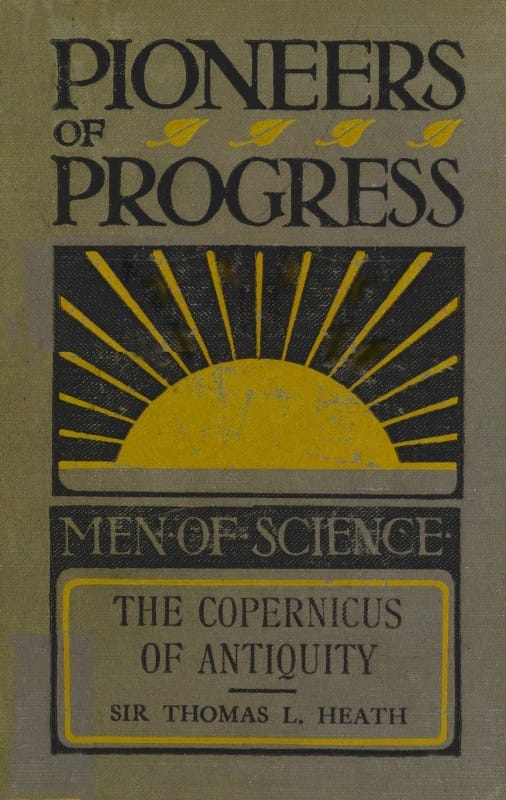
The Copernicus of Antiquity (aristarchus of Samos)
1920
Published in 1920, 'The Copernicus of Antiquity' by Thomas Little, Sir Heath examines the contributions of Aristarchus of Samos to astronomy, particularly his heliocentric theory. The book contextualizes Aristarchus's ideas within the broader history of Greek astronomy, tracing the evolution of astronomical thought from early philosophers like Thales and Anaximander to later thinkers such as Copernicus. Heath highlights the significance of Aristarchus's revolutionary proposal that the sun, not the Earth, is the center of the universe, showcasing the Greeks' observational skills and philosophical insights that laid the groundwork for modern astronomy.
Editions
X-Ray
Ancient Greek astronomer and mathematician (c. 310-230 B.C.) who first proposed the heliocentric hypothesis. Known as 'the mathematician' and called 'the Copernicus of Antiquity' for anticipating Copernicus by nearly 1800 years.
First Greek philosopher and astronomer (c. 624-547 B.C.) who predicted a solar eclipse. Considered the founder of scientific astronomy in Greece.
Greek philosopher (c. 611-547 B.C.) who proposed that Earth is suspended freely in space without support. First to speculate about sizes and distances of heavenly bodies.
Great mathematician and astronomer (c. 572-497 B.C.) who first proposed Earth's spherical shape. Founded influential school of thought and made groundbreaking discoveries in mathematics and astronomy.
About The Copernicus of Antiquity (aristarchus of Samos)
Chapter Summaries
- Part I
- Surveys the development of Greek astronomy from Thales through Heraclides of Pontus, showing the progressive evolution of ideas about the cosmos. Each philosopher contributed key insights that eventually led to Aristarchus's revolutionary heliocentric hypothesis.
- Part II
- Details Aristarchus's life, his heliocentric hypothesis, and his mathematical work on calculating the sizes and distances of the sun and moon. Explains why his correct theory was rejected and forgotten until Copernicus.
Key Themes
- Scientific Revolution and Paradigm Shifts
- The book explores how revolutionary scientific ideas, even when correct, can be rejected by contemporary scholars. Aristarchus's heliocentric theory was too radical for its time and was suppressed until Copernicus.
- The Progressive Nature of Scientific Knowledge
- Heath traces the gradual development of astronomical understanding from Thales to Aristarchus, showing how each generation built upon previous discoveries. Scientific progress is portrayed as cumulative and collaborative.
- Observation versus Theory
- The tension between careful observation and theoretical explanation runs throughout Greek astronomy. The Greeks excelled at both, always seeking to 'save the phenomena' by finding rational explanations for observed facts.
Characters
- Aristarchus of Samos(protagonist)
- Ancient Greek astronomer and mathematician (c. 310-230 B.C.) who first proposed the heliocentric hypothesis. Known as 'the mathematician' and called 'the Copernicus of Antiquity' for anticipating Copernicus by nearly 1800 years.
- Thales(major)
- First Greek philosopher and astronomer (c. 624-547 B.C.) who predicted a solar eclipse. Considered the founder of scientific astronomy in Greece.
- Anaximander(major)
- Greek philosopher (c. 611-547 B.C.) who proposed that Earth is suspended freely in space without support. First to speculate about sizes and distances of heavenly bodies.
- Pythagoras(major)
- Great mathematician and astronomer (c. 572-497 B.C.) who first proposed Earth's spherical shape. Founded influential school of thought and made groundbreaking discoveries in mathematics and astronomy.
- Anaxagoras(major)
- Natural philosopher (c. 500-428 B.C.) who discovered that the moon receives its light from the sun. First to give true explanation of eclipses.
- Plato(major)
- Philosopher (427-347 B.C.) who developed astronomical system and set problems for students. His astronomical views mixed scientific observation with mythological elements.
Link to this book
Add a free, dofollow link to Lex on your blog, forum, syllabus, or reading list.

<a href="https://lex-books.com/book/the-copernicus-of-antiquity-aristarchus-of-samos-f5c01391-86e5-4409-b92a-a44c170c613a"><img src="https://lex-books.com/badges/read-on-lex.svg" alt="Read The Copernicus of Antiquity (aristarchus of Samos) by Thomas Little, Sir Heath free on Lex" width="160" height="40"></a>[](https://lex-books.com/book/the-copernicus-of-antiquity-aristarchus-of-samos-f5c01391-86e5-4409-b92a-a44c170c613a)[url=https://lex-books.com/book/the-copernicus-of-antiquity-aristarchus-of-samos-f5c01391-86e5-4409-b92a-a44c170c613a][img]https://lex-books.com/badges/read-on-lex.svg[/img][/url]Read The Copernicus of Antiquity (aristarchus of Samos) by Thomas Little, Sir Heath free on Lex: https://lex-books.com/book/the-copernicus-of-antiquity-aristarchus-of-samos-f5c01391-86e5-4409-b92a-a44c170c613aCite this book
Reading this edition for a paper or guide? Copy a citation.
Thomas Little, Sir Heath. The Copernicus of Antiquity (aristarchus of Samos). Lex, lex-books.com/book/the-copernicus-of-antiquity-aristarchus-of-samos-f5c01391-86e5-4409-b92a-a44c170c613a.Thomas Little, S. H. (1920). The Copernicus of Antiquity (aristarchus of Samos). Lex. https://lex-books.com/book/the-copernicus-of-antiquity-aristarchus-of-samos-f5c01391-86e5-4409-b92a-a44c170c613aThomas Little, Sir Heath. The Copernicus of Antiquity (aristarchus of Samos). Lex. https://lex-books.com/book/the-copernicus-of-antiquity-aristarchus-of-samos-f5c01391-86e5-4409-b92a-a44c170c613a.