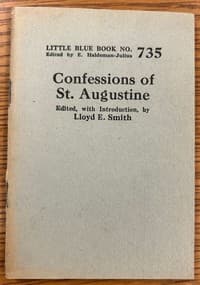
The Confessions of St. Augustine
1996

The Confessions of St. Augustine
Saint, Bishop of Hippo Augustine
1996
Translated by E. B. (Edward Bouverie) Pusey
Augustine invented the autobiography. Before the Confessions, no one had dared to examine their own life with this kind of ruthless honesty, turning the story of one man's soul into a universal meditation on what it means to be human. He begins with the now-famous prayer that has echoed through centuries: "Thou hast made us for thyself, and our heart is restless until it finds its rest in thee." From there, he unfolds the story of his life in Tagaste and Carthage, his years as a debauched young man seduced by rhetoric and lust, his intellectually glittering but spiritually hollow career as a teacher, and his gradual, agonizing conversion under the gentle pressure of his praying mother Monica and the penetrating ideas of Neoplatonist philosophy. The Confessions is not merely memoir. It is an inquiry into memory itself, into the nature of time, and into the mystery of how a Merciful God could draw a stumbling sinner toward grace. Fourteen hundred years later, it remains the most intimate account of spiritual struggle ever written, a book for anyone who has ever felt the gap between what they desire and who they actually are.
Editions
X-Ray
The author and narrator, who recounts his spiritual journey from a life of sin and intellectual wandering to Christian faith.
About The Confessions of St. Augustine
Chapter Summaries
- 1
- Augustine begins by praising God and reflecting on humanity's innate restlessness until it finds repose in God. He confesses his infancy and childhood sins, including envy and disobedience, arguing that even infants are not without sin due to their self-will and pride.
- 2
- Augustine recounts his 'foulness' and carnal corruptions during his sixteenth year, focusing on his unrestrained lust and the infamous pear theft. He analyzes the nature of this sin, concluding that he loved the sin itself, not the object, driven by a perverse desire to do what was forbidden.
- 3
- Augustine describes his arrival in Carthage, where he fell into 'a cauldron of unholy loves' and became enamored with stage-plays. He discovers Cicero's 'Hortensius,' which ignites his passion for philosophy and the pursuit of wisdom, but he is disappointed by the lack of Christ's name in it. He then falls in with the Manichees, attracted by their promise of truth and their criticisms of Scripture.
Key Themes
- Search for Truth and Wisdom
- Augustine's autobiography is a relentless intellectual and spiritual pursuit of truth. He explores various philosophies, including Manichaeism and Platonism, before ultimately finding what he believes to be the ultimate truth in Christian faith. This journey is marked by intense questioning, doubt, and eventual conviction.
- Sin and Redemption
- The book is a detailed confession of Augustine's past sins, including lust, pride, and intellectual arrogance. He vividly describes his struggles with concupiscence and his inability to overcome his sinful habits on his own. His narrative highlights the transformative power of God's grace and mercy in leading him to repentance and salvation.
- The Nature of God and Evil
- A significant portion of Augustine's intellectual struggle is dedicated to understanding the nature of God as incorruptible, immutable, and omnipresent, and reconciling this with the existence of evil. He rejects the Manichaean dualism of two opposing substances and comes to understand evil as a privation of good, stemming from free will.
Characters
- Augustine(protagonist)
- The author and narrator, who recounts his spiritual journey from a life of sin and intellectual wandering to Christian faith.
Link to this book
Add a free, dofollow link to Lex on your blog, forum, syllabus, or reading list.

<a href="https://lex-books.com/book/the-confessions-of-st-augustine-9e1c1f55-7128-43f2-ad6a-f5770496a612"><img src="https://lex-books.com/badges/read-on-lex.svg" alt="Read The Confessions of St. Augustine by Saint, Bishop of Hippo Augustine free on Lex" width="160" height="40"></a>[](https://lex-books.com/book/the-confessions-of-st-augustine-9e1c1f55-7128-43f2-ad6a-f5770496a612)[url=https://lex-books.com/book/the-confessions-of-st-augustine-9e1c1f55-7128-43f2-ad6a-f5770496a612][img]https://lex-books.com/badges/read-on-lex.svg[/img][/url]Read The Confessions of St. Augustine by Saint, Bishop of Hippo Augustine free on Lex: https://lex-books.com/book/the-confessions-of-st-augustine-9e1c1f55-7128-43f2-ad6a-f5770496a612Cite this book
Reading this edition for a paper or guide? Copy a citation.
Saint, Bishop of Hippo Augustine. The Confessions of St. Augustine. Lex, lex-books.com/book/the-confessions-of-st-augustine-9e1c1f55-7128-43f2-ad6a-f5770496a612.Saint, B. O. H. A. (1996). The Confessions of St. Augustine. Lex. https://lex-books.com/book/the-confessions-of-st-augustine-9e1c1f55-7128-43f2-ad6a-f5770496a612Saint, Bishop of Hippo Augustine. The Confessions of St. Augustine. Lex. https://lex-books.com/book/the-confessions-of-st-augustine-9e1c1f55-7128-43f2-ad6a-f5770496a612.