The Book of Mormon: An Account Written by the Hand of Mormon, upon Plates Taken from the Plates of Nephi
1830
The Book of Mormon: An Account Written by the Hand of Mormon, upon Plates Taken from the Plates of Nephi
1830
The Book of Mormon stands as one of the foundational texts of American religion, a 19th-century volume that claims to be a translated record of ancient American civilizations and their encounters with the divine. The narrative begins in 600 B.C. Jerusalem, where the prophet Lehi receives revelation that his city will face destruction, prompting his family to flee into the wilderness. His son Nephi becomes the primary chronicler, recording the family's miraculous journey to the American continent, their establishment as the Nephite people, and the tragic schism with their brothers Laman and Lemuel that spawns the rival Lamanite nation. Across a thousand years of history, the text traces cycles of righteousness, apostasy, and judgment, building toward its most extraordinary claim: that Jesus Christ, following his resurrection, appeared personally to the Nephites in the Americas, establishing his church among them. The text concludes with the civilization's final destruction and Moroni's burial of the gold plates, later revealed to young Joseph Smith in 1823. For Latter-day Saints, this is not merely history but a second witness of Jesus Christ, containing the fullness of his gospel. For readers of religious literature, it remains a singular document: an American scripture that weaves Hebrew prophecy, Christian theology, and indigenous American cosmology into something unlike anything else in Western literature.
Editions
X-Ray
“Man is, that he may have Joy.””
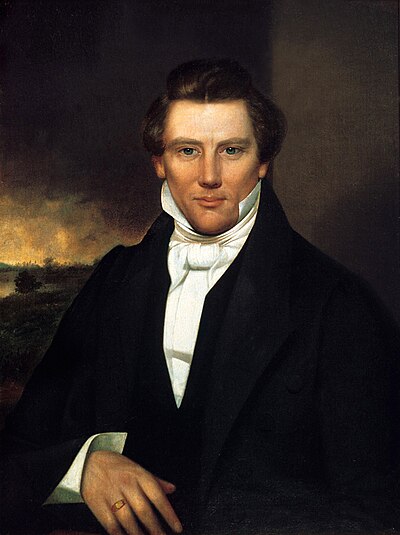
— Joseph, Jr. Smith
“For he that diligently seeketh shall find; and the mysteries of God shall be unfolded unto them, by the power of the Holy Ghost, as well in these times as in times of old as in times to come; wherefore, the course of the Lord is one eternal round" - 1 Nephi 10:19””
— Joseph, Jr. Smith
“The Book of Mormon is the most correct of any book on this Earth, and the keystone of our religion, and a man would get nearer to God by abiding by its precepts, than any other book.””
— Joseph, Jr. Smith
“The Lord did strengthen them that they could bear up their burdens with ease, and they did submit cheerfully and with patience to all the will of the Lord.””
— Joseph, Jr. Smith
“Be thou an example.””
— Joseph, Jr. Smith
“And behold, he shall be born of Mary, at Jerusalem which is the land of our forefathers, she being a virgin, a precious and chosen vessel, who shall be overshadowed and conceive by the power of the Holy Ghost, and bring forth a son, yea, even the Son of God. And he shall go forth, suffering pains and afflictions and temptations of every kind; and this that the word might be fulfilled which saith he will take upon him the pains and the sicknesses of his people. And he will take upon him death, that he may loose the bands of death which bind his people; and he will take upon him their infirmities, that his bowels may be filled with mercy, according to the flesh, that he may know according to the flesh how to succor his people according to their infirmities.' -Alma the Younger (Alme 7:10-12)””
— Joseph, Jr. Smith
“But charity is the PURE LOVE OF CHRIST, and it endureth forever; and whoso is found possessed of it at the last day, it shall be well with him.Moroni 7””
— Joseph, Jr. Smith
“I would that ye should come unto Christ, who is the Holy One of Israel, and partake of his salvation, and the power of his redemption. Yea, come unto him, and offer your whole souls as an offering unto him, and continue in fasting and praying, and endure to the end; and as the Lord liveth ye will be saved.””
— Joseph, Jr. Smith
“And when ye shall receive these things, I would exhort you that ye would ask God, the Eternal Father, in the name of Christ, if these things are not true; and if ye shall ask with a sincere heart, with real intent, having faith in Christ, he will manifest the truth of it unto you, by the power of the Holy Ghost." "And by the power of the Holy Ghost ye may know the truth of all things." - Moroni””
— Joseph, Jr. Smith
Link to this book
Add a free, dofollow link to Lex on your blog, forum, syllabus, or reading list.

<a href="https://lex-books.com/book/the-book-of-mormon-an-account-written-by-the-hand-of-mormon-upon-plates-taken-fr-5aae6fd8-e0f2-4760-a5db-46d69c1be2d4"><img src="https://lex-books.com/badges/read-on-lex.svg" alt="Read The Book of Mormon: An Account Written by the Hand of Mormon, upon Plates Taken from the Plates of Nephi by Joseph, Jr. Smith free on Lex" width="160" height="40"></a>[](https://lex-books.com/book/the-book-of-mormon-an-account-written-by-the-hand-of-mormon-upon-plates-taken-fr-5aae6fd8-e0f2-4760-a5db-46d69c1be2d4)[url=https://lex-books.com/book/the-book-of-mormon-an-account-written-by-the-hand-of-mormon-upon-plates-taken-fr-5aae6fd8-e0f2-4760-a5db-46d69c1be2d4][img]https://lex-books.com/badges/read-on-lex.svg[/img][/url]Read The Book of Mormon: An Account Written by the Hand of Mormon, upon Plates Taken from the Plates of Nephi by Joseph, Jr. Smith free on Lex: https://lex-books.com/book/the-book-of-mormon-an-account-written-by-the-hand-of-mormon-upon-plates-taken-fr-5aae6fd8-e0f2-4760-a5db-46d69c1be2d4Cite this book
Reading this edition for a paper or guide? Copy a citation.
Joseph, Jr. Smith. The Book of Mormon: An Account Written by the Hand of Mormon, upon Plates Taken from the Plates of Nephi. Lex, lex-books.com/book/the-book-of-mormon-an-account-written-by-the-hand-of-mormon-upon-plates-taken-fr-5aae6fd8-e0f2-4760-a5db-46d69c1be2d4.Joseph, J. S. (1830). The Book of Mormon: An Account Written by the Hand of Mormon, upon Plates Taken from the Plates of Nephi. Lex. https://lex-books.com/book/the-book-of-mormon-an-account-written-by-the-hand-of-mormon-upon-plates-taken-fr-5aae6fd8-e0f2-4760-a5db-46d69c1be2d4Joseph, Jr. Smith. The Book of Mormon: An Account Written by the Hand of Mormon, upon Plates Taken from the Plates of Nephi. Lex. https://lex-books.com/book/the-book-of-mormon-an-account-written-by-the-hand-of-mormon-upon-plates-taken-fr-5aae6fd8-e0f2-4760-a5db-46d69c1be2d4.