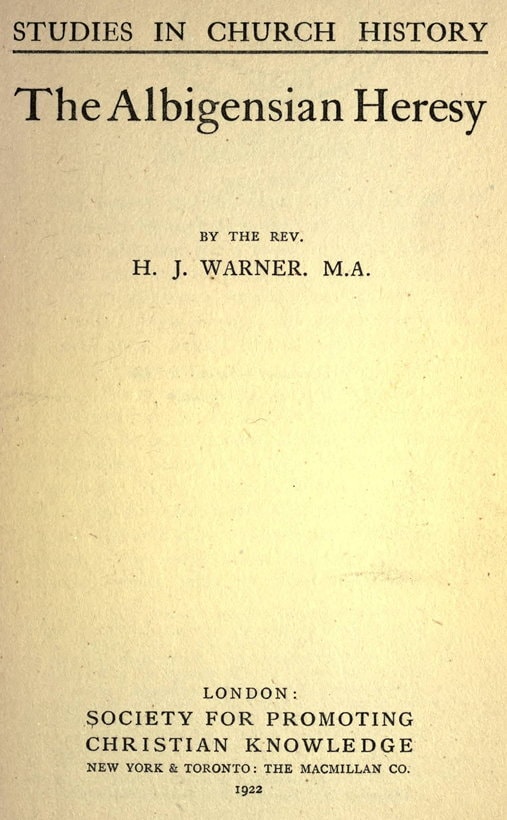
The Albigensian Heresy
1922
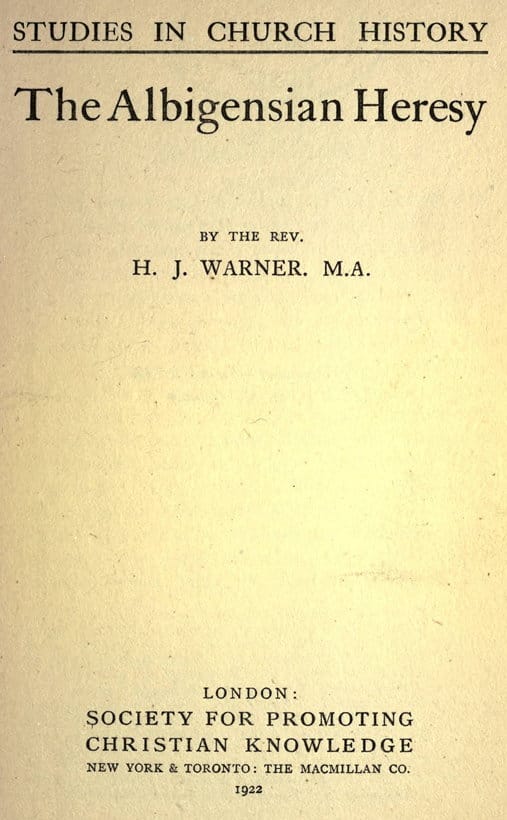
The Albigensian Heresy
1922
The Albigensian Heresy, written by Henry James Warner and first published in 1922, examines the Albigensian movement, also known as the Cathars, in Southern France during the Middle Ages. The book explores the origins, significance, and doctrinal distinctions of the Albigensians, highlighting their conflicts with the Catholic Church and the sociopolitical dynamics that allowed these heretical beliefs to thrive. Warner aims for an impartial inquiry into the narratives of both the heretics and the Church, revealing the complexities of this historical episode and its implications for medieval society.
Editions
X-Ray
The Rev. H. J. Warner, M.A., author of this scholarly work on the Albigensian Heresy. A Cambridge-educated clergyman who conducted extensive research into medieval heretical movements.
A Gaul of Narbonne who became a heresiarch in the early 12th century. He preached against infant baptism, church buildings, crosses, and the Eucharist for twenty years before being burned by the faithful.
A fellow monk at Cluny who succeeded Peter de Bruis as a heretical leader. He was more moderate than his predecessor, using crosses and church buildings while still opposing clerical corruption.
A wealthy merchant of Lyons who founded the Waldensian movement around 1170. He devoted his wealth to disseminating the Word of God and translating scriptures into the vernacular.
About The Albigensian Heresy
Chapter Summaries
- Introduction
- Warner establishes that the Albigensian Heresy was not localized to Albi but spread throughout Europe, representing multiple heresies united in opposition to Rome. He discusses the challenges of historical objectivity given biased source materials and the destruction of heretical literature.
- 1
- Examines the origins of Albigensian heresies, rejecting connections to Manicheism, Priscillianism, and Donatism. Warner traces partial connections to Eastern Paulicians and Bogomiles, while arguing the movement was largely indigenous, arising from discontent with Church corruption.
- 2
- Analyzes the favorable conditions in Southern France for heretical growth, including Gallic racial characteristics, Slavonic influences, language barriers between Latin clergy and vernacular-speaking people, secular resentment of Church wealth, commercial prosperity, and clerical corruption.
Key Themes
- Religious Authority vs. Individual Conscience
- The work explores the tension between institutional religious authority and personal spiritual conviction. The heretical movements challenged the Church's monopoly on salvation and scriptural interpretation, advocating for individual access to religious truth.
- Corruption and Reform
- A central theme examining the moral corruption within the Catholic Church hierarchy and the heretical movements' attempts at religious reform. The contrast between corrupt clergy and ascetic 'Perfect' heretics illustrates competing visions of Christian purity.
- Dualism and the Problem of Evil
- The theological struggle to explain the existence of evil in a world created by a good God. Catharist Dualism proposed two gods (good and evil) as a solution, while orthodox Christianity maintained monotheism despite the problem of evil.
Characters
- Henry James Warner(protagonist)
- The Rev. H. J. Warner, M.A., author of this scholarly work on the Albigensian Heresy. A Cambridge-educated clergyman who conducted extensive research into medieval heretical movements.
- Peter de Bruis(major)
- A Gaul of Narbonne who became a heresiarch in the early 12th century. He preached against infant baptism, church buildings, crosses, and the Eucharist for twenty years before being burned by the faithful.
- Henry of Cluny(major)
- A fellow monk at Cluny who succeeded Peter de Bruis as a heretical leader. He was more moderate than his predecessor, using crosses and church buildings while still opposing clerical corruption.
- Peter Waldo(major)
- A wealthy merchant of Lyons who founded the Waldensian movement around 1170. He devoted his wealth to disseminating the Word of God and translating scriptures into the vernacular.
- Nicetas(major)
- The Paulician 'Bishop' of Constantinople who presided over the important Synod at St. Felix de Caraman in 1167, establishing absolute Dualism as orthodox Catharist doctrine.
- Bernard of Clairvaux(major)
- Saint Bernard (b. 1091), influential Cistercian abbot who refused to connect the heretics with any human founder, declaring their heresy came from devils rather than men.
Link to this book
Add a free, dofollow link to Lex on your blog, forum, syllabus, or reading list.

<a href="https://lex-books.com/book/the-albigensian-heresy-bf07b4a6-ed96-4c31-b51a-e742299d3ed3"><img src="https://lex-books.com/badges/read-on-lex.svg" alt="Read The Albigensian Heresy by Henry James Warner free on Lex" width="160" height="40"></a>[](https://lex-books.com/book/the-albigensian-heresy-bf07b4a6-ed96-4c31-b51a-e742299d3ed3)[url=https://lex-books.com/book/the-albigensian-heresy-bf07b4a6-ed96-4c31-b51a-e742299d3ed3][img]https://lex-books.com/badges/read-on-lex.svg[/img][/url]Read The Albigensian Heresy by Henry James Warner free on Lex: https://lex-books.com/book/the-albigensian-heresy-bf07b4a6-ed96-4c31-b51a-e742299d3ed3Cite this book
Reading this edition for a paper or guide? Copy a citation.
Warner, Henry James. The Albigensian Heresy. Lex, lex-books.com/book/the-albigensian-heresy-bf07b4a6-ed96-4c31-b51a-e742299d3ed3.Warner, H. J. (1922). The Albigensian Heresy. Lex. https://lex-books.com/book/the-albigensian-heresy-bf07b4a6-ed96-4c31-b51a-e742299d3ed3Warner, Henry James. The Albigensian Heresy. Lex. https://lex-books.com/book/the-albigensian-heresy-bf07b4a6-ed96-4c31-b51a-e742299d3ed3.