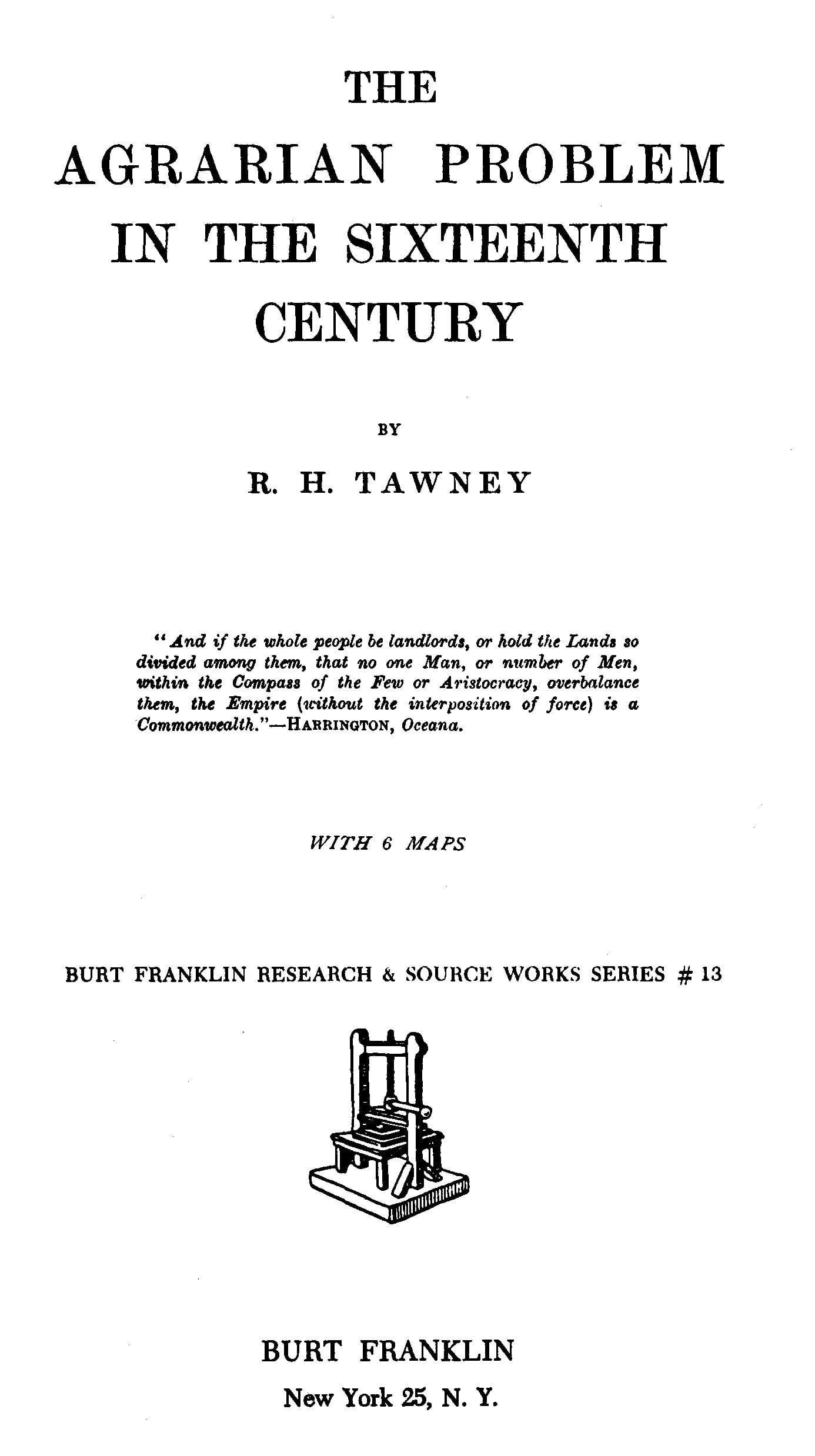
The Agrarian Problem in the Sixteenth Century
1912
The Agrarian Problem in the Sixteenth Century
1912
R.H. Tawney's 1912 masterwork fundamentally reshaped how historians understand the birth of modern England. By meticulously examining manorial records, court documents, and contemporary pamphlets, Tawney traced the catastrophic transformation of the English countryside in the sixteenth century: the enclosure of common lands, the systematic eviction of customary tenants, and the emergence of a ruthless competitive rental market that obliterated centuries of traditional rights. This was not merely an economic shift but a social revolution that dismantled the medieval order and laid the groundwork for the civil wars to come. The book documents the brutal calculus of rising wool prices and the gentry's insatiable hunger for profit, showing how legal loopholes and brute force combined to dispossess villages across England. Tawney's genius lies in his refusal to treat this as abstract economic history; he renders visible the human cost, the families thrown off land their families had farmed for generations, the communities shattered, the ancient patterns of rural life dissolved into market relations. His analysis remains the essential foundation for understanding how England became the first capitalist society, and why that transformation was neither peaceful nor inevitable.
Editions
Link to this book
Add a free, dofollow link to Lex on your blog, forum, syllabus, or reading list.

<a href="https://lex-books.com/book/the-agrarian-problem-in-the-sixteenth-century-eaef5389-1c80-4613-a3bd-0de5a70efc8a"><img src="https://lex-books.com/badges/read-on-lex.svg" alt="Read The Agrarian Problem in the Sixteenth Century by R. H. Tawney free on Lex" width="160" height="40"></a>[](https://lex-books.com/book/the-agrarian-problem-in-the-sixteenth-century-eaef5389-1c80-4613-a3bd-0de5a70efc8a)[url=https://lex-books.com/book/the-agrarian-problem-in-the-sixteenth-century-eaef5389-1c80-4613-a3bd-0de5a70efc8a][img]https://lex-books.com/badges/read-on-lex.svg[/img][/url]Read The Agrarian Problem in the Sixteenth Century by R. H. Tawney free on Lex: https://lex-books.com/book/the-agrarian-problem-in-the-sixteenth-century-eaef5389-1c80-4613-a3bd-0de5a70efc8aCite this book
Reading this edition for a paper or guide? Copy a citation.
Tawney, R. H.. The Agrarian Problem in the Sixteenth Century. Lex, lex-books.com/book/the-agrarian-problem-in-the-sixteenth-century-eaef5389-1c80-4613-a3bd-0de5a70efc8a.Tawney, R. H. (1912). The Agrarian Problem in the Sixteenth Century. Lex. https://lex-books.com/book/the-agrarian-problem-in-the-sixteenth-century-eaef5389-1c80-4613-a3bd-0de5a70efc8aTawney, R. H.. The Agrarian Problem in the Sixteenth Century. Lex. https://lex-books.com/book/the-agrarian-problem-in-the-sixteenth-century-eaef5389-1c80-4613-a3bd-0de5a70efc8a.