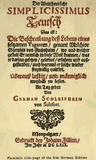
The Adventurous Simplicissimus

Meet Simplicius Simplicissimus, a naive German peasant boy whose idyllic forest life is shattered when the Thirty Years' War quite literally lands on his doorstep. Orphaned and adrift, he stumbles through the ravaged countryside, encountering hermits, soldiers, and every conceivable vice and virtue of a continent at war. From a simpleton to a cunning jester, a fortune-teller, and even a brief stint as a hermit himself, Simplicissimus's picaresque journey is a chaotic, often darkly humorous, exploration of survival amidst unimaginable brutality and moral decay. His adventures are a whirlwind of disguises, betrayals, and astonishing reversals of fortune, painting a vivid, if often horrifying, portrait of 17th-century Europe. Grimmelshausen's magnum opus, published shortly after the war's conclusion, isn't just a rollicking adventure; it's a searing indictment of the conflict's human cost, penned by a veteran who lived through it. Hailed as a foundational text of the German novel and a precursor to the modern adventure genre, its satirical bite and unflinching realism resonated with readers from Thomas Mann to Johann Strauss. Simplicissimus's "involuntary magnificence" lies in its ability to blend the absurd with the profound, offering both a gripping narrative and a timeless reflection on faith, folly, and the enduring human spirit in the face of chaos. It's a testament to resilience, a cautionary tale, and a literary landmark that continues to captivate.
Editions

Link to this book
Add a free, dofollow link to Lex on your blog, forum, syllabus, or reading list.

<a href="https://lex-books.com/book/the-adventurous-simplicissimus-18229fa3-e5d2-4b14-8c6a-44130db86a63"><img src="https://lex-books.com/badges/read-on-lex.svg" alt="Read The Adventurous Simplicissimus by Hans Jakob Christoffel von Grimmelshausen free on Lex" width="160" height="40"></a>[](https://lex-books.com/book/the-adventurous-simplicissimus-18229fa3-e5d2-4b14-8c6a-44130db86a63)[url=https://lex-books.com/book/the-adventurous-simplicissimus-18229fa3-e5d2-4b14-8c6a-44130db86a63][img]https://lex-books.com/badges/read-on-lex.svg[/img][/url]Read The Adventurous Simplicissimus by Hans Jakob Christoffel von Grimmelshausen free on Lex: https://lex-books.com/book/the-adventurous-simplicissimus-18229fa3-e5d2-4b14-8c6a-44130db86a63Cite this book
Reading this edition for a paper or guide? Copy a citation.
Grimmelshausen, Hans Jakob Christoffel von. The Adventurous Simplicissimus. Lex, lex-books.com/book/the-adventurous-simplicissimus-18229fa3-e5d2-4b14-8c6a-44130db86a63.Grimmelshausen, H. J. C. V. (n.d.). The Adventurous Simplicissimus. Lex. https://lex-books.com/book/the-adventurous-simplicissimus-18229fa3-e5d2-4b14-8c6a-44130db86a63Grimmelshausen, Hans Jakob Christoffel von. The Adventurous Simplicissimus. Lex. https://lex-books.com/book/the-adventurous-simplicissimus-18229fa3-e5d2-4b14-8c6a-44130db86a63.