Terra Australis Incognita; Or, a New Southern Discovery, Containing a Fifth Part of the World
1617
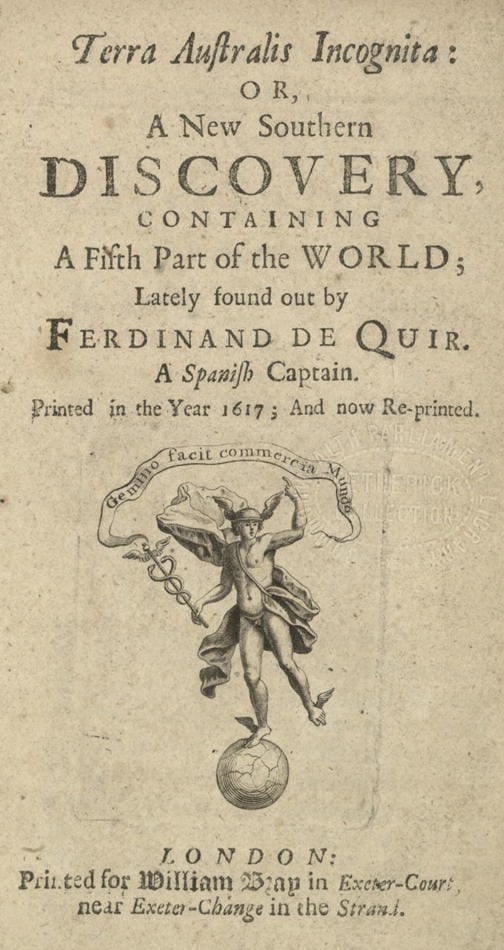
Terra Australis Incognita; Or, a New Southern Discovery, Containing a Fifth Part of the World
1617
For centuries, European cartographers left the southern hemisphere blank, marked only with the words Terra Australis Incognita. In 1606, Portuguese explorer Pedro Fernandes de Queirós, sailing under the Spanish flag, crossed the Pacific and reached islands he believed to be the edge of this fabled continent. This 1617 publication is his impassioned account and urgent petition to the King of Spain. Queirós describes islands teeming with life: coconut groves, unfamiliar fruits, pearl-dotted waters, and indigenous peoples living, in his view, in a state of natural innocence. He argues desperately for colonization, presenting the lands as ripe for settlement, rich in silver and spices, and free from rival empires. The text pulses with evangelical zeal and imperial ambition. Here is the Age of Discovery at its most audacious: a single voyage could reshape geography, and one man believed he had found a fifth part of the world. Essential reading for anyone curious about early Pacific exploration, the psychology of discovery, or the documents that launched empires.
Editions
Link to this book
Add a free, dofollow link to Lex on your blog, forum, syllabus, or reading list.

<a href="https://lex-books.com/book/terra-australis-incognita-or-a-new-southern-discovery-containing-a-fifth-part-of-1ea69240-745a-478e-9417-ce87dae1de84"><img src="https://lex-books.com/badges/read-on-lex.svg" alt="Read Terra Australis Incognita; Or, a New Southern Discovery, Containing a Fifth Part of the World by Pedro Fernandes de,Queirós free on Lex" width="160" height="40"></a>[](https://lex-books.com/book/terra-australis-incognita-or-a-new-southern-discovery-containing-a-fifth-part-of-1ea69240-745a-478e-9417-ce87dae1de84)[url=https://lex-books.com/book/terra-australis-incognita-or-a-new-southern-discovery-containing-a-fifth-part-of-1ea69240-745a-478e-9417-ce87dae1de84][img]https://lex-books.com/badges/read-on-lex.svg[/img][/url]Read Terra Australis Incognita; Or, a New Southern Discovery, Containing a Fifth Part of the World by Pedro Fernandes de,Queirós free on Lex: https://lex-books.com/book/terra-australis-incognita-or-a-new-southern-discovery-containing-a-fifth-part-of-1ea69240-745a-478e-9417-ce87dae1de84Cite this book
Reading this edition for a paper or guide? Copy a citation.
Pedro Fernandes de,Queirós. Terra Australis Incognita; Or, a New Southern Discovery, Containing a Fifth Part of the World. Lex, lex-books.com/book/terra-australis-incognita-or-a-new-southern-discovery-containing-a-fifth-part-of-1ea69240-745a-478e-9417-ce87dae1de84.Pedro Fernandes de, Q. (1617). Terra Australis Incognita; Or, a New Southern Discovery, Containing a Fifth Part of the World. Lex. https://lex-books.com/book/terra-australis-incognita-or-a-new-southern-discovery-containing-a-fifth-part-of-1ea69240-745a-478e-9417-ce87dae1de84Pedro Fernandes de,Queirós. Terra Australis Incognita; Or, a New Southern Discovery, Containing a Fifth Part of the World. Lex. https://lex-books.com/book/terra-australis-incognita-or-a-new-southern-discovery-containing-a-fifth-part-of-1ea69240-745a-478e-9417-ce87dae1de84.