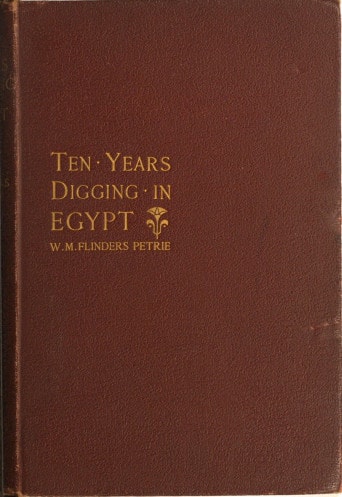
Ten Years' Digging in Egypt, 1881-1891
1892
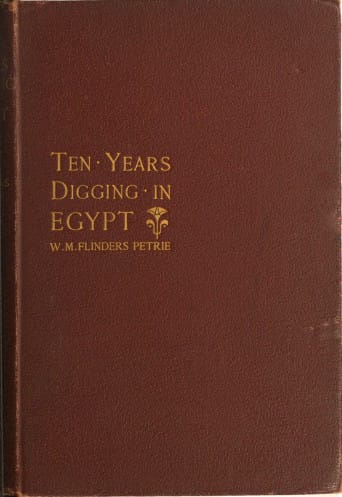
Ten Years' Digging in Egypt, 1881-1891
1892
This is the book that invented modern archaeology, told by the man who did it. W.M. Flinders Petrie arrived in Egypt in 1881 with a radical idea: that excavation should be methodical, scientific, and driven by questions rather than treasure-hunting. Over the next decade, he pioneered techniques that remain the foundation of archaeological practice today, carefully measuring the pyramids at Gizeh, unearthing the ruins of Tanis, and slowly reconstructing the daily life and engineering genius of ancient Egyptian civilization. He lived in a tomb during his first expedition, slept beside mummies, and developed surveying methods that transformed how we understand the ancient world. What makes this account extraordinary is its dual nature: part swashbuckling adventure narrative, part rigorous scientific inquiry. Petrie writes with conviction about the need for accurate measurement to test existing theories about pyramid construction, yet he also captures the visceral thrill of touching artifacts untouched for millennia. This is archaeology as it was actually practiced in its heroic age, before the discipline calcified into propriety. For anyone curious about how we came to know what we know about ancient Egypt, or anyone drawn to stories of obsessive, pioneering minds working at the edge of the known world, this remains essential reading.
Editions
X-Ray
The author and archaeologist who conducted ten years of excavations in Egypt from 1881-1891. A methodical scientist who developed new archaeological techniques and made numerous important discoveries.
One of the most intelligent men of Gizeh who helped Petrie with his work. His nephew and slave served as guards at night.
Archaeological colleague who worked with Petrie at Naukratis, clearing temples and discovering important artifacts.
Archaeological colleague who finished work at Nebesheh and accompanied Petrie on Nile expeditions.
About Ten Years' Digging in Egypt, 1881-1891
Chapter Summaries
- 1
- Petrie begins his archaeological career with precise measurement of the Gizeh pyramids, living in a tomb and developing new surveying techniques. His work reveals both extraordinary ancient craftsmanship and surprising carelessness, disproving many contemporary theories about pyramid construction.
- 2
- Working for the Egypt Exploration Fund, Petrie excavates the ancient capital of Tanis, finding it largely worked out but discovering important papyri in a Roman house, including educational texts that reveal how hieroglyphics were taught.
- 3
- Petrie discovers and excavates the Greek trading city of Naukratis, revealing the earliest Greek settlement in Egypt and finding the oldest known examples of Greek writing, along with evidence of local pottery production and scarab manufacturing.
Key Themes
- Scientific Method vs. Treasure Hunting
- Petrie advocates for systematic, scientific archaeology over the treasure-hunting approach of his predecessors. He emphasizes careful recording, measurement, and preservation of all finds, not just valuable objects.
- Cultural Exchange and Influence
- The discoveries reveal extensive cultural exchange between Egypt and the Mediterranean world, challenging assumptions about the isolation of ancient civilizations and showing how Greeks, Phoenicians, and others lived alongside Egyptians.
- The Complexity of Ancient Craftsmanship
- Petrie's work reveals the extraordinary technical skill of ancient Egyptian craftsmen, whose precision in stonework, metalworking, and other arts often exceeded modern capabilities.
Characters
- W. M. Flinders Petrie(protagonist)
- The author and archaeologist who conducted ten years of excavations in Egypt from 1881-1891. A methodical scientist who developed new archaeological techniques and made numerous important discoveries.
- Ali Gabri(minor)
- One of the most intelligent men of Gizeh who helped Petrie with his work. His nephew and slave served as guards at night.
- Mr. Ernest Gardner(minor)
- Archaeological colleague who worked with Petrie at Naukratis, clearing temples and discovering important artifacts.
- Mr. F. Ll. Griffith(minor)
- Archaeological colleague who finished work at Nebesheh and accompanied Petrie on Nile expeditions.
- Khufu(minor)
- Ancient Egyptian pharaoh of the Fourth Dynasty who built the Great Pyramid at Gizeh. His pyramid demonstrates extraordinary precision and skill.
- Khafra(minor)
- Ancient Egyptian pharaoh who built the second pyramid at Gizeh. His work was inferior in accuracy to Khufu's but still impressive.
Link to this book
Add a free, dofollow link to Lex on your blog, forum, syllabus, or reading list.

<a href="https://lex-books.com/book/ten-years-digging-in-egypt-1881-1891-18d4badd-b90b-4c2f-91db-ee96c469afe8"><img src="https://lex-books.com/badges/read-on-lex.svg" alt="Read Ten Years' Digging in Egypt, 1881-1891 by W. M. Flinders Petrie free on Lex" width="160" height="40"></a>[](https://lex-books.com/book/ten-years-digging-in-egypt-1881-1891-18d4badd-b90b-4c2f-91db-ee96c469afe8)[url=https://lex-books.com/book/ten-years-digging-in-egypt-1881-1891-18d4badd-b90b-4c2f-91db-ee96c469afe8][img]https://lex-books.com/badges/read-on-lex.svg[/img][/url]Read Ten Years' Digging in Egypt, 1881-1891 by W. M. Flinders Petrie free on Lex: https://lex-books.com/book/ten-years-digging-in-egypt-1881-1891-18d4badd-b90b-4c2f-91db-ee96c469afe8Cite this book
Reading this edition for a paper or guide? Copy a citation.
Petrie, W. M. Flinders. Ten Years' Digging in Egypt, 1881-1891. Lex, lex-books.com/book/ten-years-digging-in-egypt-1881-1891-18d4badd-b90b-4c2f-91db-ee96c469afe8.Petrie, W. M. F. (1892). Ten Years' Digging in Egypt, 1881-1891. Lex. https://lex-books.com/book/ten-years-digging-in-egypt-1881-1891-18d4badd-b90b-4c2f-91db-ee96c469afe8Petrie, W. M. Flinders. Ten Years' Digging in Egypt, 1881-1891. Lex. https://lex-books.com/book/ten-years-digging-in-egypt-1881-1891-18d4badd-b90b-4c2f-91db-ee96c469afe8.