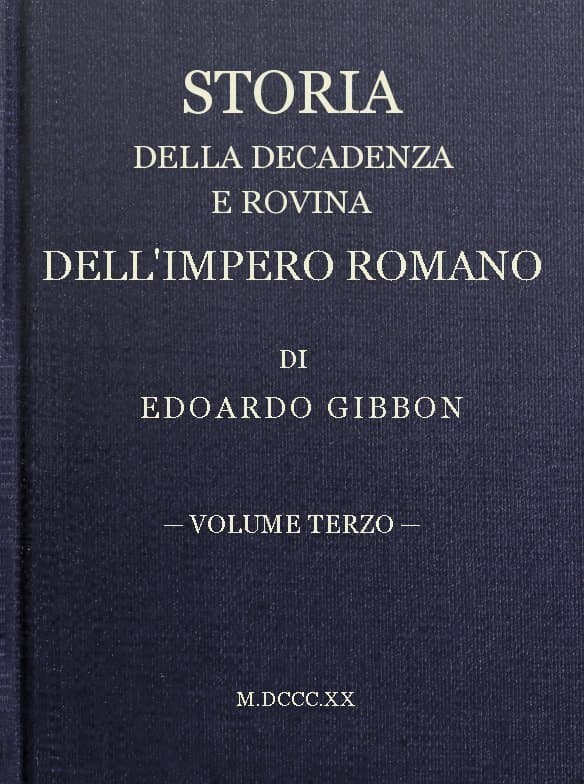
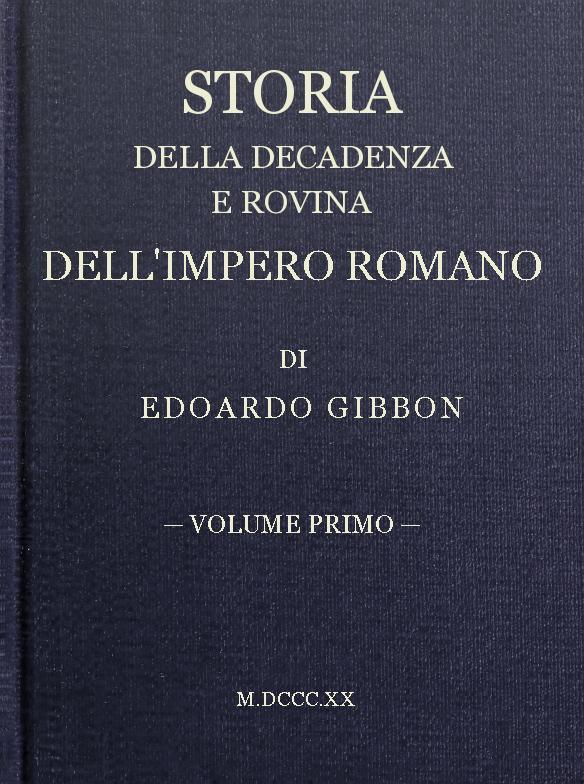
Storia Della Decadenza E Rovina Dell'impero Romano, Volume 01
1776
Storia Della Decadenza E Rovina Dell'impero Romano, Volume 01
1776
Translated by Davide Bertolotti
Storia Della Decadenza E Rovina Dell'impero Romano, Volume 01, written by Edward Gibbon and first published in 1776, provides a comprehensive historical analysis of the decline and fall of the Roman Empire from its peak under the Antonines to its eventual collapse. Gibbon examines the interplay of political, cultural, and military factors that contributed to this decline, highlighting key figures such as emperors Trajan and Hadrian. This seminal work is notable for its philosophical approach to history and its lasting influence on the study of Western civilization.
Editions
X-Ray
“... as long as mankind shall continue to bestow more liberal applause on their destroyers than their benefactors, the thirst of military glory will ever be the vice of the most exalted characters.””
— Edward Gibbon
“If we contrast the rapid progress of this mischievous discovery [of gunpowder] with the slow and laborious advances of reason, science, and the arts of peace, a philosopher, according to his temper, will laugh or weep at the folly of mankind" (Chapter 65,p. 68)””
— Edward Gibbon
“The principles of a free constitution are irrecoverably lost, when the legislative power is nominated by the executive.””
— Edward Gibbon
“The value of money has been settled by general consent to express our wants and our property, as letters were invented to express our ideas; and both these institutions, by giving a more active energy to the powers and passions of human nature, have contributed to multiply the objects they were designed to represent.””
— Edward Gibbon
“Augustus was sensible that mankind is governed by names; nor was he deceived in his expectation, that the senate and the people would submit to slavery, provided they were respectfully assured that they still enjoyed their ancient freedoms.””
— Edward Gibbon
“Under a democratical government, the citizens exercise the powers of sovereignty; and those powers will be first abused, and afterwards lost, if they are committed to an unwieldy multitude.””
— Edward Gibbon
“Hope, the best comfort of our imperfect condition,””
— Edward Gibbon
“During the age of Christ, of his apostles, and of their first disciples, the doctrine which they preached was confirmed by innumerable prodigies. The lame walked, the blind saw, the sick were healed, the dead were raised, daemons were expelled, and the laws of Nature were frequently suspended for the benefit of the church [...] But the sages of Greece and Rome turned aside from the awful spectacle, and, pursuing the ordinary occupations of life and study, appeared unconscious of any alterations in the moral or physical government of the world. Under the reign of Tiberius, the whole earth, or at least a celebrated province of the Roman empire, was involved in a preternatural darkness of three hours. Even this miraculous event, which ought to have excited the wonder, the curiosity, and the devotion of mankind, passed without notice in an age of science and history. It happened during the lifetime of Seneca and the elder Pliny, who must have experienced the immediate effects, or received the earliest intelligence, of the prodigy. Each of these philosophers, in a laborious work, has recorded all the great phenomena of Nature, earthquakes, meteors, comets, and eclipses, which his indefatigable curiosity could collect. Both the one and the other have omitted to mention the greatest phenomenon to which the mortal eye has been witness since the creation of the globe.””
— Edward Gibbon
“It was scarcely possible that the eyes of contemporaries should discover in the public felicity the latent causes of decay and corruption. This long peace, and the uniform government of the Romans, introduced a slow and secret poison into the vitals of the empire. The minds of men were gradually reduced to the same level, the fire of genius was extinguished, and even the military spirit evaporated.””
— Edward Gibbon
Link to this book
Add a free, dofollow link to Lex on your blog, forum, syllabus, or reading list.

<a href="https://lex-books.com/book/storia-della-decadenza-e-rovina-dell-impero-romano-volume-01-d24b46db-ef47-4a79-aa9f-c3459d361084"><img src="https://lex-books.com/badges/read-on-lex.svg" alt="Read Storia Della Decadenza E Rovina Dell'impero Romano, Volume 01 by Edward Gibbon free on Lex" width="160" height="40"></a>[](https://lex-books.com/book/storia-della-decadenza-e-rovina-dell-impero-romano-volume-01-d24b46db-ef47-4a79-aa9f-c3459d361084)[url=https://lex-books.com/book/storia-della-decadenza-e-rovina-dell-impero-romano-volume-01-d24b46db-ef47-4a79-aa9f-c3459d361084][img]https://lex-books.com/badges/read-on-lex.svg[/img][/url]Read Storia Della Decadenza E Rovina Dell'impero Romano, Volume 01 by Edward Gibbon free on Lex: https://lex-books.com/book/storia-della-decadenza-e-rovina-dell-impero-romano-volume-01-d24b46db-ef47-4a79-aa9f-c3459d361084Cite this book
Reading this edition for a paper or guide? Copy a citation.
Gibbon, Edward. Storia Della Decadenza E Rovina Dell'impero Romano, Volume 01. Lex, lex-books.com/book/storia-della-decadenza-e-rovina-dell-impero-romano-volume-01-d24b46db-ef47-4a79-aa9f-c3459d361084.Gibbon, E. (1776). Storia Della Decadenza E Rovina Dell'impero Romano, Volume 01. Lex. https://lex-books.com/book/storia-della-decadenza-e-rovina-dell-impero-romano-volume-01-d24b46db-ef47-4a79-aa9f-c3459d361084Gibbon, Edward. Storia Della Decadenza E Rovina Dell'impero Romano, Volume 01. Lex. https://lex-books.com/book/storia-della-decadenza-e-rovina-dell-impero-romano-volume-01-d24b46db-ef47-4a79-aa9f-c3459d361084.