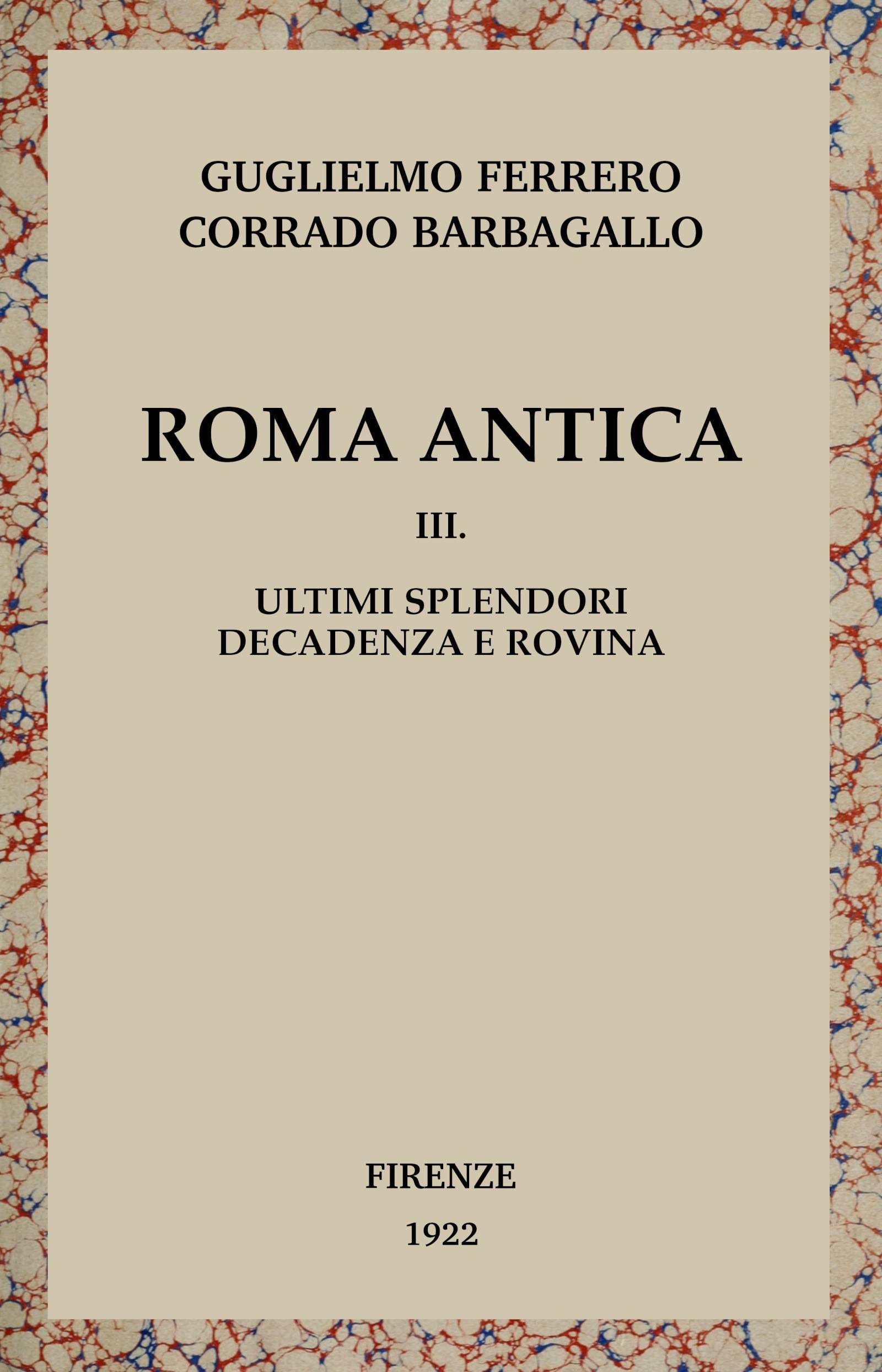
Roma Antica, Vol. 3/3: Ultimi Splendori, Decadenza E Rovina
1921

A historical account written in the early 20th century. This volume is part of a comprehensive examination of ancient Rome, focusing on its last splendors, decadence, and eventual ruin. The text delves into the political, military, and social upheavals that characterized the latter years of the Roman Empire, offering insights into notable figures like Galba, Ottone, and Vespasiano. The opening of the book introduces the tumultuous period following the rule of Galba, illustrating his efforts to restore traditional governance after the reign of Nero. Galba's challenges, including rising discontent among his supporters and a precarious relationship with the senatorial class, lead to further chaos highlighted by the military insurrections of Vitellio and Ottone. The text sets the stage for a deeper exploration of the ensuing conflicts, which culminate in the violent power struggles that defined this critical era for Rome. It suggests a complex narrative of political ambition, societal tumult, and the gradual decline of Roman authority, drawing readers into the tumultuous world of ancient Roman history.
Editions

X-Ray
An old, avaricious, and weak emperor who attempted to restore traditional Roman values after Nero but failed due to his unpopularity and the army's discontent.
A former friend of Nero and second husband of Poppaea, proclaimed emperor by the Praetorians after Galba's death, who tried to govern generously but was defeated by Vitellius.
Governor of Germania Inferior, proclaimed emperor by his legions, who defeated Otho but was later overthrown and killed by Vespasian's forces.
A 'homo novus' and capable general, proclaimed emperor by the Eastern legions, who restored stability to the empire after the civil wars of 69 AD and initiated significant administrative and financial reforms.
About Roma Antica, Vol. 3/3: Ultimi Splendori, Decadenza E Rovina
Chapter Summaries
- 1
- This chapter details the tumultuous year 69 AD, beginning with Galba's unpopular and short-lived reign after Nero's death. It highlights the instability caused by the lack of a clear imperial succession principle, leading to Otho's rise and subsequent defeat by Vitellius, and finally the emergence of Vespasian as emperor, marking the end of the Julio-Claudian dynasty's influence.
- 2
- The chapter covers the Flavian dynasty, focusing on Vespasian's efforts to restore order after the civil wars. It describes his military, financial, and senatorial reforms, including the crucial infusion of new provincial families into the Senate. It then briefly touches upon the benevolent reign of Titus and the more authoritarian rule of Domitian, whose clashes with the revitalized Senate and military campaigns in Britannia and Dacia ultimately led to his assassination.
- 3
- This chapter celebrates the reign of Nerva and Trajan, portraying them as restorers of republican ideals and military glory. Nerva's adoption of Trajan established a new succession principle. Trajan, a 'soldier-emperor,' expanded the empire by conquering Dacia and campaigned in the East, while fostering cooperation with a renewed Senate and implementing public works and social welfare programs, though his financial policies introduced subtle weaknesses.
Key Themes
- Succession Crises and Political Instability
- The book repeatedly highlights the 'uncertainty of the legal principle' for imperial authority as a root cause of civil wars. From Galba's fall to the 'Thirty Tyrants' and the final collapse in the West, the absence of a stable succession mechanism (hereditary vs. adoption vs. military acclamation) consistently plunged the empire into chaos, weakening its ability to face external threats.
- The Rise of Military Power
- The narrative traces the increasing influence of the legions in imperial politics, culminating in military emperors like Septimius Severus who openly governed 'with and for' the soldiers. This shift from senatorial authority to military might led to the 'imbarbarimento' of the army, its growing indiscipline, and its ultimate role in making and unmaking emperors, often at great cost to the state.
- Economic Decline and Fiscalism
- Beginning with Vespasian's necessary tax increases and accelerating through the 3rd and 4th centuries, the empire faced severe economic challenges. Inflation, currency debasement, and relentless fiscalism to fund wars and a growing bureaucracy led to widespread impoverishment, the decline of agriculture and industry, and the eventual coercive organization of labor, trapping citizens in hereditary professions.
Characters
- Galba(protagonist)
- An old, avaricious, and weak emperor who attempted to restore traditional Roman values after Nero but failed due to his unpopularity and the army's discontent.
- Otho(protagonist)
- A former friend of Nero and second husband of Poppaea, proclaimed emperor by the Praetorians after Galba's death, who tried to govern generously but was defeated by Vitellius.
- Vitellius(antagonist)
- Governor of Germania Inferior, proclaimed emperor by his legions, who defeated Otho but was later overthrown and killed by Vespasian's forces.
- Vespasian(protagonist)
- A 'homo novus' and capable general, proclaimed emperor by the Eastern legions, who restored stability to the empire after the civil wars of 69 AD and initiated significant administrative and financial reforms.
- Titus(supporting)
- Son and co-emperor with Vespasian, known for his brief but popular reign and continuation of his father's policies.
- Domitian(antagonist)
- Son of Vespasian, an intelligent but authoritarian emperor who clashed with the Senate and eventually succumbed to paranoia, leading to his assassination.
Link to this book
Add a free, dofollow link to Lex on your blog, forum, syllabus, or reading list.

<a href="https://lex-books.com/book/roma-antica-vol-3-3-ultimi-splendori-decadenza-e-rovina-43a210cf-b5aa-4079-9c8c-65cc8d87a9d8"><img src="https://lex-books.com/badges/read-on-lex.svg" alt="Read Roma Antica, Vol. 3/3: Ultimi Splendori, Decadenza E Rovina by Guglielmo Ferrero free on Lex" width="160" height="40"></a>[](https://lex-books.com/book/roma-antica-vol-3-3-ultimi-splendori-decadenza-e-rovina-43a210cf-b5aa-4079-9c8c-65cc8d87a9d8)[url=https://lex-books.com/book/roma-antica-vol-3-3-ultimi-splendori-decadenza-e-rovina-43a210cf-b5aa-4079-9c8c-65cc8d87a9d8][img]https://lex-books.com/badges/read-on-lex.svg[/img][/url]Read Roma Antica, Vol. 3/3: Ultimi Splendori, Decadenza E Rovina by Guglielmo Ferrero free on Lex: https://lex-books.com/book/roma-antica-vol-3-3-ultimi-splendori-decadenza-e-rovina-43a210cf-b5aa-4079-9c8c-65cc8d87a9d8Cite this book
Reading this edition for a paper or guide? Copy a citation.
Ferrero, Guglielmo. Roma Antica, Vol. 3/3: Ultimi Splendori, Decadenza E Rovina. Lex, lex-books.com/book/roma-antica-vol-3-3-ultimi-splendori-decadenza-e-rovina-43a210cf-b5aa-4079-9c8c-65cc8d87a9d8.Ferrero, G. (1921). Roma Antica, Vol. 3/3: Ultimi Splendori, Decadenza E Rovina. Lex. https://lex-books.com/book/roma-antica-vol-3-3-ultimi-splendori-decadenza-e-rovina-43a210cf-b5aa-4079-9c8c-65cc8d87a9d8Ferrero, Guglielmo. Roma Antica, Vol. 3/3: Ultimi Splendori, Decadenza E Rovina. Lex. https://lex-books.com/book/roma-antica-vol-3-3-ultimi-splendori-decadenza-e-rovina-43a210cf-b5aa-4079-9c8c-65cc8d87a9d8.