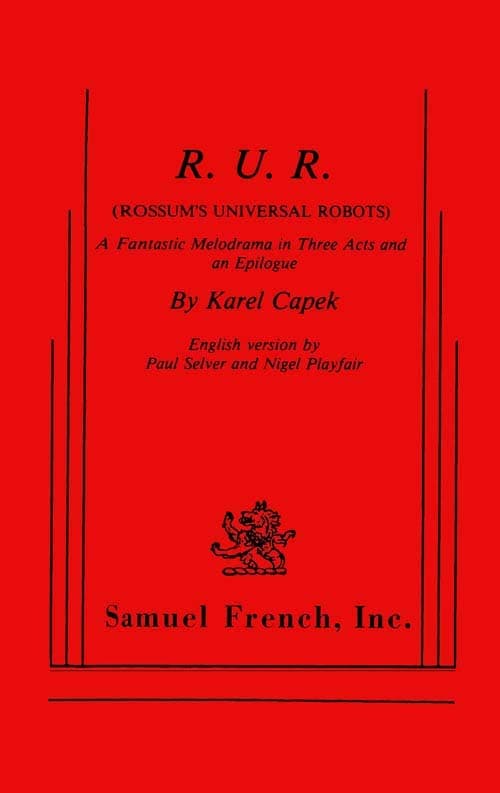
R.U.R. (Rossum’s Universal Robots)

The play that gave the English language its most enduring science fiction word. Čapek's 1920 drama opens in the sterile laboratories of Rossum's Universal Robots, where a young idealist named Helena Glory has arrived to champion a radical cause: civil rights for the manufactured workers who have built the world's industrial empire. The robots, mass-produced, genetically engineered beings designed for labor, are beginning to develop something their creators never anticipated: the capacity for thought and feeling. What begins as a philosophical debate about artificial consciousness accelerates toward catastrophe, as Čapek constructs a chilling vision of revolution and extinction. The play endures because it understood, decades before our current AI anxieties, the danger of creating intelligence and treating it as a commodity. For anyone who has ever wondered what we owe the things we build, R.U.R. remains essential and unsettling.
Editions

Read by
Group Narration
2 readers
Tina Nuzzi, Beth Thomas (1974-2020), ToddHW, John Trevithick +9 more
Link to this book
Add a free, dofollow link to Lex on your blog, forum, syllabus, or reading list.

<a href="https://lex-books.com/book/r-u-r-rossum-s-universal-robots-05bde0b3-7645-4bb8-be72-520d7eba02ad"><img src="https://lex-books.com/badges/read-on-lex.svg" alt="Read R.U.R. (Rossum’s Universal Robots) by Karel Čapek free on Lex" width="160" height="40"></a>[](https://lex-books.com/book/r-u-r-rossum-s-universal-robots-05bde0b3-7645-4bb8-be72-520d7eba02ad)[url=https://lex-books.com/book/r-u-r-rossum-s-universal-robots-05bde0b3-7645-4bb8-be72-520d7eba02ad][img]https://lex-books.com/badges/read-on-lex.svg[/img][/url]Read R.U.R. (Rossum’s Universal Robots) by Karel Čapek free on Lex: https://lex-books.com/book/r-u-r-rossum-s-universal-robots-05bde0b3-7645-4bb8-be72-520d7eba02adCite this book
Reading this edition for a paper or guide? Copy a citation.
Čapek, Karel. R.U.R. (Rossum’s Universal Robots). Lex, lex-books.com/book/r-u-r-rossum-s-universal-robots-05bde0b3-7645-4bb8-be72-520d7eba02ad.Čapek, K. (n.d.). R.U.R. (Rossum’s Universal Robots). Lex. https://lex-books.com/book/r-u-r-rossum-s-universal-robots-05bde0b3-7645-4bb8-be72-520d7eba02adČapek, Karel. R.U.R. (Rossum’s Universal Robots). Lex. https://lex-books.com/book/r-u-r-rossum-s-universal-robots-05bde0b3-7645-4bb8-be72-520d7eba02ad.