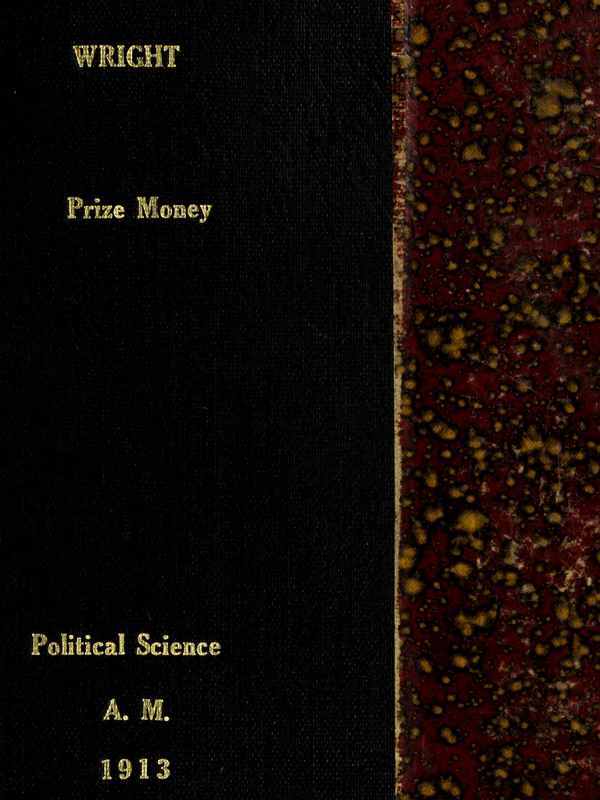
Prize Money
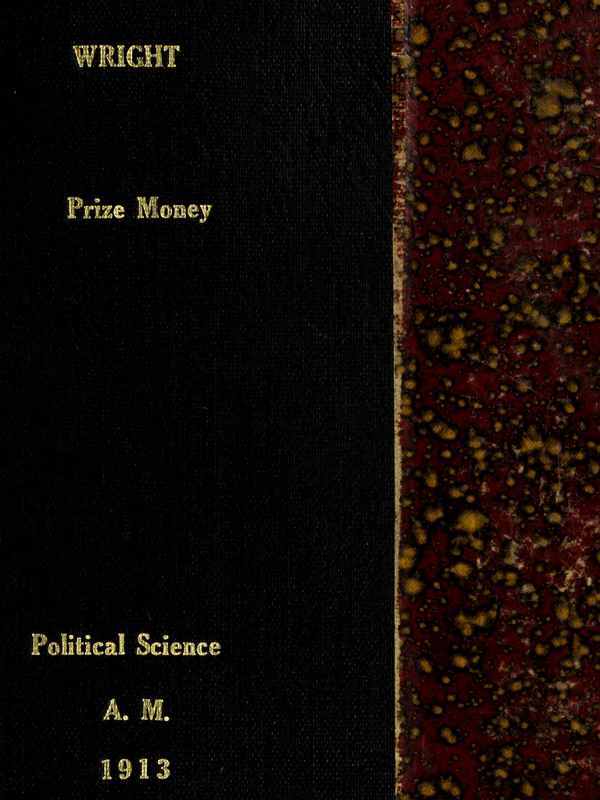
Prize Money
Prize Money, written by Quincy Wright in the early 20th century, is a scholarly examination of the laws governing the distribution of prize money from maritime captures during wartime. The work traces the evolution of these laws from ancient civilizations through the Middle Ages to modern legal frameworks, particularly in Great Britain. It highlights the significance of prize money laws in international law and maritime warfare, analyzing their historical context and contemporary implications. The text begins with reflections on ancient Greek practices regarding prize distribution, setting a foundation for understanding modern interpretations of prize capture and restitution at sea.
Editions
X-Ray
The author and researcher of this academic thesis on prize money laws. A graduate student at the University of Illinois pursuing a Master of Arts in Political Science in 1913.
Wright's thesis supervisor and head of the Political Science department at the University of Illinois. He recommended acceptance of Wright's thesis on prize money.
17th century Dutch jurist and philosopher, author of 'De Jure Belli et Pacis' (1625). A foundational figure in international law whose theories on prize distribution Wright extensively analyzes.
Judge of the British admiralty and prize court during the Napoleonic wars. Wright credits him as the creator of English prize law and considers his court an international authority.
About Prize Money
Chapter Summaries
- Introduction
- Wright establishes that prize money distribution is a matter of municipal law but has international significance. He outlines his purpose to investigate the character, conditions, and effects of prize money laws across different countries and historical periods.
- 1
- Examines prize distribution in ancient Greece and Rome, showing early recognition that prizes belong to the state rather than individual captors. Greeks developed equitable distribution principles while Romans created elaborate legal frameworks, though maritime enforcement remained weak due to widespread piracy.
- 2
- Analyzes medieval maritime codes like the Consolato del Mare and the emergence of international law theory. Wright traces how merchant leagues created legal frameworks for prize distribution, followed by 16th-17th century theorists who established state supremacy in war and prize matters.
Key Themes
- State Sovereignty vs Individual Rights
- Wright explores the fundamental tension between the state's ultimate authority over war prizes and the practical need to incentivize individual captors through monetary rewards.
- Evolution of International Law
- The work traces how prize money laws evolved from ancient customs to sophisticated legal frameworks, reflecting broader developments in international jurisprudence and state organization.
- Commercial vs Military Interests
- Wright analyzes how England's dependence on commerce conflicted with aggressive naval policies, leading to complex legal frameworks that balanced belligerent rights with neutral protections.
Characters
- Philip Quincy Wright(protagonist)
- The author and researcher of this academic thesis on prize money laws. A graduate student at the University of Illinois pursuing a Master of Arts in Political Science in 1913.
- James W. Garner(major)
- Wright's thesis supervisor and head of the Political Science department at the University of Illinois. He recommended acceptance of Wright's thesis on prize money.
- Hugo Grotius(major)
- 17th century Dutch jurist and philosopher, author of 'De Jure Belli et Pacis' (1625). A foundational figure in international law whose theories on prize distribution Wright extensively analyzes.
- Sir William Scott (Lord Stowell)(major)
- Judge of the British admiralty and prize court during the Napoleonic wars. Wright credits him as the creator of English prize law and considers his court an international authority.
- Lord Mansfield(major)
- Lord Chief Justice of England who began correlating prize law through his famous decisions in appealed cases during the 18th century.
- Machiavelli(minor)
- 16th century Italian political theorist who recognized state supremacy in war and recommended liberal prize distribution to encourage soldier loyalty.
Link to this book
Add a free, dofollow link to Lex on your blog, forum, syllabus, or reading list.

<a href="https://lex-books.com/book/prize-money-8876fefb-64b8-4798-afcf-45ada281b653"><img src="https://lex-books.com/badges/read-on-lex.svg" alt="Read Prize Money by Quincy Wright free on Lex" width="160" height="40"></a>[](https://lex-books.com/book/prize-money-8876fefb-64b8-4798-afcf-45ada281b653)[url=https://lex-books.com/book/prize-money-8876fefb-64b8-4798-afcf-45ada281b653][img]https://lex-books.com/badges/read-on-lex.svg[/img][/url]Read Prize Money by Quincy Wright free on Lex: https://lex-books.com/book/prize-money-8876fefb-64b8-4798-afcf-45ada281b653Cite this book
Reading this edition for a paper or guide? Copy a citation.
Wright, Quincy. Prize Money. Lex, lex-books.com/book/prize-money-8876fefb-64b8-4798-afcf-45ada281b653.Wright, Q. (n.d.). Prize Money. Lex. https://lex-books.com/book/prize-money-8876fefb-64b8-4798-afcf-45ada281b653Wright, Quincy. Prize Money. Lex. https://lex-books.com/book/prize-money-8876fefb-64b8-4798-afcf-45ada281b653.