Principles of Economics, The Appendices
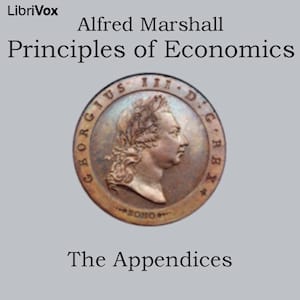
When Alfred Marshall published Principles of Economics in 1890, he didn't just write a textbook - he fundamentally restructured how the world would understand wealth, value, and exchange. Marshall took the scattered insights of earlier economists and synthesized them into a coherent whole: supply and demand as forces that dance around price, marginal utility as the engine of value, production costs as the floor beneath which no market can fall. His rigorous analytical framework introduced concepts like elasticity and consumer surplus that economists still deploy daily. The Appendices contain the technical scaffolding - the mathematical expositions and refinements that gave his ideas their durability. First written in 1881 and revised across eight editions over three decades, this work became the dominant economics textbook in England and established Marshall as the defining economic mind of his generation. For anyone seeking to understand where modern economic theory comes from - not as a survey, but as it actually originated - this remains the essential document.
Editions

Read by
Group Narration
5 readers
Rhonda Federman, icyjumbo (1964-2010), Sibella Denton, webround +1 more
Link to this book
Add a free, dofollow link to Lex on your blog, forum, syllabus, or reading list.

<a href="https://lex-books.com/book/principles-of-economics-the-appendices-108ef206-ff69-4cfe-b874-9ce0f6d70e6e"><img src="https://lex-books.com/badges/read-on-lex.svg" alt="Read Principles of Economics, The Appendices by Alfred Marshall free on Lex" width="160" height="40"></a>[](https://lex-books.com/book/principles-of-economics-the-appendices-108ef206-ff69-4cfe-b874-9ce0f6d70e6e)[url=https://lex-books.com/book/principles-of-economics-the-appendices-108ef206-ff69-4cfe-b874-9ce0f6d70e6e][img]https://lex-books.com/badges/read-on-lex.svg[/img][/url]Read Principles of Economics, The Appendices by Alfred Marshall free on Lex: https://lex-books.com/book/principles-of-economics-the-appendices-108ef206-ff69-4cfe-b874-9ce0f6d70e6eCite this book
Reading this edition for a paper or guide? Copy a citation.
Marshall, Alfred. Principles of Economics, The Appendices. Lex, lex-books.com/book/principles-of-economics-the-appendices-108ef206-ff69-4cfe-b874-9ce0f6d70e6e.Marshall, A. (n.d.). Principles of Economics, The Appendices. Lex. https://lex-books.com/book/principles-of-economics-the-appendices-108ef206-ff69-4cfe-b874-9ce0f6d70e6eMarshall, Alfred. Principles of Economics, The Appendices. Lex. https://lex-books.com/book/principles-of-economics-the-appendices-108ef206-ff69-4cfe-b874-9ce0f6d70e6e.