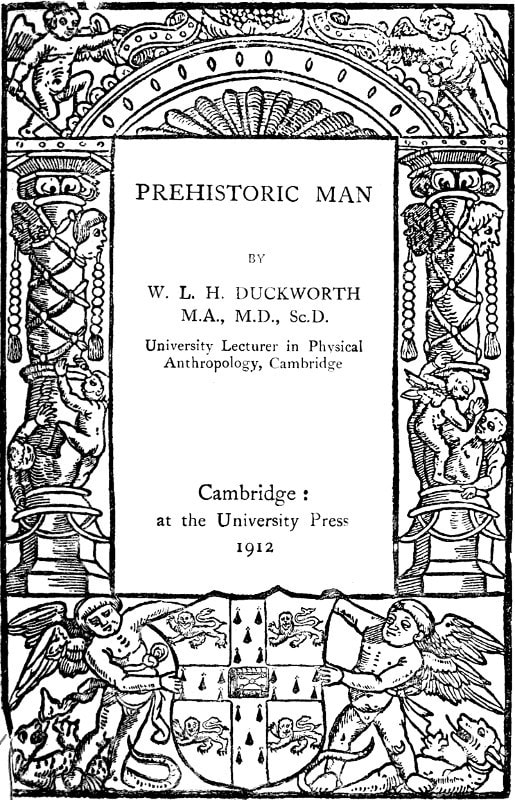
Prehistoric Man
1912
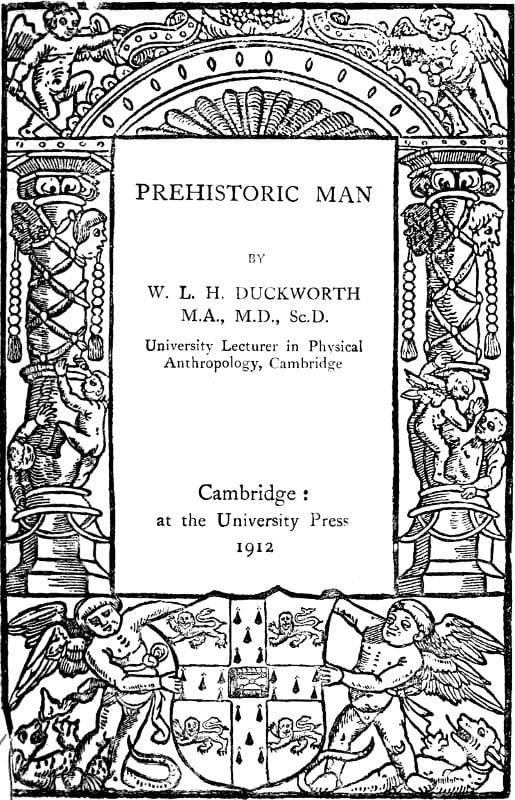
Prehistoric Man
1912
Published in 1912, this Cambridge Manual captures paleoanthropology at a pivotal moment, just before major discoveries would reshape our understanding of human origins. W. L. H. Duckworth surveys what turn-of-the-century scientists believed about prehistoric humans, from the controversial Pithecanthropus erectus fossils to the enigmatic Mauer jaw. The book traces the precursors to Paleolithic man and concludes at the Aurignacian culture, synthesizing the fragmentary fossil evidence and stone tools that constituted the sum of human knowledge about our deep past. What makes this volume fascinating today is not its scientific accuracy, but its historical value. Duckworth writes with characteristic early-20th-century confidence about classification and geological dating, never imagining the upheavals to come including the Piltdown hoax that would later shame British anthropology. The book reveals how scholars constructed evolutionary trees from tantalizingly incomplete evidence, and where their intuitions happened to be right or spectacularly wrong. For readers curious about the history of science, or anyone who wants to understand how we got from early speculation to modern paleoanthropology, this little manual offers a remarkable window into the past.
Editions
X-Ray
The author and narrator, a Cambridge anatomist and anthropologist who systematically analyzes prehistoric human remains. He presents evidence objectively while offering his own interpretations of controversial discoveries.
Dutch paleontologist who discovered Pithecanthropus erectus in Java (1891-1892). His controversial claims about finding a 'missing link' between apes and humans sparked intense scientific debate.
German paleontologist who discovered the Heidelberg (Mauer) jaw in 1907. He had anticipated the find for twenty years, maintaining contact with local quarry workers.
Croatian paleontologist who excavated the Krapina rock-shelter (1899-1905), discovering numerous fragmentary human remains suggesting cannibalism among early humans.
About Prehistoric Man
Chapter Summaries
- Preface
- Duckworth explains his focus on the earliest phases of human history ending at the Aurignacian period. He discusses the difficulty of assigning definite dates and mentions recent discoveries including Henri Martin's La Quina skeleton and Moir's pre-Pliocene implements.
- 1
- Examines the most ancient possible human remains: Pithecanthropus erectus from Java and the Heidelberg jaw from Mauer. Duckworth analyzes the controversial evidence for these specimens representing transitional forms between apes and humans.
- 2
- Surveys recent discoveries of undoubtedly human fossils from the Palaeolithic period, including finds from Taubach, Krapina, La Chapelle-aux-Saints, Le Moustier, and other sites. Establishes three main groups of early human types.
Key Themes
- Scientific Method and Evidence
- Duckworth emphasizes the importance of rigorous analysis, careful observation, and critical evaluation of evidence. He consistently weighs competing interpretations and acknowledges uncertainties in the fossil record.
- Human Evolution and Origins
- The central theme explores humanity's prehistoric development, from possible ape-like ancestors to modern humans. The book examines various evolutionary pathways and the evidence supporting gradual development versus sudden appearance of human traits.
- Academic Controversy and Debate
- The text reveals the contentious nature of early 20th-century paleontology, with scholars fiercely debating interpretations of fossil evidence. Duckworth navigates these disputes while maintaining scholarly objectivity.
Characters
- W. L. H. Duckworth(protagonist)
- The author and narrator, a Cambridge anatomist and anthropologist who systematically analyzes prehistoric human remains. He presents evidence objectively while offering his own interpretations of controversial discoveries.
- Professor Dubois(major)
- Dutch paleontologist who discovered Pithecanthropus erectus in Java (1891-1892). His controversial claims about finding a 'missing link' between apes and humans sparked intense scientific debate.
- Dr Schoetensack(major)
- German paleontologist who discovered the Heidelberg (Mauer) jaw in 1907. He had anticipated the find for twenty years, maintaining contact with local quarry workers.
- Professor Kramberger(major)
- Croatian paleontologist who excavated the Krapina rock-shelter (1899-1905), discovering numerous fragmentary human remains suggesting cannibalism among early humans.
- Professor Boule(major)
- French paleontologist who studied the La Chapelle-aux-Saints skeleton and developed theories about glacial periods and human chronology. A leading authority on Neanderthal remains.
- Professor Klaatsch(major)
- German anthropologist who proposed the controversial 'diphyletic theory' suggesting two separate lines of human descent from different ape ancestors.
Link to this book
Add a free, dofollow link to Lex on your blog, forum, syllabus, or reading list.

<a href="https://lex-books.com/book/prehistoric-man-46321a32-c10f-4553-9ab2-ebfe391d4eb1"><img src="https://lex-books.com/badges/read-on-lex.svg" alt="Read Prehistoric Man by W. L. H. Duckworth free on Lex" width="160" height="40"></a>[](https://lex-books.com/book/prehistoric-man-46321a32-c10f-4553-9ab2-ebfe391d4eb1)[url=https://lex-books.com/book/prehistoric-man-46321a32-c10f-4553-9ab2-ebfe391d4eb1][img]https://lex-books.com/badges/read-on-lex.svg[/img][/url]Read Prehistoric Man by W. L. H. Duckworth free on Lex: https://lex-books.com/book/prehistoric-man-46321a32-c10f-4553-9ab2-ebfe391d4eb1Cite this book
Reading this edition for a paper or guide? Copy a citation.
Duckworth, W. L. H.. Prehistoric Man. Lex, lex-books.com/book/prehistoric-man-46321a32-c10f-4553-9ab2-ebfe391d4eb1.Duckworth, W. L. H. (1912). Prehistoric Man. Lex. https://lex-books.com/book/prehistoric-man-46321a32-c10f-4553-9ab2-ebfe391d4eb1Duckworth, W. L. H.. Prehistoric Man. Lex. https://lex-books.com/book/prehistoric-man-46321a32-c10f-4553-9ab2-ebfe391d4eb1.