Picturesque Sketches of London, Past and Present
1852
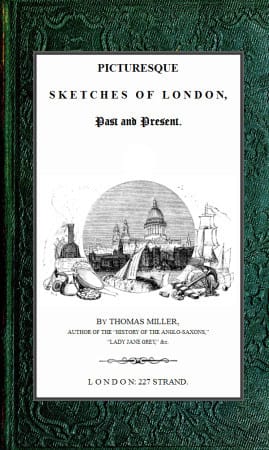
Thomas Miller's 1852 portrait of London is not a guidebook but a love letter to a city that even then was vanishing. Drawing on pieces he wrote for The Illustrated London News between 1848 and 1851, Miller walks the reader through the older, eastern quarters of the capital - its ancient churches, its crowded markets, its narrow lanes still holding the ghosts of medieval London. He contrasts the bustling Victorian metropolis around him with the phantom city that preceded it: the Roman settlement, the Tudor stews, the great fire's scars still fresh in collective memory. Miller writes in what he calls "poetic prose" - vivid, musical, unafraid of beauty - so that a description of St. Paul's at dusk or a fog-bound bridge over the Thames becomes something closer to verse than journalism. This is London as lived experience, filtered through a mind that finds meaning in old stone and older legends. For readers who crave the texture of a city before electricity, before the blitz, before modernity swept so much away, these sketches offer an extraordinary time capsule: a poet's eye applied to a London that exists now only in these pages.
Editions
Link to this book
Add a free, dofollow link to Lex on your blog, forum, syllabus, or reading list.

<a href="https://lex-books.com/book/picturesque-sketches-of-london-past-and-present-d01cfe0c-0333-4ab9-b364-6eb02b99a3f5"><img src="https://lex-books.com/badges/read-on-lex.svg" alt="Read Picturesque Sketches of London, Past and Present by Thomas Miller free on Lex" width="160" height="40"></a>[](https://lex-books.com/book/picturesque-sketches-of-london-past-and-present-d01cfe0c-0333-4ab9-b364-6eb02b99a3f5)[url=https://lex-books.com/book/picturesque-sketches-of-london-past-and-present-d01cfe0c-0333-4ab9-b364-6eb02b99a3f5][img]https://lex-books.com/badges/read-on-lex.svg[/img][/url]Read Picturesque Sketches of London, Past and Present by Thomas Miller free on Lex: https://lex-books.com/book/picturesque-sketches-of-london-past-and-present-d01cfe0c-0333-4ab9-b364-6eb02b99a3f5Cite this book
Reading this edition for a paper or guide? Copy a citation.
Miller, Thomas. Picturesque Sketches of London, Past and Present. Lex, lex-books.com/book/picturesque-sketches-of-london-past-and-present-d01cfe0c-0333-4ab9-b364-6eb02b99a3f5.Miller, T. (1852). Picturesque Sketches of London, Past and Present. Lex. https://lex-books.com/book/picturesque-sketches-of-london-past-and-present-d01cfe0c-0333-4ab9-b364-6eb02b99a3f5Miller, Thomas. Picturesque Sketches of London, Past and Present. Lex. https://lex-books.com/book/picturesque-sketches-of-london-past-and-present-d01cfe0c-0333-4ab9-b364-6eb02b99a3f5.