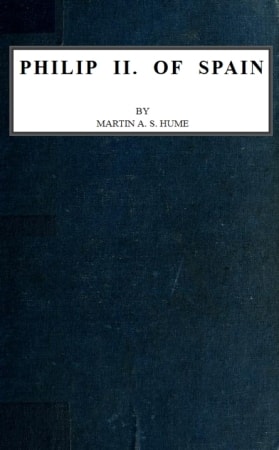
Philip II. of Spain
1897
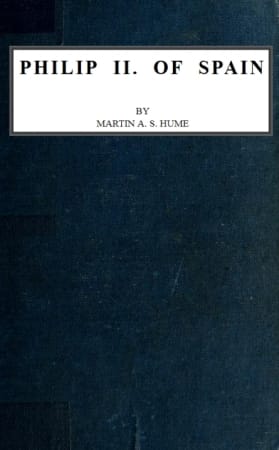
Philip II inherited the greatest empire Christendom had ever seen: Spain's vast territories stretched across every continent then known to Europeans, and the prospect of universal dominion seemed within his grasp. Yet Martin A. S. Hume's 1897 biography argues that this monarch, far from the monster of Protestant legend, was instead a man destroyed by his own impossible ambitions and the crushing weight of inherited expectations. Hume examines Philip chiefly as a statesman, probing the political problems that consumed his reign while seeking the reasons for his catastrophic failures. Despite considerable intellect and a lifetime of relentless toil, Philip's record is one of unbroken defeat: the Armada wrecked, the Netherlands in revolt, Catholic France bleeding itself dry, and the dream of Spanish universal supremacy collapsed into bankruptcy and humiliation. Hume presents Philip not as the embodiment of a system but as an individual whose rigid devotion to Catholic uniformity proved tragically out of step with an emerging modern world. This Victorian biography, written when Britain's own imperial zenith invited reflection on the rise and fall of great powers, remains a nuanced portrait of ambition foundering on the rocks of history.
Editions
Link to this book
Add a free, dofollow link to Lex on your blog, forum, syllabus, or reading list.

<a href="https://lex-books.com/book/philip-ii-of-spain-5a37060a-7fb5-404f-b722-fed198f8af0d"><img src="https://lex-books.com/badges/read-on-lex.svg" alt="Read Philip II. of Spain by Martin A. S. Hume free on Lex" width="160" height="40"></a>[](https://lex-books.com/book/philip-ii-of-spain-5a37060a-7fb5-404f-b722-fed198f8af0d)[url=https://lex-books.com/book/philip-ii-of-spain-5a37060a-7fb5-404f-b722-fed198f8af0d][img]https://lex-books.com/badges/read-on-lex.svg[/img][/url]Read Philip II. of Spain by Martin A. S. Hume free on Lex: https://lex-books.com/book/philip-ii-of-spain-5a37060a-7fb5-404f-b722-fed198f8af0dCite this book
Reading this edition for a paper or guide? Copy a citation.
Hume, Martin A. S.. Philip II. of Spain. Lex, lex-books.com/book/philip-ii-of-spain-5a37060a-7fb5-404f-b722-fed198f8af0d.Hume, M. A. S. (1897). Philip II. of Spain. Lex. https://lex-books.com/book/philip-ii-of-spain-5a37060a-7fb5-404f-b722-fed198f8af0dHume, Martin A. S.. Philip II. of Spain. Lex. https://lex-books.com/book/philip-ii-of-spain-5a37060a-7fb5-404f-b722-fed198f8af0d.