Phantasie in der Malerei

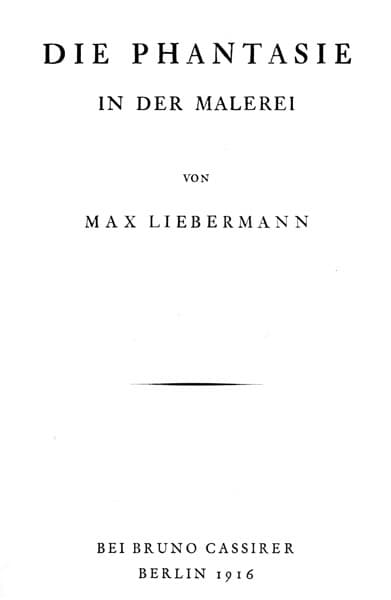
In this passionate polemic, Max Liebermann, the leading voice of German Impressionism, mounts a rigorous defense of painting rooted in direct observation of nature. Written during his tenure as professor at Berlin's Academy of Arts and first published in 1903, the essay rejects any imagery that does not derive from the sensible world, arguing that the subject matter matters far less than "the conception of nature most adequate to the pictorial means." Liebermann's target was clear: the rising tide of abstraction and Expressionism that would come to dominate twentieth-century art. For him, the painter's fantasy was not invention from nothing, but the ability to reveal the hidden life within visible reality. The 1916 book edition added a new introduction written amid the chaos of World War I, lending the work an additional layer of historical weight. This is not merely a document of artistic controversy; it is a profound meditation on what painting is, what it owes to the world, and why lying about nature in the name of imagination serves neither art nor truth. It remains essential reading for anyone interested in the philosophical foundations of modern art and the bitter disputes that shaped its development.
Editions

Link to this book
Add a free, dofollow link to Lex on your blog, forum, syllabus, or reading list.

<a href="https://lex-books.com/book/phantasie-in-der-malerei-0ba433f9-ccc8-4cd3-b073-fdeedf1b0093"><img src="https://lex-books.com/badges/read-on-lex.svg" alt="Read Phantasie in der Malerei by Max Liebermann free on Lex" width="160" height="40"></a>[](https://lex-books.com/book/phantasie-in-der-malerei-0ba433f9-ccc8-4cd3-b073-fdeedf1b0093)[url=https://lex-books.com/book/phantasie-in-der-malerei-0ba433f9-ccc8-4cd3-b073-fdeedf1b0093][img]https://lex-books.com/badges/read-on-lex.svg[/img][/url]Read Phantasie in der Malerei by Max Liebermann free on Lex: https://lex-books.com/book/phantasie-in-der-malerei-0ba433f9-ccc8-4cd3-b073-fdeedf1b0093Cite this book
Reading this edition for a paper or guide? Copy a citation.
Liebermann, Max. Phantasie in der Malerei. Lex, lex-books.com/book/phantasie-in-der-malerei-0ba433f9-ccc8-4cd3-b073-fdeedf1b0093.Liebermann, M. (n.d.). Phantasie in der Malerei. Lex. https://lex-books.com/book/phantasie-in-der-malerei-0ba433f9-ccc8-4cd3-b073-fdeedf1b0093Liebermann, Max. Phantasie in der Malerei. Lex. https://lex-books.com/book/phantasie-in-der-malerei-0ba433f9-ccc8-4cd3-b073-fdeedf1b0093.