Passages from the Life of a Philosopher
1864
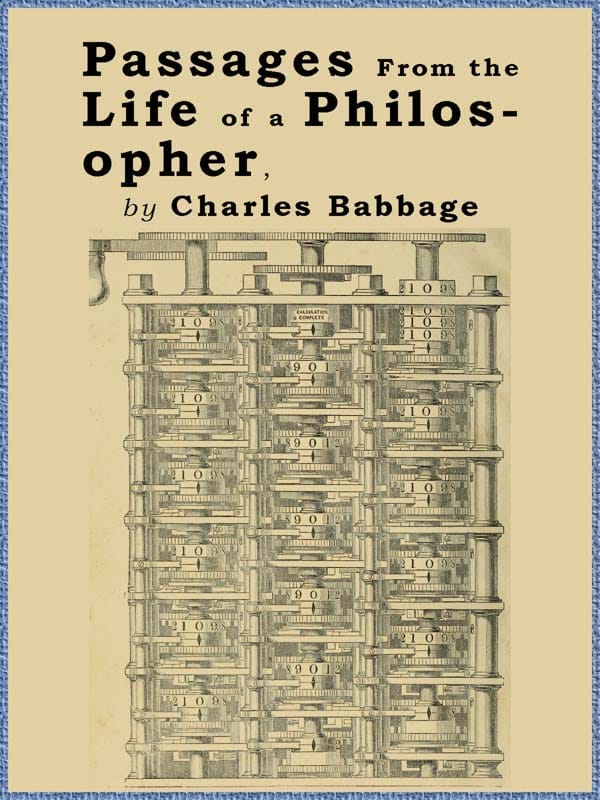
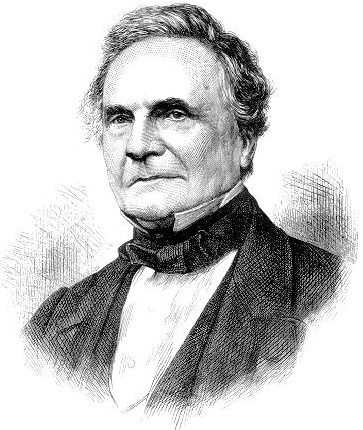
Charles Babbage invented machines that would not be built for a century, yet his autobiography reveals something no blueprint could capture: the beautifully odd mind behind the calculating engines. Written in 1864, this is not a dry technical account but a wandering, witty stroll through the life of a man who genuinely believed he could build a machine to think. Babbage recounts getting spectacularly lost on London Bridge as a child, nearly poisoning himself out of scientific curiosity, and watching Victorian society transform around him with a mixture of wonder and exasperation. He reflects on inheritance, identity, and what it means to carry a name weighted with expectation. Throughout, the reader encounters not just the father of computing but a Victorian character of the first order: argumentative, curious, funny, and occasionally maddening. The book endures because it captures the human origins of the digital age, showing us that the revolution started not with code but with a brilliant man scribbling notes in a world still lit by gaslight.
Editions

X-Ray
“Whenever a man can get hold of numbers, they are invaluable: if correct, they assist in informing his own mind, but they are still more useful in deluding the minds of others. Numbers are the masters of the weak, but the slaves of the strong.””
— Charles Babbage
“occupation of the mind is such a source of pleasure that it can relieve even the pain of a headache;””
— Charles Babbage
“One of the most singular characteristics of the art of deciphering is the strong conviction possessed by every person, even moderately acquainted with it, that he is able to construct a cipher which nobody else can decipher. I have also observed that the cleverer the person, the more intimate is his conviction.””
— Charles Babbage
“Some men write their lives to save themselves from ennui, careless of the amount they inflict on their readers.””
— Charles Babbage
“Having myself worked with a variety of tools, and having studied the art of constructing each of them, I at length laid it down as a principle”
— Charles Babbage
“As soon as an Analytical Engine exists, it will necessarily guide the future course of the science. Whenever any result is sought by its aid, the question will then arise”
— Charles Babbage
“If I played any of the ordinary openings, such as are found in the books, I was sure to be beaten. The only way in which I had a chance of winning, was by making early in the game a move so bad that it had not been mentioned in any treatise.””
— Charles Babbage
“gently expressed a doubt whether the plan was possible, to which I replied that, not being able to prove its impossibility, I should follow out a slight glimmering of light which I thought I perceived.””
— Charles Babbage
“Man wrongs, and Time avenges. Byron”
— Charles Babbage
Link to this book
Add a free, dofollow link to Lex on your blog, forum, syllabus, or reading list.

<a href="https://lex-books.com/book/passages-from-the-life-of-a-philosopher-439c699a-5fe7-4214-8f86-31cbdeed11b8"><img src="https://lex-books.com/badges/read-on-lex.svg" alt="Read Passages from the Life of a Philosopher by Charles Babbage free on Lex" width="160" height="40"></a>[](https://lex-books.com/book/passages-from-the-life-of-a-philosopher-439c699a-5fe7-4214-8f86-31cbdeed11b8)[url=https://lex-books.com/book/passages-from-the-life-of-a-philosopher-439c699a-5fe7-4214-8f86-31cbdeed11b8][img]https://lex-books.com/badges/read-on-lex.svg[/img][/url]Read Passages from the Life of a Philosopher by Charles Babbage free on Lex: https://lex-books.com/book/passages-from-the-life-of-a-philosopher-439c699a-5fe7-4214-8f86-31cbdeed11b8Cite this book
Reading this edition for a paper or guide? Copy a citation.
Babbage, Charles. Passages from the Life of a Philosopher. Lex, lex-books.com/book/passages-from-the-life-of-a-philosopher-439c699a-5fe7-4214-8f86-31cbdeed11b8.Babbage, C. (1864). Passages from the Life of a Philosopher. Lex. https://lex-books.com/book/passages-from-the-life-of-a-philosopher-439c699a-5fe7-4214-8f86-31cbdeed11b8Babbage, Charles. Passages from the Life of a Philosopher. Lex. https://lex-books.com/book/passages-from-the-life-of-a-philosopher-439c699a-5fe7-4214-8f86-31cbdeed11b8.