Overland Through Asia; Pictures of Siberian, Chinese, and Tartar Life
1870
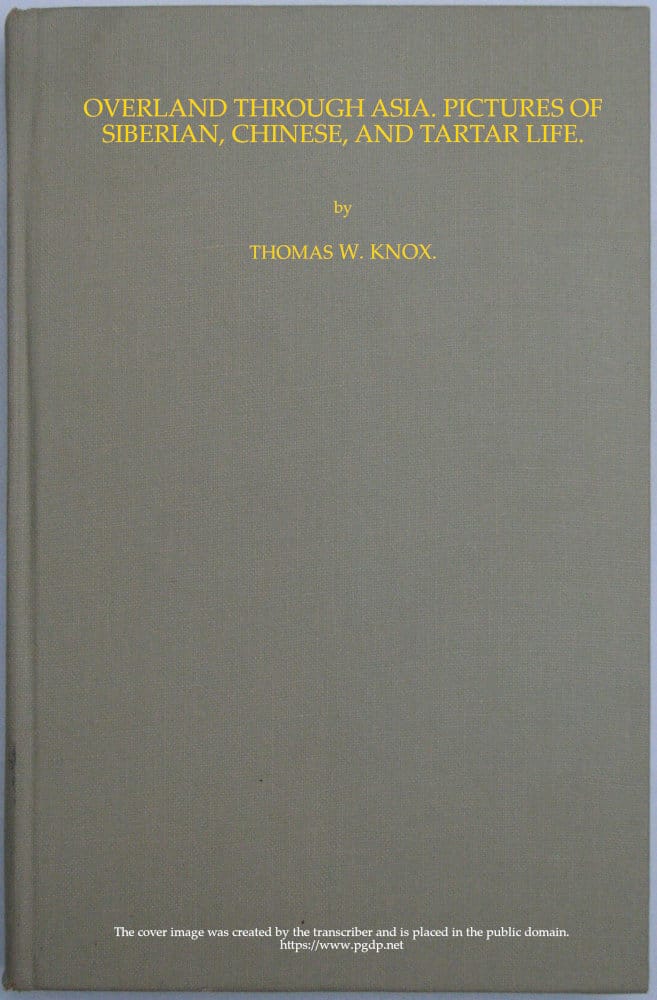
Overland Through Asia; Pictures of Siberian, Chinese, and Tartar Life
1870
In 1870, an American journalist named Thomas Wallace Knox made a choice that defined his literary legacy: instead of taking the safe ocean route to Asia, he boarded the steamer G.S. Wright for an audacious overland journey through lands most Westerners could only imagine. His destination: the frozen extremities of Siberia, the volcanic wilds of Kamchatka, and the ancient kingdoms of China and Mongolia. What follows is a travelogue that reads less like a Victorian encyclopedia and more like a fever dream of encounters with exiles, shamans, merchants, and prisoners dragged to the edge of the Russian Empire. Knox documents Siberian exile culture with an eye that is neither purely anthropological nor merely sensational. He walks among men and women stripped of freedom, examining their conditions, their resilience, and the strange communities they form in the empire's frozen penal colonies. He steams up the Amoor River past shores where the taiga meets the frozen ocean, and he ventures into regions the West had barely mapped. The book crackles with the energy of a writer who chose the harder path and found stories no traditional route could have offered. This is travel writing as it existed before tourism existed: rough, curious, unafraid to stare at what made it uncomfortable. For readers who want to see a vanished world through the eyes of someone who walked through it.
Editions

X-Ray
Link to this book
Add a free, dofollow link to Lex on your blog, forum, syllabus, or reading list.

<a href="https://lex-books.com/book/overland-through-asia-pictures-of-siberian-chinese-and-tartar-life-99109083-5053-4493-b850-e08fc305e4ee"><img src="https://lex-books.com/badges/read-on-lex.svg" alt="Read Overland Through Asia; Pictures of Siberian, Chinese, and Tartar Life by Thomas Wallace Knox free on Lex" width="160" height="40"></a>[](https://lex-books.com/book/overland-through-asia-pictures-of-siberian-chinese-and-tartar-life-99109083-5053-4493-b850-e08fc305e4ee)[url=https://lex-books.com/book/overland-through-asia-pictures-of-siberian-chinese-and-tartar-life-99109083-5053-4493-b850-e08fc305e4ee][img]https://lex-books.com/badges/read-on-lex.svg[/img][/url]Read Overland Through Asia; Pictures of Siberian, Chinese, and Tartar Life by Thomas Wallace Knox free on Lex: https://lex-books.com/book/overland-through-asia-pictures-of-siberian-chinese-and-tartar-life-99109083-5053-4493-b850-e08fc305e4eeCite this book
Reading this edition for a paper or guide? Copy a citation.
Knox, Thomas Wallace. Overland Through Asia; Pictures of Siberian, Chinese, and Tartar Life. Lex, lex-books.com/book/overland-through-asia-pictures-of-siberian-chinese-and-tartar-life-99109083-5053-4493-b850-e08fc305e4ee.Knox, T. W. (1870). Overland Through Asia; Pictures of Siberian, Chinese, and Tartar Life. Lex. https://lex-books.com/book/overland-through-asia-pictures-of-siberian-chinese-and-tartar-life-99109083-5053-4493-b850-e08fc305e4eeKnox, Thomas Wallace. Overland Through Asia; Pictures of Siberian, Chinese, and Tartar Life. Lex. https://lex-books.com/book/overland-through-asia-pictures-of-siberian-chinese-and-tartar-life-99109083-5053-4493-b850-e08fc305e4ee.