Other People's Money, and How the Bankers Use It
1914
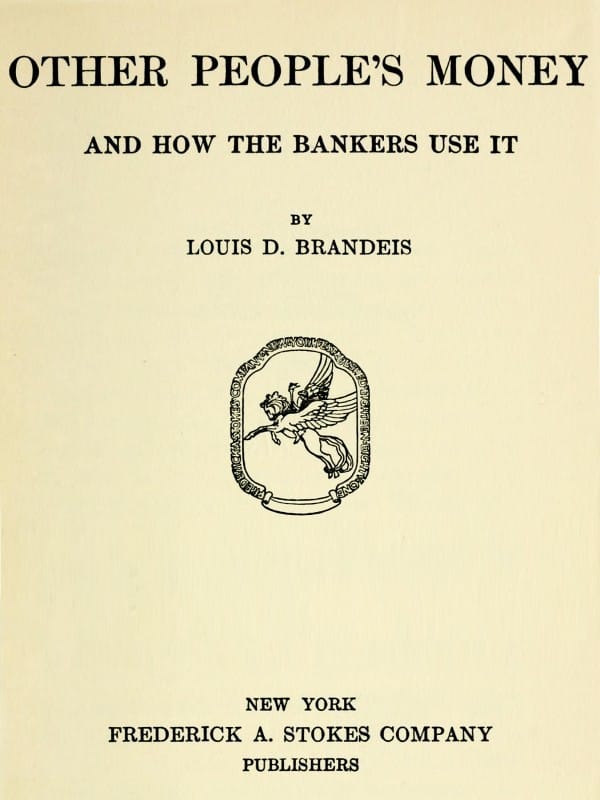
Other People's Money, and How the Bankers Use It
1914
In 1914, a future Supreme Court Justice turned his formidable intellect to a more immediate enemy: the handful of bankers who had quietly seized control of American industry. Louis Brandeis's explosive polemic解剖 the "Money Trust" - the concentrated financial power that, through interlocking directorates and strategic control of credit, had made a private cabal the gatekeepers of America's economic life. Drawing on Congressional testimony and meticulous research, Brandeis argued that democracy itself was at stake when a small group of men could determine which businesses lived or died, which industries flourished or withered. The book reads less like a dry economic treatise and more like an urgent dispatch from a battlefield - one where the weapons are capital and the casualties are competition, opportunity, and the public good. A century of regulation came in response to the conditions Brandeis described, yet his central question remains unanswered: how much concentrated financial power can a democracy tolerate? Essential reading for anyone seeking to understand the roots of American economic anxiety - and the debates that still shape our financial system.
Editions
X-Ray
“The power and the growth of power of our financial oligarchs comes from wielding the savings and quick capital of others.””
— Louis Dembitz Brandeis
“But sporadic evidence indicates how great are the possibilities of accumulation when one has the use of “other people’s money.””
— Louis Dembitz Brandeis
“When once a banker has entered the Board – whatever may have been the occasion – his grip proves tenacious and his influence usually supreme; for he controls the supply of new money.””
— Louis Dembitz Brandeis
“They became the directing power in the life insurance companies, and other corporate reservoirs of the people’s savings-the buyers of bonds and stocks. They became the directing power also in banks and trust companies-the depositaries of the quick capital of the country-the life blood of business, with which they and others carried on their operations. Thus four distinct functions, each essential to business, and each exercised, originally, by a distinct set of men, became united in the investment banker. It is to this union of business functions that the existence of the Money Trust is mainly due.[1]””
— Louis Dembitz Brandeis
“The statement of Mr. Justice Holmes of the Supreme Court of the United States, in the Oklahoma Bank case, is significant: “We cannot say that the public interests to which we have adverted, and others, are not sufficient to warrant the State in taking the whole business of banking under its control. On the contrary we are of opinion that it may go on from regulation to prohibition except upon such conditions as it may prescribe.””
— Louis Dembitz Brandeis
“Such affiliations tend as a cover and conduit for secret arrangements and understandings in restriction of competition through the agency of the banking house thus situated.””
— Louis Dembitz Brandeis
“But as the Pujo Committee finds “the so-called control of life insurance companies by policy-holders through mutualization is a farce” and “its only result is to keep in office a self-constituted, self-perpetuating management.””
— Louis Dembitz Brandeis
“The investment banker is naturally on the lookout for good bargains in bonds and stocks. Like other merchants he wants to buy his merchandise cheap. But when he becomes director of a corporation, he occupies a position which prevents the transaction by which he acquires its corporate securities from being properly called a bargain. Can there be real bargaining where the same man is on both sides of a trade?””
— Louis Dembitz Brandeis
“Publicity is justly commended as a remedy for social and industrial diseases. Sunlight is said to be the best of disinfectants; electric light the most efficient policeman.””
— Louis Dembitz Brandeis
Link to this book
Add a free, dofollow link to Lex on your blog, forum, syllabus, or reading list.

<a href="https://lex-books.com/book/other-people-s-money-and-how-the-bankers-use-it-5d9c4037-3377-40e2-bb34-378beb5531bb"><img src="https://lex-books.com/badges/read-on-lex.svg" alt="Read Other People's Money, and How the Bankers Use It by Louis Dembitz Brandeis free on Lex" width="160" height="40"></a>[](https://lex-books.com/book/other-people-s-money-and-how-the-bankers-use-it-5d9c4037-3377-40e2-bb34-378beb5531bb)[url=https://lex-books.com/book/other-people-s-money-and-how-the-bankers-use-it-5d9c4037-3377-40e2-bb34-378beb5531bb][img]https://lex-books.com/badges/read-on-lex.svg[/img][/url]Read Other People's Money, and How the Bankers Use It by Louis Dembitz Brandeis free on Lex: https://lex-books.com/book/other-people-s-money-and-how-the-bankers-use-it-5d9c4037-3377-40e2-bb34-378beb5531bbCite this book
Reading this edition for a paper or guide? Copy a citation.
Brandeis, Louis Dembitz. Other People's Money, and How the Bankers Use It. Lex, lex-books.com/book/other-people-s-money-and-how-the-bankers-use-it-5d9c4037-3377-40e2-bb34-378beb5531bb.Brandeis, L. D. (1914). Other People's Money, and How the Bankers Use It. Lex. https://lex-books.com/book/other-people-s-money-and-how-the-bankers-use-it-5d9c4037-3377-40e2-bb34-378beb5531bbBrandeis, Louis Dembitz. Other People's Money, and How the Bankers Use It. Lex. https://lex-books.com/book/other-people-s-money-and-how-the-bankers-use-it-5d9c4037-3377-40e2-bb34-378beb5531bb.