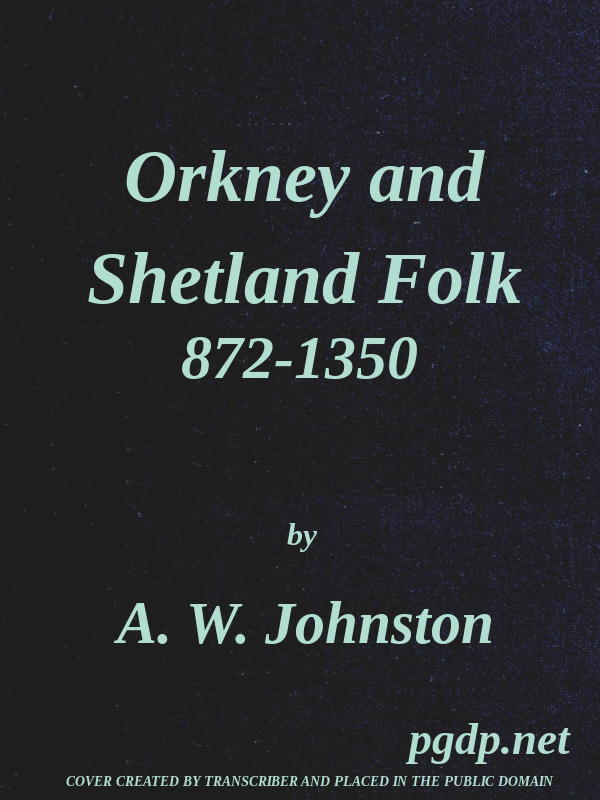
Orkney and Shetland Folk 872-1350
1914
Orkney and Shetland Folk 872-1350
1914
At the edge of the medieval world, where the North Sea hammered against treeless cliffs, a extraordinary society took shape. Orkney and Shetland became the northernmost jewel of the Norse empire, ruled by earls whose bloodlines stretched back to the legendary jarls of Norway. This book traces the turbulent centuries from 872, when Torf-Einarr carved out the first Norse earldom from the ruins of Pictish power, through the reign of Þorfinnr the Mighty, to the gradual Gaelic resurgence of the 14th century. Johnston reconstructs the intimate history of these islands not through dry chronology but through the lives of their people: Norse warlords intermarrying with Gael, thralls and freedmen forging new communities, saga-heroes and forgotten farmers alike caught in the sweep of empire. The result is a vivid portrait of cultural collision and fusion, showing how two peoples became one in a place where Viking longships and Celtic courts existed in uneasy balance. For anyone who has stood on the cliffs of Hoy or walked the sandy beaches of Shetland, this book breathes life into the stones and names that surround them.
Editions
X-Ray
First earl of the main line (875-910), half Norse and half thrall. Ugly, one-eyed but keen-sighted, with poetic genius possibly from Norse-Finn mixture.
The great earl (1014-1064), tallest and strongest of men with black hair and swarthy complexion. Nearly pure Gael in descent but a mighty warrior and ruler.
Saintly earl (1108-1116) known for his noble character and good governance. Murdered by his cousin Earl Hákon for political reasons.
Overbearing and jealous earl (1103-1122) who murdered his cousin St. Magnús to gain sole control of the earldom. Later became a good ruler.
About Orkney and Shetland Folk 872-1350
Chapter Summaries
- Introduction
- Johnston establishes his thesis about the mixed racial composition of the islands from 872-1350, explaining how Norse settlers intermarried with existing Picts and later Gaelic immigrants. Sets up the anthropological and historical framework for analysis.
- Early Settlement
- Describes how early Norse adventurers settled among the Pictish population, intermarrying due to lack of Norse women. Explains the stronger Pictish strain in Shetland due to less complete colonization.
- The Norse Earls
- Detailed analysis of the first Norse earls, starting with Torf-Einarr (half-thrall) through the increasingly Gaelic-influenced succession. Shows how only the first three earls were pure Norse.
Key Themes
- Racial and Cultural Mixing
- The central theme examining how Norse settlers intermarried with Picts, Irish, and Gaels, creating a mixed population. Johnston traces the genetic dilution of Norse blood through successive generations of earls.
- Political Succession and Power
- The struggle for control of the earldom through murder, marriage alliances, and political maneuvering. Shows how power shifted from Norse to Gaelic hands through strategic marriages and violence.
- Religious Transformation
- The transition from Norse paganism to Christianity, including the martyrdom of St. Magnús and the influence of Christian missionaries. Represents broader cultural change in the islands.
Characters
- Earl Torf-Einarr(major)
- First earl of the main line (875-910), half Norse and half thrall. Ugly, one-eyed but keen-sighted, with poetic genius possibly from Norse-Finn mixture.
- Earl Þorfinnr hinn ríki(protagonist)
- The great earl (1014-1064), tallest and strongest of men with black hair and swarthy complexion. Nearly pure Gael in descent but a mighty warrior and ruler.
- Earl St. Magnús(major)
- Saintly earl (1108-1116) known for his noble character and good governance. Murdered by his cousin Earl Hákon for political reasons.
- Earl Hákon Pálsson(antagonist)
- Overbearing and jealous earl (1103-1122) who murdered his cousin St. Magnús to gain sole control of the earldom. Later became a good ruler.
- Earl Rögnvaldr Kali hinn helgi(major)
- Accomplished earl (1136-1158) skilled in nine arts including chess, runes, and poetry. Light chestnut hair, well-built, and considered the most accomplished of earls.
- Sveinn Ásleifarson(major)
- Masterful and unfair warrior, described as the most masterful man in the West. Prophetic abilities, but known as a truce-breaker and oath-breaker.
Link to this book
Add a free, dofollow link to Lex on your blog, forum, syllabus, or reading list.

<a href="https://lex-books.com/book/orkney-and-shetland-folk-872-1350-2620b068-3d5d-4da1-9af1-766b0234d066"><img src="https://lex-books.com/badges/read-on-lex.svg" alt="Read Orkney and Shetland Folk 872-1350 by Alfred Wintle Johnston free on Lex" width="160" height="40"></a>[](https://lex-books.com/book/orkney-and-shetland-folk-872-1350-2620b068-3d5d-4da1-9af1-766b0234d066)[url=https://lex-books.com/book/orkney-and-shetland-folk-872-1350-2620b068-3d5d-4da1-9af1-766b0234d066][img]https://lex-books.com/badges/read-on-lex.svg[/img][/url]Read Orkney and Shetland Folk 872-1350 by Alfred Wintle Johnston free on Lex: https://lex-books.com/book/orkney-and-shetland-folk-872-1350-2620b068-3d5d-4da1-9af1-766b0234d066Cite this book
Reading this edition for a paper or guide? Copy a citation.
Johnston, Alfred Wintle. Orkney and Shetland Folk 872-1350. Lex, lex-books.com/book/orkney-and-shetland-folk-872-1350-2620b068-3d5d-4da1-9af1-766b0234d066.Johnston, A. W. (1914). Orkney and Shetland Folk 872-1350. Lex. https://lex-books.com/book/orkney-and-shetland-folk-872-1350-2620b068-3d5d-4da1-9af1-766b0234d066Johnston, Alfred Wintle. Orkney and Shetland Folk 872-1350. Lex. https://lex-books.com/book/orkney-and-shetland-folk-872-1350-2620b068-3d5d-4da1-9af1-766b0234d066.