Nervous Ills, Their Cause and Cure
1922
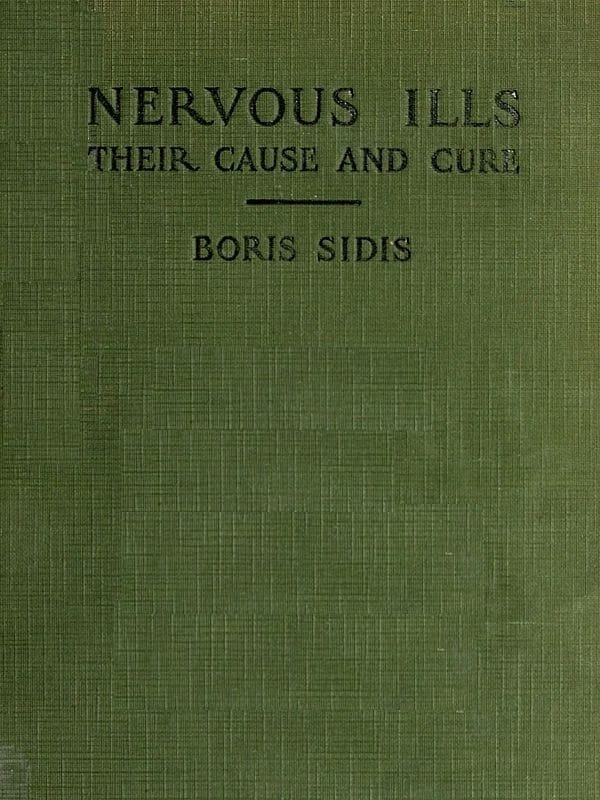
In 1922, a Ukrainian-American psychologist mounts a radical challenge to Freud. Boris Sidis believed the father of psychoanalysis had psychology all wrong, reducing the human mind to sexual obsessions when the real engine of neurosis was something far more primal: fear. This dense, argumentative work builds from a single premise, that self-preservation, not sexuality, is the foundational impulse of human behavior, and traces how fear, the body's ancient alarm system, spirals into the nervous illnesses that plague modern life. Sidis walks through case after case of patients whose fears have manifested as paralysis, organ dysfunction, and psychological collapse. He distinguishes between healthy fear (a necessary survival tool) and pathological fear (an engine of suffering). The result is an early, ambitious attempt at what we'd now call psychosomatic medicine, grounded in the conviction that understanding fear is the key to understanding the mind itself. Sidis critiques the psychoanalytic establishment directly, arguing that reducing psychology to sexual theories blinds us to the richer picture of human instinct. For readers interested in the history of psychology, this is a fascinating artifact, a voice from a moment when the discipline was still fighting over its own foundations. It also feels surprisingly contemporary. Sidis's focus on fear as the root of nervous illness anticipates much later research on anxiety, trauma, and the body-mind connection. Not a casual read, but a rewarding one for anyone curious about where psychological science came from and where it might have gone differently.
Editions
Link to this book
Add a free, dofollow link to Lex on your blog, forum, syllabus, or reading list.

<a href="https://lex-books.com/book/nervous-ills-their-cause-and-cure-0232b841-a7d5-4437-854d-0aa958a44065"><img src="https://lex-books.com/badges/read-on-lex.svg" alt="Read Nervous Ills, Their Cause and Cure by Boris Sidis free on Lex" width="160" height="40"></a>[](https://lex-books.com/book/nervous-ills-their-cause-and-cure-0232b841-a7d5-4437-854d-0aa958a44065)[url=https://lex-books.com/book/nervous-ills-their-cause-and-cure-0232b841-a7d5-4437-854d-0aa958a44065][img]https://lex-books.com/badges/read-on-lex.svg[/img][/url]Read Nervous Ills, Their Cause and Cure by Boris Sidis free on Lex: https://lex-books.com/book/nervous-ills-their-cause-and-cure-0232b841-a7d5-4437-854d-0aa958a44065Cite this book
Reading this edition for a paper or guide? Copy a citation.
Sidis, Boris. Nervous Ills, Their Cause and Cure. Lex, lex-books.com/book/nervous-ills-their-cause-and-cure-0232b841-a7d5-4437-854d-0aa958a44065.Sidis, B. (1922). Nervous Ills, Their Cause and Cure. Lex. https://lex-books.com/book/nervous-ills-their-cause-and-cure-0232b841-a7d5-4437-854d-0aa958a44065Sidis, Boris. Nervous Ills, Their Cause and Cure. Lex. https://lex-books.com/book/nervous-ills-their-cause-and-cure-0232b841-a7d5-4437-854d-0aa958a44065.