Naturalistic Photography for Students of the Art.
1889
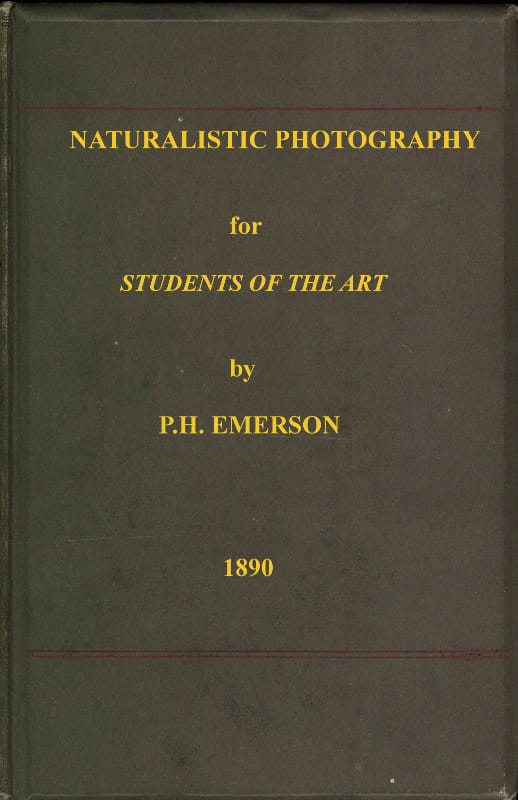
In 1889, P.H. Emerson sparked a revolution in how we think about photography. This isn't merely a technical manual. It is a passionate argument for seeing, for understanding that true photographic art emerges not from rigid rules but from profound engagement with nature. Emerson, a towering figure in photographic history, challenged the stiff academic conventions of his era and refused to let photography remain in painting's shadow. The book traces photography's brief but explosive trajectory, from its first miraculous demonstrations to its surprising applications in astronomy, biology, and forensic science. Emerson argues fiercely for photography's legitimacy as an art form while acknowledging its debt to both scientific understanding and artistic skill. He introduces naturalism not as a technique but as a philosophy: the photographer must become a student of nature, capturing impressions rather than constructions. More than a century later, this text endures because it asks a question every photographer still grapples with. What makes a photograph beautiful? Emerson's answer remains radical: abandon the rules, trust your eye, and let nature teach you its own grammar of light and form.
Editions
Link to this book
Add a free, dofollow link to Lex on your blog, forum, syllabus, or reading list.

<a href="https://lex-books.com/book/naturalistic-photography-for-students-of-the-art-16465226-f01b-47c7-a5f1-2117c8ebb978"><img src="https://lex-books.com/badges/read-on-lex.svg" alt="Read Naturalistic Photography for Students of the Art. by P. H. Emerson free on Lex" width="160" height="40"></a>[](https://lex-books.com/book/naturalistic-photography-for-students-of-the-art-16465226-f01b-47c7-a5f1-2117c8ebb978)[url=https://lex-books.com/book/naturalistic-photography-for-students-of-the-art-16465226-f01b-47c7-a5f1-2117c8ebb978][img]https://lex-books.com/badges/read-on-lex.svg[/img][/url]Read Naturalistic Photography for Students of the Art. by P. H. Emerson free on Lex: https://lex-books.com/book/naturalistic-photography-for-students-of-the-art-16465226-f01b-47c7-a5f1-2117c8ebb978Cite this book
Reading this edition for a paper or guide? Copy a citation.
Emerson, P. H.. Naturalistic Photography for Students of the Art.. Lex, lex-books.com/book/naturalistic-photography-for-students-of-the-art-16465226-f01b-47c7-a5f1-2117c8ebb978.Emerson, P. H. (1889). Naturalistic Photography for Students of the Art.. Lex. https://lex-books.com/book/naturalistic-photography-for-students-of-the-art-16465226-f01b-47c7-a5f1-2117c8ebb978Emerson, P. H.. Naturalistic Photography for Students of the Art.. Lex. https://lex-books.com/book/naturalistic-photography-for-students-of-the-art-16465226-f01b-47c7-a5f1-2117c8ebb978.