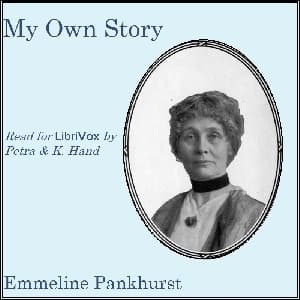
My Own Story
Emmeline Pankhurst did not ask for permission. She demanded it, and when the doors of Parliament remained closed to women, she broke them down. My Own Story is her fierce, unsparing account of building a movement that would shake the foundations of British democracy. From her childhood in a family that had fought abolition to her founding of the Women's Social and Political Union in 1903, Pankhurst traces the arc of her radicalization: the polite petitions that went unanswered, the speeches that fell on deaf ears, and the moment she realized that the only language the state understood was force. She recounts her seven arrests, the horror of prison solitary confinement, and the brutal forced feedings that followed her hunger strikes. But this is not merely a chronicle of suffering. It is a manifesto from the front lines, arguing that militancy was not violence but necessity, that imprisonment was not defeat but platform. Written as World War I erupted, the memoir also captures Pankhurst's controversial decision to suspend the suffrage fight, a pause she justified as patriotic duty. The result is an electrifying document from a woman who refused to be invisible, whose words still carry the weight of a century-old battle half-won.
Editions
X-Ray
“Men make the moral code and they expect women to accept it. They have decided that it is entirely right and proper for men to fight for their liberties and their rights, but that it is not right and proper for women to fight for theirs.””
— Emmeline Pankhurst
“Governments have always tried to crush reform movements, to destroy ideas, to kill the thing that cannot die. Without regard to history, which shows that no Government have ever succeeded in doing this, they go on trying in the old, senseless way.””
— Emmeline Pankhurst
“I had to get a close-hand view of the misery and unhappiness of a man made world, before I reached the point where I could successfully revolt against it.””
— Emmeline Pankhurst
“I thought I had been a suffragist before I became a Poor Law Guardian, but now I began to think about the vote in women's hands not only as a right but as a desperate necessity.””
— Emmeline Pankhurst
“It is obvious to you that the struggle will be an unequal one, but I shall make it - I shall make it as long as I have an ounce of strength left in me, or any life left in me.””
— Emmeline Pankhurst
“The militancy of men, through all the centuries, has drenched the world with blood, and for these deeds of horror and destruction men have been rewarded with monuments, with great songs and epics.””
— Emmeline Pankhurst
“I do not remember a time when I could not read, nor any time when reading was not a joy and a solace.””
— Emmeline Pankhurst
“Every man with a vote was considered a foe to woman suffrage unless he was prepared to be actively a friend.””
— Emmeline Pankhurst
“Justice and judgement lie often a world apart."~ Emmeline Pankhurst””
— Emmeline Pankhurst
Link to this book
Add a free, dofollow link to Lex on your blog, forum, syllabus, or reading list.

<a href="https://lex-books.com/book/my-own-story-e4fea60d-5d0e-43ab-80e2-02a7c0a28211"><img src="https://lex-books.com/badges/read-on-lex.svg" alt="Read My Own Story by Emmeline Pankhurst free on Lex" width="160" height="40"></a>[](https://lex-books.com/book/my-own-story-e4fea60d-5d0e-43ab-80e2-02a7c0a28211)[url=https://lex-books.com/book/my-own-story-e4fea60d-5d0e-43ab-80e2-02a7c0a28211][img]https://lex-books.com/badges/read-on-lex.svg[/img][/url]Read My Own Story by Emmeline Pankhurst free on Lex: https://lex-books.com/book/my-own-story-e4fea60d-5d0e-43ab-80e2-02a7c0a28211Cite this book
Reading this edition for a paper or guide? Copy a citation.
Pankhurst, Emmeline. My Own Story. Lex, lex-books.com/book/my-own-story-e4fea60d-5d0e-43ab-80e2-02a7c0a28211.Pankhurst, E. (n.d.). My Own Story. Lex. https://lex-books.com/book/my-own-story-e4fea60d-5d0e-43ab-80e2-02a7c0a28211Pankhurst, Emmeline. My Own Story. Lex. https://lex-books.com/book/my-own-story-e4fea60d-5d0e-43ab-80e2-02a7c0a28211.