Mediæval London
1901
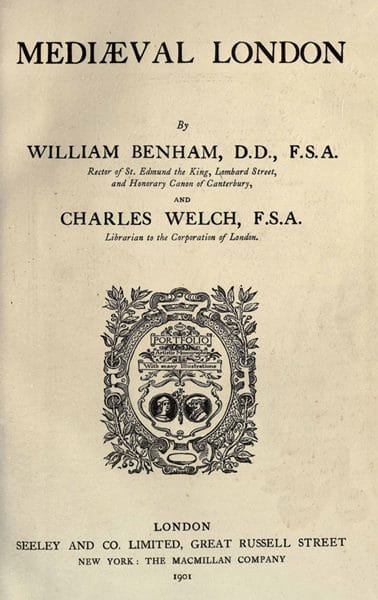
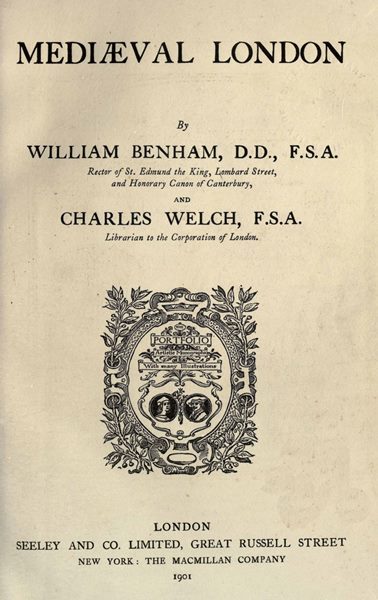
Mediæval London
1901
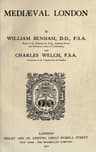
Here is a book that lets you walk the medieval streets of London as if you lived there yourself. Benham reconstructs the city from Roman ruins to the flourishing medieval metropolis, tracing how a settlement dismissed as a backwater rose to become England's commercial heart. He guides you through the winding lanes where merchants bargained, monks prayed in newly founded abbeys, and kings held court in palaces that still stand today. You'll learn why Westminster outgrew the City, how the Thames became a highway of trade, and what daily life felt like for everyone from the bishop to the apprentice. Written in 1901 with the confidence of an era that still remembered its medieval roots, this is both a scholarly portrait and a love letter to a city that has continuously reinvented itself for a thousand years. For anyone who wants to understand London, this is where the story begins.
Editions
X-Ray
Co-author and rector of St. Edmund the King, Lombard Street. A scholarly clergyman who provides historical expertise on medieval London's religious and civic development.
Co-author and Librarian to the Corporation of London. Provides institutional knowledge and access to civic records for the historical analysis.
Saxon king who restored London's prosperity after Danish invasions and made it the chief city of his dominion. Marks the beginning of Medieval London.
Norman king who brought London's halcyon days and assured its greatness. Built the White Tower and granted important charters to the city.
About Mediæval London
Chapter Summaries
- 1
- Establishes the historical limits of Medieval London from King Alfred to the Stuarts, tracing the city's development from Roman decline through Saxon revival to Norman prosperity. Describes the physical layout including St. Paul's Cathedral, Cheapside market, city walls, and religious houses.
- 2
- Details the governance of medieval London through Guildhall, the mayoralty, aldermen, and guild system. Describes civic ceremonies, punishments for trade offenses, and the evolution of the Livery Companies from religious fraternities to trade organizations.
- 3
- Explores London Bridge as the city's crucial link, describing its houses, shops, and role in commerce. Covers Southwark's development, including its inns, prisons, theaters, and the jurisdiction disputes between city and borough.
Key Themes
- Urban Evolution and Continuity
- The book traces London's continuous development from Roman Londinium through Saxon renewal to Norman grandeur, showing how each era built upon previous foundations while adapting to new circumstances.
- Religious Authority and Civic Power
- A central tension between ecclesiastical control through monasteries, cathedral chapters, and episcopal authority versus the growing independence of civic institutions like guilds, mayoralty, and common council.
- Commerce and Urban Growth
- London's prosperity consistently derived from trade, with the Thames as highway, markets like Cheapside as centers, and merchant guilds as organizing principles of civic life.
Characters
- William Benham(major)
- Co-author and rector of St. Edmund the King, Lombard Street. A scholarly clergyman who provides historical expertise on medieval London's religious and civic development.
- Charles Welch(major)
- Co-author and Librarian to the Corporation of London. Provides institutional knowledge and access to civic records for the historical analysis.
- King Alfred(major)
- Saxon king who restored London's prosperity after Danish invasions and made it the chief city of his dominion. Marks the beginning of Medieval London.
- William the Conqueror(major)
- Norman king who brought London's halcyon days and assured its greatness. Built the White Tower and granted important charters to the city.
- Mellitus(major)
- First Bishop of London (604 AD), appointed by St. Augustine. Built the first cathedral but was forced to flee due to pagan relapse.
- St. Erkenwald(major)
- Fourth Bishop of London (675-693), canonized saint whose shrine drew pilgrims to St. Paul's. Founded monasteries at Chertsey and Barking.
Link to this book
Add a free, dofollow link to Lex on your blog, forum, syllabus, or reading list.

<a href="https://lex-books.com/book/medi-val-london-4f01bc5d-bd0b-4564-9570-44252faaf41e"><img src="https://lex-books.com/badges/read-on-lex.svg" alt="Read Mediæval London by William Benham free on Lex" width="160" height="40"></a>[](https://lex-books.com/book/medi-val-london-4f01bc5d-bd0b-4564-9570-44252faaf41e)[url=https://lex-books.com/book/medi-val-london-4f01bc5d-bd0b-4564-9570-44252faaf41e][img]https://lex-books.com/badges/read-on-lex.svg[/img][/url]Read Mediæval London by William Benham free on Lex: https://lex-books.com/book/medi-val-london-4f01bc5d-bd0b-4564-9570-44252faaf41eCite this book
Reading this edition for a paper or guide? Copy a citation.
Benham, William. Mediæval London. Lex, lex-books.com/book/medi-val-london-4f01bc5d-bd0b-4564-9570-44252faaf41e.Benham, W. (1901). Mediæval London. Lex. https://lex-books.com/book/medi-val-london-4f01bc5d-bd0b-4564-9570-44252faaf41eBenham, William. Mediæval London. Lex. https://lex-books.com/book/medi-val-london-4f01bc5d-bd0b-4564-9570-44252faaf41e.