Mary Wollstonecraft
1788
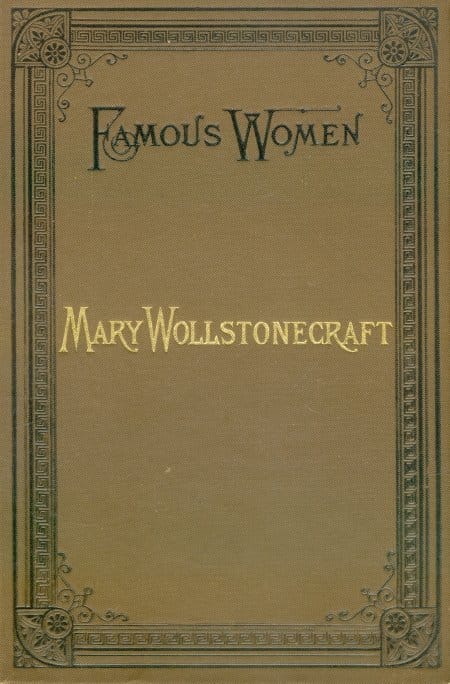
Elizabeth Robins Pennell's 1888 biography captures a woman who refused to be contained. Mary Wollstonecraft - philosopher, novelist, and the first great English feminist - spent her short life dismantling the prejudices her era considered sacred. Born into a household of cruelty and chaos, she forged her own education, her own income, and her own ideas, culminating in A Vindication of the Rights of Woman (1792), a radical treatise that demanded women be treated not as decorative lackeys but as rational beings entitled to the same education as men. Pennell traces the threads of Wollstonecraft's turbulent existence: the difficult childhood, the friendships that shaped her thought, the loves that scandalized a world not ready for her independence, and the literary career that ensured her ideas would outlast the century that dismissed her. The biography also chronicles the tragic irony of Wollstonecraft's legacy: her husband's memoir of her life revealed her unconventional choices, and for nearly a century afterward, her reputation lay in ruins even as her arguments grew impossible to ignore. This is the story of a woman who lived with ferocious honesty in an era that punished honesty in women - and whose daughter would go on to imagine monsters.
Editions
X-Ray
“I do not wish them [women] to have power over men; but over themselves.””
— Elizabeth Robins Pennell
“My own sex, I hope, will excuse me, if I treat them like rational creatures, instead of flattering their graces, and viewing them as if they were in a state of perpetual childhood, unable to stand alone.””
— Elizabeth Robins Pennell
“[I]f we revert to history, we shall find that the women who have distinguished themselves have neither been the most beautiful nor the most gentle of their sex.””
— Elizabeth Robins Pennell
“Taught from their infancy that beauty is woman's sceptre, the mind shapes itself to the body, and roaming round its gilt cage, only seeks to adorn its prison.””
— Elizabeth Robins Pennell
“It is vain to expect virtue from women till they are in some degree independent of men.””
— Elizabeth Robins Pennell
“Strengthen the female mind by enlarging it, and there will be an end to blind obedience.””
— Elizabeth Robins Pennell
“I love man as my fellow; but his scepter, real, or usurped, extends not to me, unless the reason of an individual demands my homage; and even then the submission is to reason, and not to man.””
— Elizabeth Robins Pennell
“It is time to effect a revolution in female manners - time to restore to them their lost dignity - and make them, as a part of the human species, labour by reforming themselves to reform the world. It is time to separate unchangeable morals from local manners.””
— Elizabeth Robins Pennell
“I earnestly wish to point out in what true dignity and human happiness consists. I wish to persuade women to endeavor to acquire strength, both of mind and body, and to convince them that the soft phrases, susceptibility of heart, delicacy of sentiment, and refinement of taste, are almost synonymous with epithets of weakness, and that those beings are only the objects of pity, and that kind of love which has been termed its sister, will soon become objects of contempt.””
— Elizabeth Robins Pennell
Link to this book
Add a free, dofollow link to Lex on your blog, forum, syllabus, or reading list.

<a href="https://lex-books.com/book/mary-wollstonecraft-76ffc965-d80d-46ad-a5a7-2b5b89e2b352"><img src="https://lex-books.com/badges/read-on-lex.svg" alt="Read Mary Wollstonecraft by Elizabeth Robins Pennell free on Lex" width="160" height="40"></a>[](https://lex-books.com/book/mary-wollstonecraft-76ffc965-d80d-46ad-a5a7-2b5b89e2b352)[url=https://lex-books.com/book/mary-wollstonecraft-76ffc965-d80d-46ad-a5a7-2b5b89e2b352][img]https://lex-books.com/badges/read-on-lex.svg[/img][/url]Read Mary Wollstonecraft by Elizabeth Robins Pennell free on Lex: https://lex-books.com/book/mary-wollstonecraft-76ffc965-d80d-46ad-a5a7-2b5b89e2b352Cite this book
Reading this edition for a paper or guide? Copy a citation.
Pennell, Elizabeth Robins. Mary Wollstonecraft. Lex, lex-books.com/book/mary-wollstonecraft-76ffc965-d80d-46ad-a5a7-2b5b89e2b352.Pennell, E. R. (1788). Mary Wollstonecraft. Lex. https://lex-books.com/book/mary-wollstonecraft-76ffc965-d80d-46ad-a5a7-2b5b89e2b352Pennell, Elizabeth Robins. Mary Wollstonecraft. Lex. https://lex-books.com/book/mary-wollstonecraft-76ffc965-d80d-46ad-a5a7-2b5b89e2b352.