Letters from England, Volume 1 (of 3)
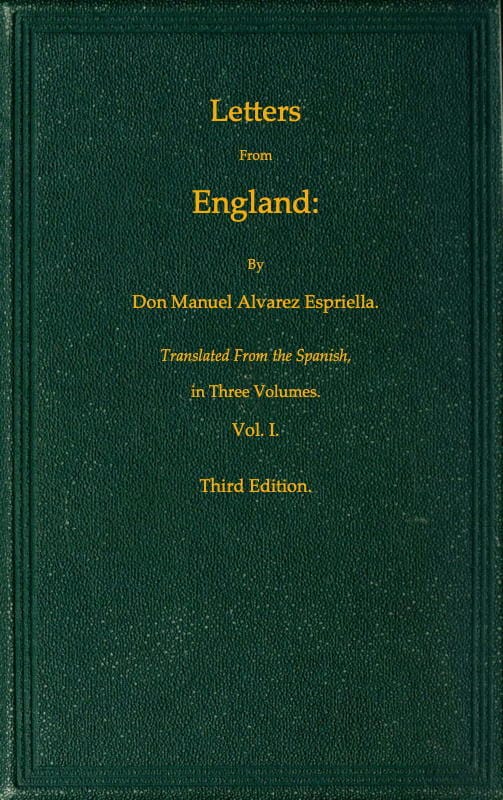
In 1807, the English poet Robert Southey invented a fictional Spanish traveler named Don Manuel Alvarez Espriella and let him loose on England. The result is a brilliant piece of literary disguise: every English custom, landscape, and social habit is made strange again by foreign eyes. Don Manuel marvels at Protestant church services, puzzles over English politeness, and falls headlong in love with the Lake District's mountains. He comments on politics, poverty, and the price of bread with the sharpness only a newcomer can muster. Southey uses his mask to say things about English society that would sound like mere opinion from an English mouth but read like revelation from a Spanish one. Two centuries later, the letters endure because they are not really about 1807 at all. They are about how we see, what we overlook, and how an outsider's gaze can make the familiar miraculous. This is travel writing as defamiliarization art, wrapped in the epistolary form and powered by genuine literary cunning.
Editions
Link to this book
Add a free, dofollow link to Lex on your blog, forum, syllabus, or reading list.

<a href="https://lex-books.com/book/letters-from-england-volume-1-of-3-2324676b-d468-4213-b5f1-118ec0a29652"><img src="https://lex-books.com/badges/read-on-lex.svg" alt="Read Letters from England, Volume 1 (of 3) by Robert Southey free on Lex" width="160" height="40"></a>[](https://lex-books.com/book/letters-from-england-volume-1-of-3-2324676b-d468-4213-b5f1-118ec0a29652)[url=https://lex-books.com/book/letters-from-england-volume-1-of-3-2324676b-d468-4213-b5f1-118ec0a29652][img]https://lex-books.com/badges/read-on-lex.svg[/img][/url]Read Letters from England, Volume 1 (of 3) by Robert Southey free on Lex: https://lex-books.com/book/letters-from-england-volume-1-of-3-2324676b-d468-4213-b5f1-118ec0a29652Cite this book
Reading this edition for a paper or guide? Copy a citation.
Southey, Robert. Letters from England, Volume 1 (of 3). Lex, lex-books.com/book/letters-from-england-volume-1-of-3-2324676b-d468-4213-b5f1-118ec0a29652.Southey, R. (n.d.). Letters from England, Volume 1 (of 3). Lex. https://lex-books.com/book/letters-from-england-volume-1-of-3-2324676b-d468-4213-b5f1-118ec0a29652Southey, Robert. Letters from England, Volume 1 (of 3). Lex. https://lex-books.com/book/letters-from-england-volume-1-of-3-2324676b-d468-4213-b5f1-118ec0a29652.