Les Évangiles Des Quenouilles
1855
Les Évangiles Des Quenouilles
1855
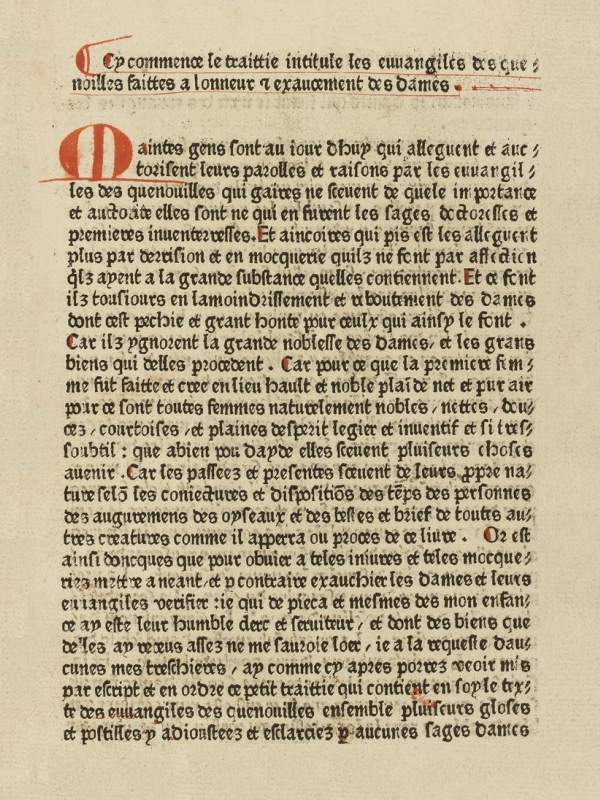
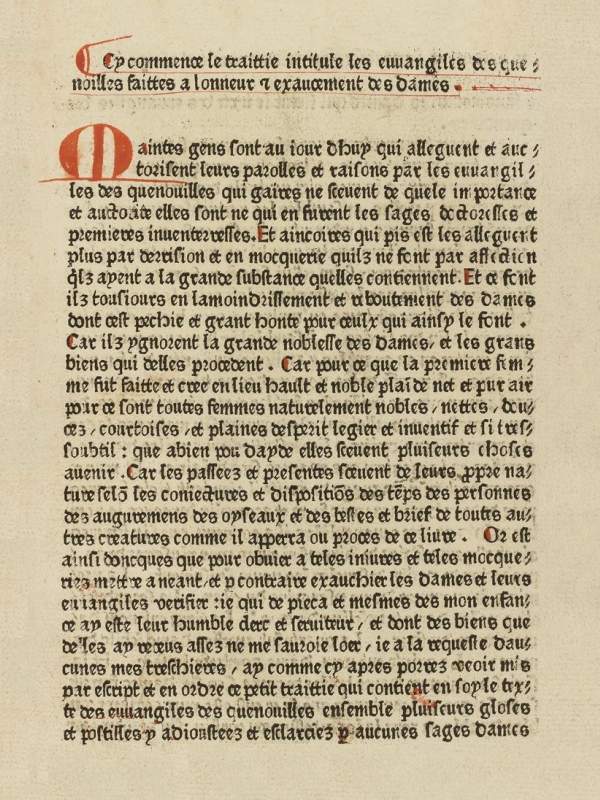
A collection of literary works probably written in the late Middle Ages. The text serves as a compendium of sayings, advice, and reflections presented in a whimsical and often humorous format, focusing on the wisdom and experiences of women as they navigate love, marriage, and domestic life. The book gives voice to various female characters, likely representing the collective experiences of women in that era. At the start of the narrative, the author recounts a gathering of wise women who have come together to discuss and record their insights—what they call the ''euvangiles des quenouilles.'' The lively exchange covers numerous chapters, filled with practical wisdom, social commentary, and mystical beliefs relating to love, family life, and various aspects of human behavior. The women share personal anecdotes, humorous observations, and folkloric traditions, creating a tapestry of knowledge that reflects both their unique perspectives and broader societal norms. These discussions illustrate their understanding of gender dynamics and the importance of female solidarity in a patriarchal world.
Editions
X-Ray
The narrator and scribe who records the women's gospels. He is reluctantly drawn into documenting their evening gatherings and serves as their secretary throughout the week.
The first and eldest of the six matrons who presides on Monday. She is described as the most ancient and leads the group in establishing their project.
An ancient damsel of about sixty years who presides on Tuesday. She is tall, thin, and knowledgeable in geomancy, having lived with a lady who practiced divination.
Presides on Wednesday. In her youth she was a merchant of luxury retail, later keeping shop wholesale in Bruges. She studied at the College of Glatigny in Paris for seven years.
About Les Évangiles Des Quenouilles
Chapter Summaries
- Prologue
- The narrator explains how six wise matrons were chosen to create women's gospels, paralleling the four male evangelists. He introduces the six women and explains how he was recruited to serve as their scribe.
- Monday
- Dame Ysengrine presents 26 chapters covering marital relations, pregnancy omens, and domestic wisdom. Topics include husbands who waste wives' money, predicting baby gender, and various superstitions about food and behavior during pregnancy.
- Tuesday
- Dame Transeline shares wisdom about love potions, household management, and omens. She covers topics like making husbands faithful, interpreting animal behavior, and various protective charms and superstitions.
Key Themes
- Gender and Authority
- The work satirizes the battle between male and female claims to wisdom and authority. The women explicitly state they are creating their gospels because men constantly write defamatory works against their sex.
- Folk Wisdom vs. Official Knowledge
- The text contrasts traditional women's knowledge (herbal remedies, superstitions, domestic wisdom) with official male learning (theology, medicine, law), questioning the boundaries between wisdom and foolishness.
- Marriage and Domestic Relations
- Many chapters focus on marital dynamics, offering advice on controlling husbands, predicting marital happiness, and managing household relationships, reflecting medieval concerns about domestic power.
Characters
- Maistre Fouquart de Cambray(protagonist)
- The narrator and scribe who records the women's gospels. He is reluctantly drawn into documenting their evening gatherings and serves as their secretary throughout the week.
- Dame Ysengrine du Glay(major)
- The first and eldest of the six matrons who presides on Monday. She is described as the most ancient and leads the group in establishing their project.
- Dame Transeline du Croq(major)
- An ancient damsel of about sixty years who presides on Tuesday. She is tall, thin, and knowledgeable in geomancy, having lived with a lady who practiced divination.
- Dame Abonde du Four(major)
- Presides on Wednesday. In her youth she was a merchant of luxury retail, later keeping shop wholesale in Bruges. She studied at the College of Glatigny in Paris for seven years.
- Dame Sebile des Marez(major)
- The fourth matron who presides on Thursday. She is well-versed in various folk beliefs and superstitions, particularly regarding marriage and childbirth.
- Dame Gomberde la Faee(major)
- Presides on Friday. She claims to be a gentlewoman, is skilled in finding lost objects and arranging secret affairs. She has been married seven times and would consider an eighth.
Link to this book
Add a free, dofollow link to Lex on your blog, forum, syllabus, or reading list.

<a href="https://lex-books.com/book/les-vangiles-des-quenouilles-8c16961e-088c-456c-8c04-3eb8ea6a4490"><img src="https://lex-books.com/badges/read-on-lex.svg" alt="Read Les Évangiles Des Quenouilles by de Cambray, maistre Fouquart free on Lex" width="160" height="40"></a>[](https://lex-books.com/book/les-vangiles-des-quenouilles-8c16961e-088c-456c-8c04-3eb8ea6a4490)[url=https://lex-books.com/book/les-vangiles-des-quenouilles-8c16961e-088c-456c-8c04-3eb8ea6a4490][img]https://lex-books.com/badges/read-on-lex.svg[/img][/url]Read Les Évangiles Des Quenouilles by de Cambray, maistre Fouquart free on Lex: https://lex-books.com/book/les-vangiles-des-quenouilles-8c16961e-088c-456c-8c04-3eb8ea6a4490Cite this book
Reading this edition for a paper or guide? Copy a citation.
de Cambray, maistre Fouquart. Les Évangiles Des Quenouilles. Lex, lex-books.com/book/les-vangiles-des-quenouilles-8c16961e-088c-456c-8c04-3eb8ea6a4490.de Cambray, M. F. (1855). Les Évangiles Des Quenouilles. Lex. https://lex-books.com/book/les-vangiles-des-quenouilles-8c16961e-088c-456c-8c04-3eb8ea6a4490de Cambray, maistre Fouquart. Les Évangiles Des Quenouilles. Lex. https://lex-books.com/book/les-vangiles-des-quenouilles-8c16961e-088c-456c-8c04-3eb8ea6a4490.