Legends of Babylon and Egypt in Relation to Hebrew Tradition
1918
Legends of Babylon and Egypt in Relation to Hebrew Tradition
1918
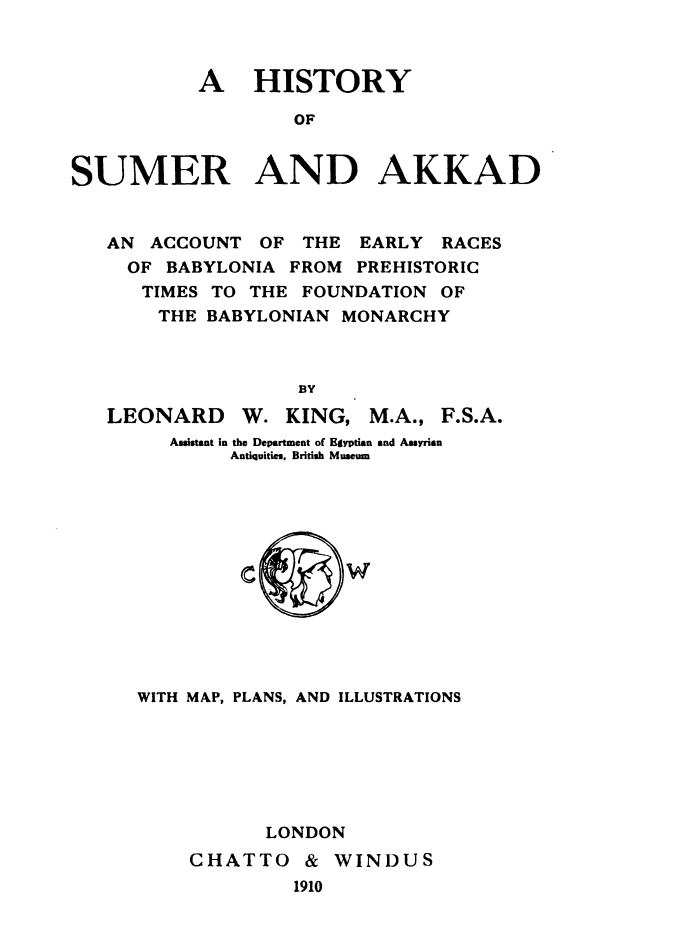
The discovery of ancient Sumerian tablets revolutionized biblical scholarship. When archaeologists unearthed Creation and Flood narratives predating Genesis by centuries, they forced a radical question: were the foundational stories of the Hebrew Bible original, or were they inherited from the great civilizations of Mesopotamia? L.W. King, drawing on groundbreaking excavations in Babylonia during World War I, traces these connections with meticulous precision and startling implications. This volume examines the striking parallels between Babylonian, Egyptian, and Hebrew traditions, stories of creation, cosmic order, and catastrophic deluge that echo across cultures. King compares the Epic of Gilgamesh with Genesis, the Enuma Elish with the Creation account, and traces how these ancient narratives might have flowed between civilizations through conquest, trade, and cultural exchange. The evidence from newly deciphered Sumerian texts demands a reevaluation of where these stories truly originated. For readers curious about the roots of biblical mythology and the ancient world that produced it, this early work of comparative scholarship remains essential. It captures a pivotal moment when archaeology first illuminated the deep interconnections of Near Eastern civilizations, and raised questions about cultural transmission that still divide scholars today.
Editions
X-Ray
“The description of Ziusudu has also great interest in furnishing us with a close parallel to the piety of Noah in the Hebrew Versions. For in the Gilgamesh Epic and in Berossus this feature of the story is completely absent. We are there given no reason why Ut-napishtim was selected by Ea, nor Xisuthros by Kronos. For all that those versions tell us, the favour of each deity might have been conferred arbitrarily, and not in recognition of, or in response to, any particular quality or action on the part of its recipient. The Sumerian Version now restores the original setting of the story and incidentally proves that, in this particular, the Hebrew Versions have not embroidered a simpler narrative for the purpose of edification, but have faithfully reproduced an original strand of the tradition.””
— L. W. King
“In the first two dynasties, which had their seats at the cities of Kish and Erech, we see gods mingling with men upon the earth. Tammuz, the god of vegetation, for whose annual death Ezekiel saw women weeping beside the Temple at Jerusalem, is here an earthly monarch. He appears to be described as "a hunter", a phrase which recalls the death of Adonis in Greek mythology. According to our Sumerian text he reigned in Erech for a hundred years.””
— L. W. King
“We shall see that the problems we have to face concern the possible influence of Babylon, rather than of Egypt, upon Hebrew tradition. And one last example, drawn from the later period, will serve to demonstrate how Babylonian influence penetrated the ancient world and has even left some trace upon modern civilization. It is a fact, though one perhaps not generally realized, that the twelve divisions on the dials of our clocks and watches have a Babylonian, and ultimately a Sumerian, ancestry. For why is it we divide the day into twenty-four hours? We have a decimal system of reckoning, we count by tens; why then should we divide the day and night into twelve hours each, instead of into ten or some multiple of ten? The reason is that the Babylonians divided the day into twelve double-hours; and the Greeks took over their ancient system of time-division along with their knowledge of astronomy and passed it on to us.””
— L. W. King
Link to this book
Add a free, dofollow link to Lex on your blog, forum, syllabus, or reading list.

<a href="https://lex-books.com/book/legends-of-babylon-and-egypt-in-relation-to-hebrew-tradition-fc09e42f-1b43-4771-95d5-356ed6186bf2"><img src="https://lex-books.com/badges/read-on-lex.svg" alt="Read Legends of Babylon and Egypt in Relation to Hebrew Tradition by L. W. King free on Lex" width="160" height="40"></a>[](https://lex-books.com/book/legends-of-babylon-and-egypt-in-relation-to-hebrew-tradition-fc09e42f-1b43-4771-95d5-356ed6186bf2)[url=https://lex-books.com/book/legends-of-babylon-and-egypt-in-relation-to-hebrew-tradition-fc09e42f-1b43-4771-95d5-356ed6186bf2][img]https://lex-books.com/badges/read-on-lex.svg[/img][/url]Read Legends of Babylon and Egypt in Relation to Hebrew Tradition by L. W. King free on Lex: https://lex-books.com/book/legends-of-babylon-and-egypt-in-relation-to-hebrew-tradition-fc09e42f-1b43-4771-95d5-356ed6186bf2Cite this book
Reading this edition for a paper or guide? Copy a citation.
King, L. W.. Legends of Babylon and Egypt in Relation to Hebrew Tradition. Lex, lex-books.com/book/legends-of-babylon-and-egypt-in-relation-to-hebrew-tradition-fc09e42f-1b43-4771-95d5-356ed6186bf2.King, L. W. (1918). Legends of Babylon and Egypt in Relation to Hebrew Tradition. Lex. https://lex-books.com/book/legends-of-babylon-and-egypt-in-relation-to-hebrew-tradition-fc09e42f-1b43-4771-95d5-356ed6186bf2King, L. W.. Legends of Babylon and Egypt in Relation to Hebrew Tradition. Lex. https://lex-books.com/book/legends-of-babylon-and-egypt-in-relation-to-hebrew-tradition-fc09e42f-1b43-4771-95d5-356ed6186bf2.