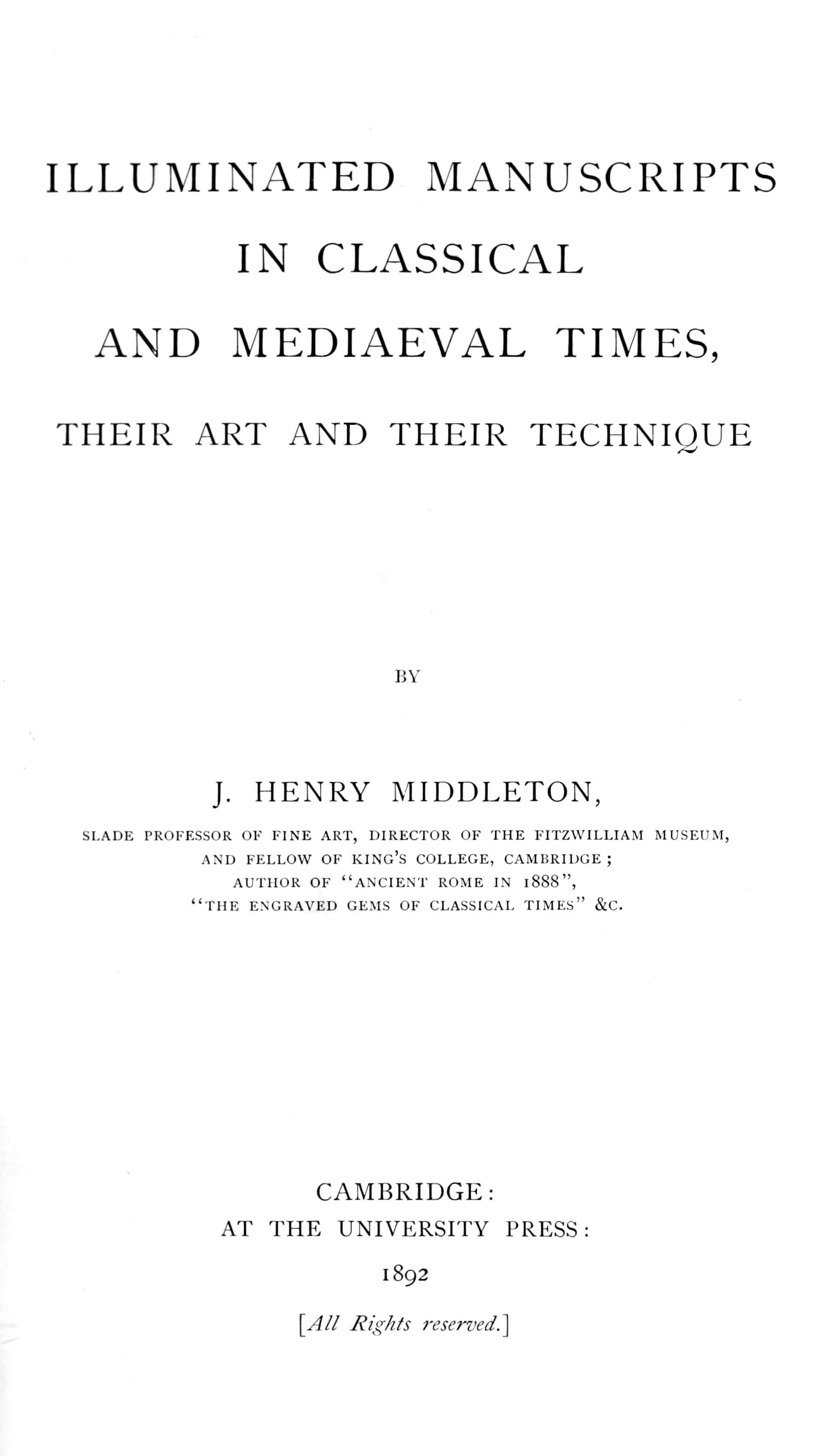
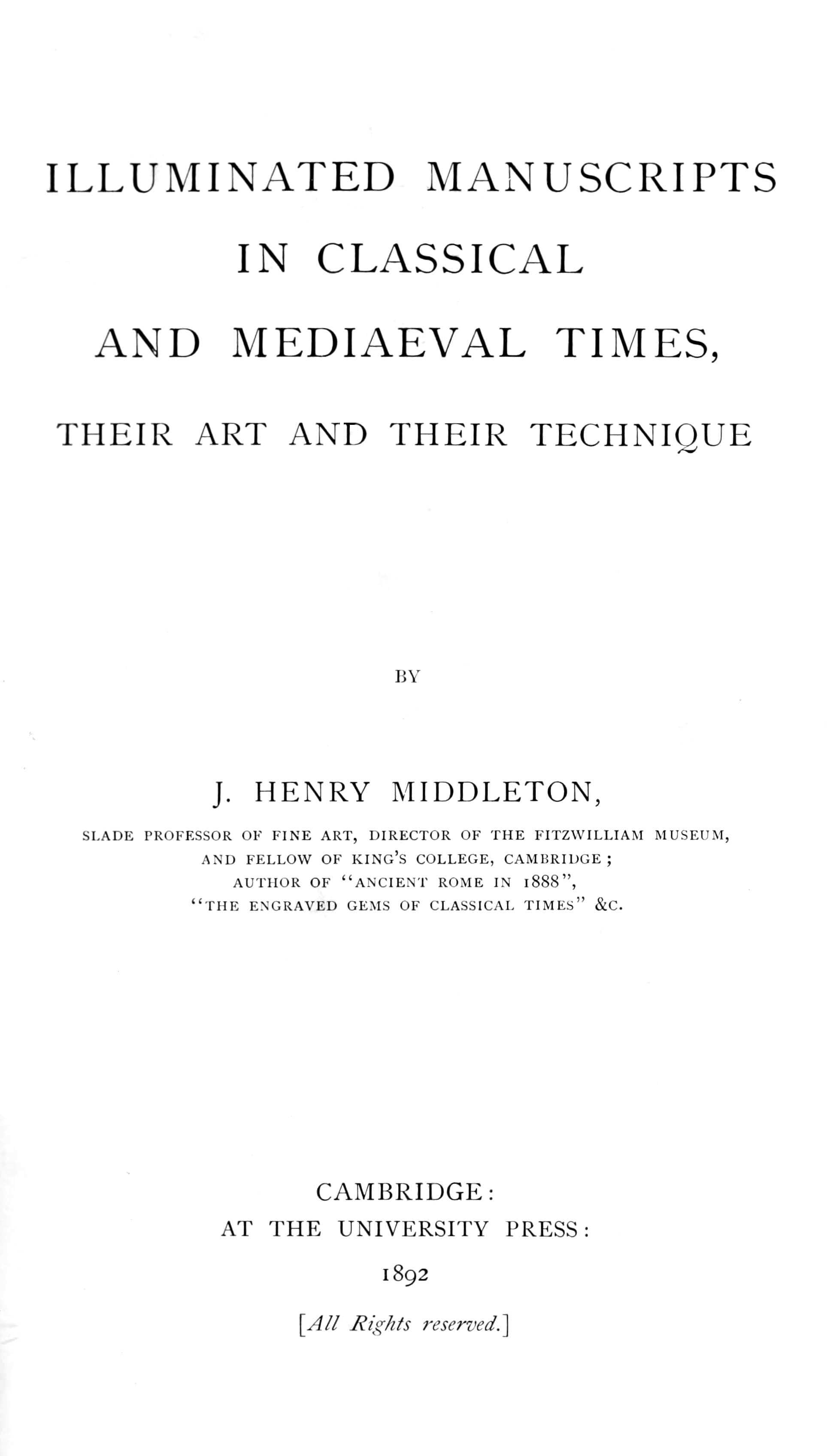
Illuminated Manuscripts in Classical and Mediaeval Times, Their Art and Their Technique
1892
Illuminated Manuscripts in Classical and Mediaeval Times, Their Art and Their Technique
1892
A historical account written in the late 19th century. This work explores the evolution and artistry of illuminated manuscripts, tracing their development from classical antiquity through the Middle Ages. The book focuses on the various methods, materials, and techniques employed in manuscript creation, highlighting the significance of illumination as an art form. The opening of the work establishes the author's intention to provide a comprehensive overview of manuscript writing and decoration from the earliest times to the sixteenth century, marking the transition from illuminated texts to printed works. Middleton emphasizes the survival of classical techniques throughout the mediaeval period and introduces the reader to the types of manuscripts, such as those inscribed on metal and wax tablets, which set the stage for the ensuing exploration of decorated texts. The early chapters delve into specific forms of writing, such as the use of a stylus and pen, and hint at the intricate process and care taken by scribes and illuminators, setting up a rich narrative of the artistry and craftsmanship involved in these historical texts.
Editions
X-Ray
The author and narrator, a scholar and professor who serves as Slade Professor of Fine Art and Director of the Fitzwilliam Museum at Cambridge. He provides expert analysis and historical context throughout the work.
A famous English scholar and manuscript writer who aided Charles the Great in reviving manuscript illumination. He was Abbot of St Martin at Tours and created the Anglo-Carolingian school.
Emperor of the West who fostered manuscript illumination and created the Carolingian revival. He patronized scribes and established important scriptoria.
Irish monk who founded monasteries and was credited with writing 300 manuscripts by hand. Associated with the Book of Kells and Book of Durrow.
About Illuminated Manuscripts in Classical and Mediaeval Times, Their Art and Their Technique
Chapter Summaries
- I
- Middleton begins with ancient writing methods using stylus on wax tablets, metal plates, and other materials. He traces the survival of classical techniques into medieval times and describes various forms of ancient writing materials including the famous Petelia tablet.
- II
- The chapter covers papyrus and parchment manuscripts, describing Egyptian Books of the Dead, Greek and Roman libraries, and the technical processes of making papyrus paper. It details the economics of ancient book production and the role of slave scribes.
- III
- This chapter examines the earliest illuminated manuscripts, including the Ambrosian Iliad and Vatican Virgil. Middleton discusses how classical illumination differed from medieval methods and analyzes the artistic quality of surviving examples.
Key Themes
- Sacred vs. Secular Art
- Middleton contrasts the devotional, patient work of monastic scribes with the commercial, hurried production of secular illuminators. The transition from monastery to guild represents a fundamental shift in artistic purpose and quality.
- Cultural Transmission and Influence
- The work traces how artistic styles and techniques spread across Europe through monastic networks, royal patronage, and cultural exchange. Celtic, Byzantine, Classical, and Oriental influences merge and evolve throughout different periods.
- Technological Change and Artistic Decline
- The invention of printing represents both progress and loss—while books became more accessible, the exquisite art of hand illumination gradually died. Middleton mourns this transition from handcraft to mechanical reproduction.
Characters
- J. Henry Middleton(protagonist)
- The author and narrator, a scholar and professor who serves as Slade Professor of Fine Art and Director of the Fitzwilliam Museum at Cambridge. He provides expert analysis and historical context throughout the work.
- Alcuin of York(major)
- A famous English scholar and manuscript writer who aided Charles the Great in reviving manuscript illumination. He was Abbot of St Martin at Tours and created the Anglo-Carolingian school.
- Charles the Great (Charlemagne)(major)
- Emperor of the West who fostered manuscript illumination and created the Carolingian revival. He patronized scribes and established important scriptoria.
- Saint Columba(major)
- Irish monk who founded monasteries and was credited with writing 300 manuscripts by hand. Associated with the Book of Kells and Book of Durrow.
- Saint Cuthbert(major)
- Northumbrian saint whose illuminated Gospels became one of the most famous Celtic manuscripts. The book survived Viking raids and many adventures.
- Don Silvestro(major)
- Camaldolese monk of 14th century Florence who created magnificent illuminated choir-books. His hand was preserved as a relic after his death due to his artistic skill.
Link to this book
Add a free, dofollow link to Lex on your blog, forum, syllabus, or reading list.

<a href="https://lex-books.com/book/illuminated-manuscripts-in-classical-and-mediaeval-times-their-art-and-their-tec-2105b097-4223-489b-8e69-36ccb5088b57"><img src="https://lex-books.com/badges/read-on-lex.svg" alt="Read Illuminated Manuscripts in Classical and Mediaeval Times, Their Art and Their Technique by J. H. Middleton free on Lex" width="160" height="40"></a>[](https://lex-books.com/book/illuminated-manuscripts-in-classical-and-mediaeval-times-their-art-and-their-tec-2105b097-4223-489b-8e69-36ccb5088b57)[url=https://lex-books.com/book/illuminated-manuscripts-in-classical-and-mediaeval-times-their-art-and-their-tec-2105b097-4223-489b-8e69-36ccb5088b57][img]https://lex-books.com/badges/read-on-lex.svg[/img][/url]Read Illuminated Manuscripts in Classical and Mediaeval Times, Their Art and Their Technique by J. H. Middleton free on Lex: https://lex-books.com/book/illuminated-manuscripts-in-classical-and-mediaeval-times-their-art-and-their-tec-2105b097-4223-489b-8e69-36ccb5088b57Cite this book
Reading this edition for a paper or guide? Copy a citation.
Middleton, J. H.. Illuminated Manuscripts in Classical and Mediaeval Times, Their Art and Their Technique. Lex, lex-books.com/book/illuminated-manuscripts-in-classical-and-mediaeval-times-their-art-and-their-tec-2105b097-4223-489b-8e69-36ccb5088b57.Middleton, J. H. (1892). Illuminated Manuscripts in Classical and Mediaeval Times, Their Art and Their Technique. Lex. https://lex-books.com/book/illuminated-manuscripts-in-classical-and-mediaeval-times-their-art-and-their-tec-2105b097-4223-489b-8e69-36ccb5088b57Middleton, J. H.. Illuminated Manuscripts in Classical and Mediaeval Times, Their Art and Their Technique. Lex. https://lex-books.com/book/illuminated-manuscripts-in-classical-and-mediaeval-times-their-art-and-their-tec-2105b097-4223-489b-8e69-36ccb5088b57.