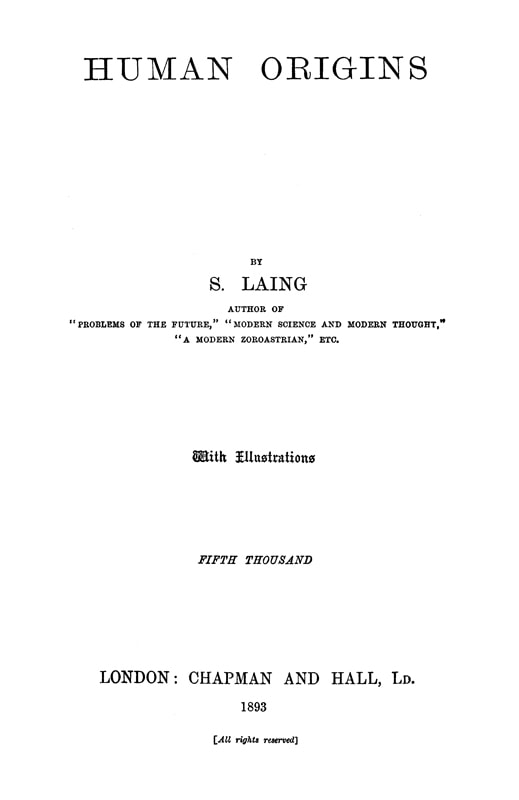
Human Origins
1892
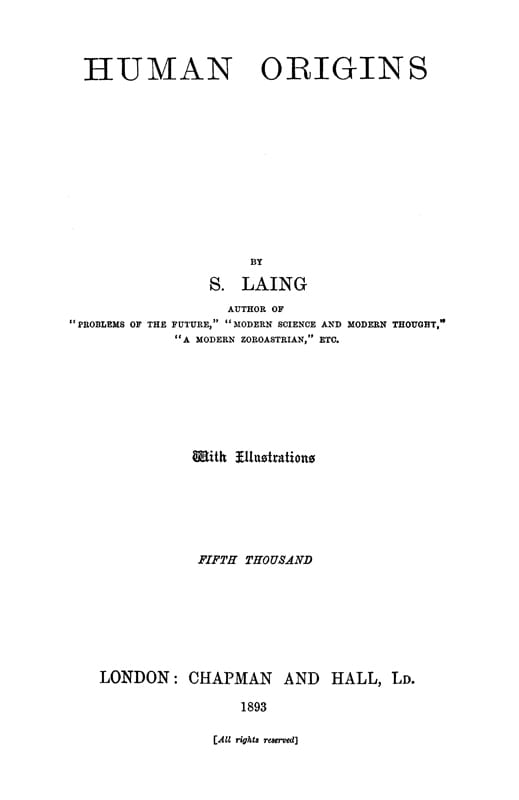
Published in 1892, 'Human Origins' by S. Laing is a scientific exploration of the evolution of the human race, drawing from history, archaeology, and geology. Laing critically examines traditional biblical accounts of human origins, particularly in relation to ancient civilizations like Egypt and Chaldæa. The book highlights the tension between religious beliefs and emerging scientific evidence, suggesting a more complex and older history of humanity than previously accepted. This work is notable for challenging established narratives and encouraging a deeper understanding of prehistoric times.
Editions
X-Ray
The author and narrator who guides readers through scientific evidence about human origins. He presents himself as an educator seeking to make modern scientific discoveries accessible to general readers.
First historical king of unified Egypt, dated around 5004 BC according to Manetho's lists. Represents the dawn of recorded history and advanced civilization.
Egyptian priest and historian who compiled lists of Egyptian dynasties and kings for Ptolemy Philadelphus. His chronology extends Egyptian history back over 5000 years.
Ancient Chaldean king dated around 3800 BC, founder of the united monarchy of Sumir and Accad. Represents early Mesopotamian civilization.
About Human Origins
Chapter Summaries
- Introduction
- Laing explains his purpose: to trace human origins through historical and scientific evidence. He contrasts the biblical timeline of 6000 years with evidence for much greater antiquity from Egyptian and Mesopotamian records.
- 1
- Egyptian historical records, confirmed by hieroglyphic inscriptions, extend back to at least 5004 BC with King Menes. The decipherment of hieroglyphics by Champollion validates Manetho's ancient chronology and reveals advanced civilization at the dawn of recorded history.
- 2
- Mesopotamian cuneiform records, deciphered from clay tablets, reveal civilizations dating back to Sargon I around 3800 BC. These records parallel Egyptian chronology and show advanced astronomy, literature, and governance in extreme antiquity.
Key Themes
- Science vs. Religious Orthodoxy
- Laing argues that scientific evidence from archaeology, geology, and other fields contradicts literal biblical interpretation while supporting evolutionary theory. He advocates for reconciling religious faith with scientific truth.
- The Antiquity of Civilization
- Ancient Egyptian and Mesopotamian records demonstrate advanced civilizations existing thousands of years before the biblical creation date. This vast antiquity provides the time necessary for evolutionary development.
- Evolution and Progress
- Human development from primitive origins through increasingly sophisticated civilizations demonstrates evolutionary progress. This applies to technology, religion, morality, and social organization.
Characters
- S. Laing(protagonist)
- The author and narrator who guides readers through scientific evidence about human origins. He presents himself as an educator seeking to make modern scientific discoveries accessible to general readers.
- Menes(major)
- First historical king of unified Egypt, dated around 5004 BC according to Manetho's lists. Represents the dawn of recorded history and advanced civilization.
- Manetho(major)
- Egyptian priest and historian who compiled lists of Egyptian dynasties and kings for Ptolemy Philadelphus. His chronology extends Egyptian history back over 5000 years.
- Sargon I(major)
- Ancient Chaldean king dated around 3800 BC, founder of the united monarchy of Sumir and Accad. Represents early Mesopotamian civilization.
- Champollion(major)
- French scholar who deciphered Egyptian hieroglyphics using the Rosetta Stone. His work unlocked ancient Egyptian records for modern study.
- Charles Darwin(major)
- Naturalist whose theory of evolution provides the scientific framework for understanding human origins over vast time periods.
Link to this book
Add a free, dofollow link to Lex on your blog, forum, syllabus, or reading list.

<a href="https://lex-books.com/book/human-origins-8cb60727-3771-4629-9693-4f8116e4ba57"><img src="https://lex-books.com/badges/read-on-lex.svg" alt="Read Human Origins by S. Laing free on Lex" width="160" height="40"></a>[](https://lex-books.com/book/human-origins-8cb60727-3771-4629-9693-4f8116e4ba57)[url=https://lex-books.com/book/human-origins-8cb60727-3771-4629-9693-4f8116e4ba57][img]https://lex-books.com/badges/read-on-lex.svg[/img][/url]Read Human Origins by S. Laing free on Lex: https://lex-books.com/book/human-origins-8cb60727-3771-4629-9693-4f8116e4ba57Cite this book
Reading this edition for a paper or guide? Copy a citation.
Laing, S.. Human Origins. Lex, lex-books.com/book/human-origins-8cb60727-3771-4629-9693-4f8116e4ba57.Laing, S. (1892). Human Origins. Lex. https://lex-books.com/book/human-origins-8cb60727-3771-4629-9693-4f8116e4ba57Laing, S.. Human Origins. Lex. https://lex-books.com/book/human-origins-8cb60727-3771-4629-9693-4f8116e4ba57.