History of the Conquest of Mexico; vol. 1/4
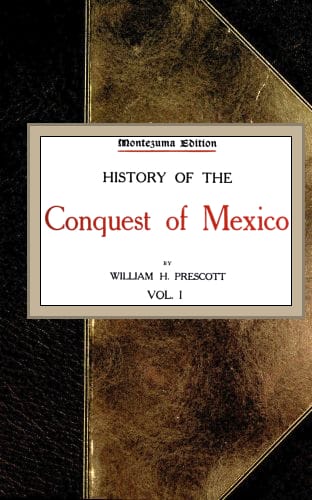
The Spanish conquest of Mexico remains one of history's most staggering collisions of civilizations. In 1843, William Hickling Prescott transformed years of meticulous research into a narrative that reads like epic fiction while maintaining rigorous scholarship. His account follows Hernán Cortés from his first landing on Mexican shores through the fall of Tenochtitlan and the destruction of the Aztec Empire, rendering the fateful encounter between Spanish steel and indigenous power with unprecedented literary force. What elevates this work beyond conventional history is Prescott's extraordinary gift for characterization. Montezuma emerges as a tragic figure, a Greek hero doomed by forces beyond his control, while Cortés appears as the consummate Renaissance conqueror: ruthless, charismatic, endlessly adaptable. The narrative captures not merely military conquest but the profound cultural and psychological dimensions of two worlds colliding. Though written from a particular 19th-century perspective, Prescott's achievement endures as both a foundational work of Latin American historiography and a landmark of English prose.
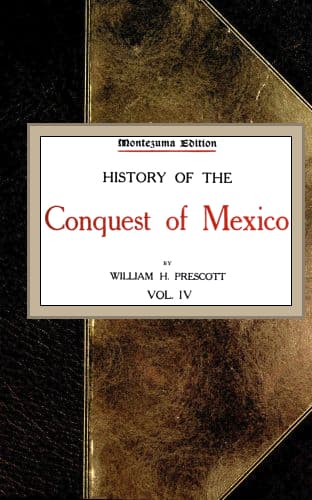
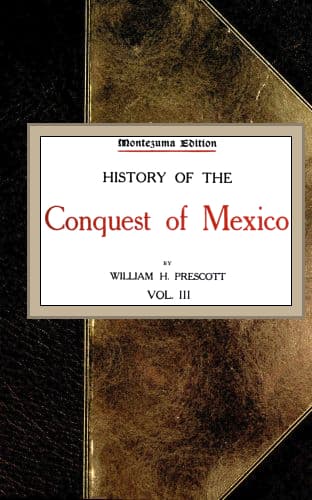
Editions
X-Ray
“a government, which does not rest on the sympathies of its subjects, cannot long abide; that human institutions, when not connected with human prosperity and progress, must fall, if not before the increasing light of civilisation, by the hand of violence; by violence from within, if not from without. And who shall lament their fall?””
— William Hickling Prescott
“The life of the Spanish discoverers was one long day-dream. Illusion after illusion chased one another like the bubbles which the child throws off from his pipe, as bright, as beautiful, and as empty. They lived in a world of enchantment.””
— William Hickling Prescott
“But, to judge the action fairly, we must transport ourselves to the age when it happened.””
— William Hickling Prescott
Link to this book
Add a free, dofollow link to Lex on your blog, forum, syllabus, or reading list.

<a href="https://lex-books.com/book/history-of-the-conquest-of-mexico-vol-1-4-ab07dc6c-38d8-44ca-8a84-67b63cf73b3d"><img src="https://lex-books.com/badges/read-on-lex.svg" alt="Read History of the Conquest of Mexico; vol. 1/4 by William Hickling Prescott free on Lex" width="160" height="40"></a>[](https://lex-books.com/book/history-of-the-conquest-of-mexico-vol-1-4-ab07dc6c-38d8-44ca-8a84-67b63cf73b3d)[url=https://lex-books.com/book/history-of-the-conquest-of-mexico-vol-1-4-ab07dc6c-38d8-44ca-8a84-67b63cf73b3d][img]https://lex-books.com/badges/read-on-lex.svg[/img][/url]Read History of the Conquest of Mexico; vol. 1/4 by William Hickling Prescott free on Lex: https://lex-books.com/book/history-of-the-conquest-of-mexico-vol-1-4-ab07dc6c-38d8-44ca-8a84-67b63cf73b3dCite this book
Reading this edition for a paper or guide? Copy a citation.
Prescott, William Hickling. History of the Conquest of Mexico; vol. 1/4. Lex, lex-books.com/book/history-of-the-conquest-of-mexico-vol-1-4-ab07dc6c-38d8-44ca-8a84-67b63cf73b3d.Prescott, W. H. (n.d.). History of the Conquest of Mexico; vol. 1/4. Lex. https://lex-books.com/book/history-of-the-conquest-of-mexico-vol-1-4-ab07dc6c-38d8-44ca-8a84-67b63cf73b3dPrescott, William Hickling. History of the Conquest of Mexico; vol. 1/4. Lex. https://lex-books.com/book/history-of-the-conquest-of-mexico-vol-1-4-ab07dc6c-38d8-44ca-8a84-67b63cf73b3d.