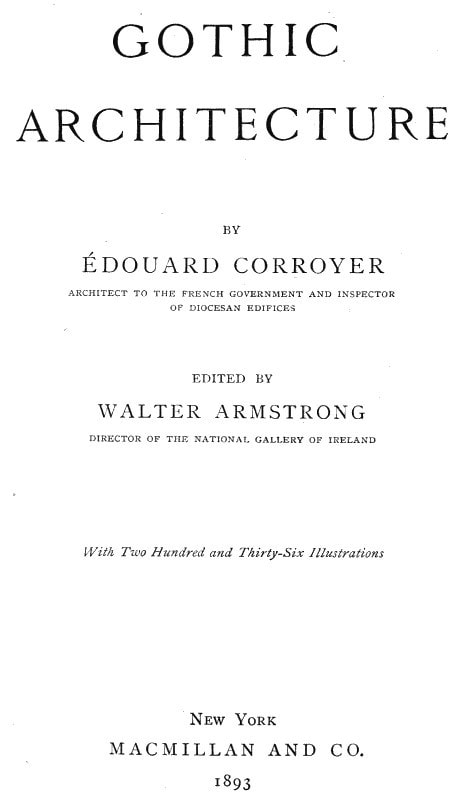
Gothic Architecture
1893
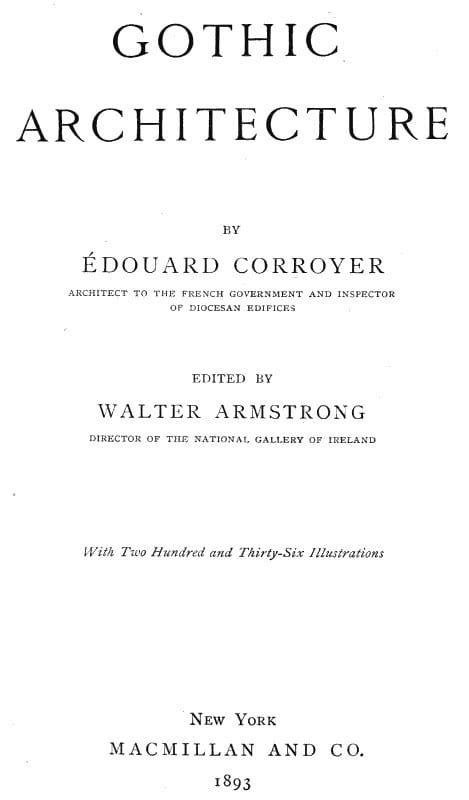
Gothic Architecture
1893
Translated by Florence Simmonds
Written by a French government architect and Inspector of Diocesan Edifices, this 1893 treatise offers an intimate, firsthand account of the style the French called 'opera francigena' - the French work that reshaped the skyline of Europe. Corroyer traces Gothic architecture from its contested origins (the misleading name has nothing to do with the Goths) through its technical revolution: the pointed arch, the rib vault, and above all, the flying buttress - that audacious engineering leap that allowed walls to become windows, flooding cathedrals with colored light. The book is grounded in close study of French monuments, from the Abbey of Saint-Denis, where the Gothic language was first spoken around 1140, to the soaring cathedrals of Chartres, Amiens, and Reims. Yet this is not neutral scholarship. The translator's preface openly acknowledges Corroyer's nationalist fervor - his insistence that every Gothic achievement traces back to French genius. This partiality, rather than diminishing the work, gives it texture: a window into how the French understood their own architectural heritage at the height of the 19th century's cathedral preservation movement. For readers who have stood in a Gothic nave and wondered how it was built, or who want to understand the origins of the style that defines Europe's sacred landscape, Corroyer offers both technical clarity and period charm.
Editions

X-Ray
French architect and inspector of diocesan edifices who authored this comprehensive study of Gothic architecture. He demonstrates deep knowledge of architectural history and construction techniques.
Director of the National Gallery of Ireland who edited this work. He provides editorial commentary and occasionally challenges Corroyer's French-centric viewpoints.
Sixth-century saint who established the Benedictine Rule and founded Monte Casino monastery. His architectural principles influenced monastic building throughout the Middle Ages.
Twelfth-century abbot who reformed the Benedictine order and founded the Cistercian movement. He advocated for architectural simplicity and established numerous monasteries.
About Gothic Architecture
Chapter Summaries
- Introduction
- Corroyer argues that the term 'Gothic' is misleading and that this architectural style should be called 'French Medieval Architecture.' He establishes the French origins of the style and its spread throughout Europe.
- I.1
- Traces how the cupola of St. Front at Périgueux influenced the development of Gothic vaulting systems. The Aquitainian cupola led to the intersecting arch, which became fundamental to Gothic construction.
- I.2
- Explains how the intersecting arch developed from cupola pendentives, particularly at St. Front. This innovation replaced Roman ribbed vaults with a more active structural system.
Key Themes
- French Architectural Supremacy
- Corroyer consistently argues that Gothic architecture originated in France and spread throughout Europe, challenging the Germanic associations of the term 'Gothic.'
- Evolution vs Revolution
- The work demonstrates how Gothic architecture evolved gradually from Romanesque traditions rather than appearing suddenly, showing continuous development of building techniques.
- Religious and Secular Integration
- The text explores how religious architectural principles influenced all forms of medieval building, from cathedrals to castles to domestic structures.
Characters
- Édouard Corroyer(protagonist)
- French architect and inspector of diocesan edifices who authored this comprehensive study of Gothic architecture. He demonstrates deep knowledge of architectural history and construction techniques.
- Walter Armstrong(major)
- Director of the National Gallery of Ireland who edited this work. He provides editorial commentary and occasionally challenges Corroyer's French-centric viewpoints.
- St. Benedict(major)
- Sixth-century saint who established the Benedictine Rule and founded Monte Casino monastery. His architectural principles influenced monastic building throughout the Middle Ages.
- St. Bernard(major)
- Twelfth-century abbot who reformed the Benedictine order and founded the Cistercian movement. He advocated for architectural simplicity and established numerous monasteries.
- Viollet-le-Duc(major)
- Nineteenth-century French architect and theorist frequently cited as an authority on Gothic architecture. His restoration work and writings shaped understanding of medieval building.
- Philip Augustus(minor)
- French king who commissioned major fortifications and architectural projects in the early thirteenth century.
Link to this book
Add a free, dofollow link to Lex on your blog, forum, syllabus, or reading list.

<a href="https://lex-books.com/book/gothic-architecture-721b0b91-a318-4790-a68b-74112ba83a28"><img src="https://lex-books.com/badges/read-on-lex.svg" alt="Read Gothic Architecture by douard Corroyer free on Lex" width="160" height="40"></a>[](https://lex-books.com/book/gothic-architecture-721b0b91-a318-4790-a68b-74112ba83a28)[url=https://lex-books.com/book/gothic-architecture-721b0b91-a318-4790-a68b-74112ba83a28][img]https://lex-books.com/badges/read-on-lex.svg[/img][/url]Read Gothic Architecture by douard Corroyer free on Lex: https://lex-books.com/book/gothic-architecture-721b0b91-a318-4790-a68b-74112ba83a28Cite this book
Reading this edition for a paper or guide? Copy a citation.
Corroyer, douard. Gothic Architecture. Lex, lex-books.com/book/gothic-architecture-721b0b91-a318-4790-a68b-74112ba83a28.Corroyer, D. (1893). Gothic Architecture. Lex. https://lex-books.com/book/gothic-architecture-721b0b91-a318-4790-a68b-74112ba83a28Corroyer, douard. Gothic Architecture. Lex. https://lex-books.com/book/gothic-architecture-721b0b91-a318-4790-a68b-74112ba83a28.