From October to Brest-Litovsk
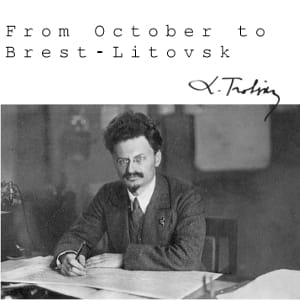
In the winter of 1917-18, Russia was bleeding. The Bolsheviks had seized power, but the new Soviet state faced annihilation: a collapsed economy, a shattered army, and the German army advancing with terrifying speed. Trotsky's account captures the most agonizing decision of the early Soviet period: signing the Treaty of Brest-Litovsk, which surrendered a third of Russia's population and most of its industrial heartland to German control. This is not a memoir of triumph. It is a document of political anguish, a reasoned defense of capitulation when every revolutionary instinct screamed for resistance. Trotsky writes as both participant and analyst, reconstructing the internal debates, the factions, the terrible arithmetic of survival. Why surrender the revolution's gains to imperialism? Because the revolution would survive nothing at all if Germany swallowed it whole. The book endures because it captures a truth most revolutionary literature hides: that power sometimes means knowing when to retreat.
Editions

Link to this book
Add a free, dofollow link to Lex on your blog, forum, syllabus, or reading list.

<a href="https://lex-books.com/book/from-october-to-brest-litovsk-1fa3bf15-4d28-45cf-913d-b6d4d87cf0a0"><img src="https://lex-books.com/badges/read-on-lex.svg" alt="Read From October to Brest-Litovsk by Leon Trotsky free on Lex" width="160" height="40"></a>[](https://lex-books.com/book/from-october-to-brest-litovsk-1fa3bf15-4d28-45cf-913d-b6d4d87cf0a0)[url=https://lex-books.com/book/from-october-to-brest-litovsk-1fa3bf15-4d28-45cf-913d-b6d4d87cf0a0][img]https://lex-books.com/badges/read-on-lex.svg[/img][/url]Read From October to Brest-Litovsk by Leon Trotsky free on Lex: https://lex-books.com/book/from-october-to-brest-litovsk-1fa3bf15-4d28-45cf-913d-b6d4d87cf0a0Cite this book
Reading this edition for a paper or guide? Copy a citation.
Trotsky, Leon. From October to Brest-Litovsk. Lex, lex-books.com/book/from-october-to-brest-litovsk-1fa3bf15-4d28-45cf-913d-b6d4d87cf0a0.Trotsky, L. (n.d.). From October to Brest-Litovsk. Lex. https://lex-books.com/book/from-october-to-brest-litovsk-1fa3bf15-4d28-45cf-913d-b6d4d87cf0a0Trotsky, Leon. From October to Brest-Litovsk. Lex. https://lex-books.com/book/from-october-to-brest-litovsk-1fa3bf15-4d28-45cf-913d-b6d4d87cf0a0.