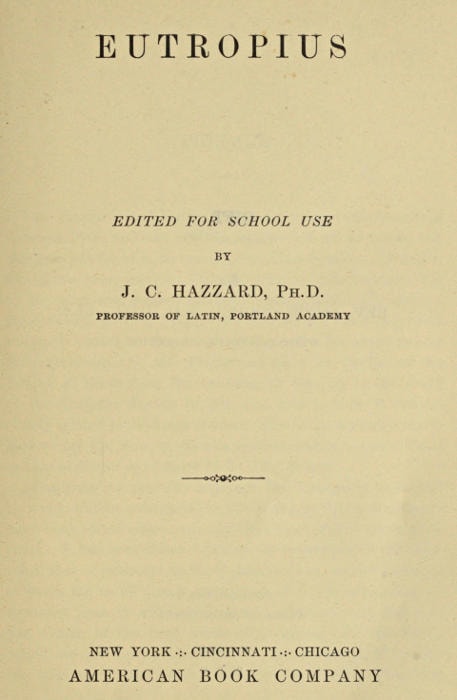
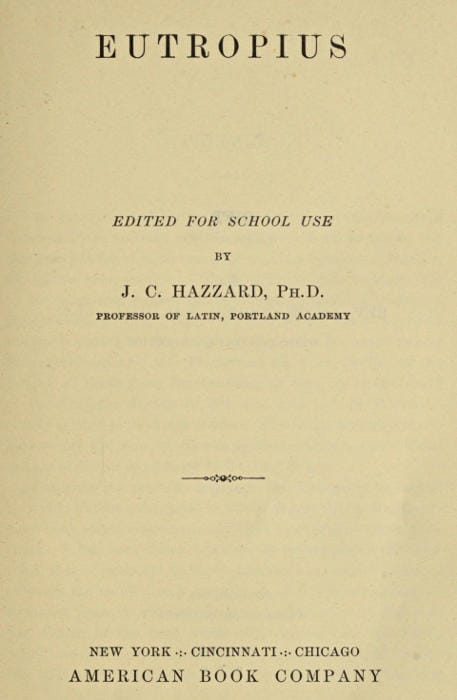
Eutropius
1887
A Roman official writing in the 4th century offers his contemporaries and future readers something rare: a clear-eyed reckoning with a thousand years of empire, from Romulus to the death of Jovian in 364 AD. Eutropius wrote his Breviarium as an act of intellectual generosity, distilling the vast arc of Roman history into a single readable volume for students and busy officials who wanted the shape of their world without wading through fragmentary chronicles. What emerges is a voice from antiquity itself, unencumbered by modern distance, telling the rise of Rome through kings, republic, and emperors with striking simplicity. The early sections handle the legendary founders with the sober restraint of a man who knows myth and history sometimes blur. But as Eutropius approaches his own time, the account gains urgency and weight: here is a writer who served under the emperors he describes, who witnessed the crises and transformations that would reshape the Mediterranean forever. For anyone curious about how Romans understood their own past, this compact work remains a vital and surprisingly lively窗口.
Editions

X-Ray
A Roman hero and general, known for his victories against the Volsci, Aequi, and Sutrini, and for his role after the Gallic invasion.
King of Epirus, a formidable foreign enemy who fought against Rome in Italy, initially winning battles with the aid of elephants.
A Roman consul and legate, admired by Pyrrhus for his integrity and refusal of bribes, embodying Roman virtue.
The Carthaginian general who initiated and led the Second Punic War, invading Italy and inflicting devastating defeats on the Romans.
About Eutropius
Chapter Summaries
- 2.1
- In 390 B.C., military tribunes with consular power replaced consuls. Camillus achieved significant victories against the Volsci, Aequi, and Sutrini, celebrating three triumphs, marking a period of Roman growth.
- 2.2
- T. Quīntius Cincinnātus defeated the Praenestini near the Allia River, annexed eight cities, and accepted Praeneste's surrender, all within twenty days, earning him a triumph.
- 2.3
- The dignity of military tribunes was short-lived, with a four-year period without major magistrates, followed by a three-year return of tribunes, before consuls were again appointed.
Key Themes
- Military Glory and Conquest
- The book consistently highlights Roman military prowess and the achievements of its generals. Victories, triumphs, and territorial expansion are central to the narrative, showcasing the Roman drive for dominance and the valor of its commanders from the early Republic through the Empire.
- Political Ambition and Power Struggles
- From the rivalry between consuls and military tribunes to the civil wars of Marius and Sulla, Caesar and Pompey, and Octavian and Antony, the text frequently depicts intense competition for political power. This ambition often leads to violence, proscriptions, and the overthrow of established norms, shaping the course of Roman history.
- Imperial Expansion and Administration
- The narrative traces Rome's growth from a small city-state to a vast empire, detailing the annexation of numerous provinces across Italy, Spain, Africa, Greece, and the East. It also touches upon the challenges of governing such an expansive territory and the various administrative approaches taken by different emperors.
Characters
- Camillus(supporting)
- A Roman hero and general, known for his victories against the Volsci, Aequi, and Sutrini, and for his role after the Gallic invasion.
- Pyrrhus(antagonist)
- King of Epirus, a formidable foreign enemy who fought against Rome in Italy, initially winning battles with the aid of elephants.
- Fabricius(supporting)
- A Roman consul and legate, admired by Pyrrhus for his integrity and refusal of bribes, embodying Roman virtue.
- Hannibal(antagonist)
- The Carthaginian general who initiated and led the Second Punic War, invading Italy and inflicting devastating defeats on the Romans.
- Scipio Africanus Maior(protagonist)
- A brilliant Roman general who conquered Spain, invaded Africa, and decisively defeated Hannibal at Zama, ending the Second Punic War.
- Philip V(antagonist)
- King of Macedon, who allied with Hannibal and later waged the Second Macedonian War against Rome.
Link to this book
Add a free, dofollow link to Lex on your blog, forum, syllabus, or reading list.

<a href="https://lex-books.com/book/eutropius-11a3f6e8-04f3-4227-be33-313235a84058"><img src="https://lex-books.com/badges/read-on-lex.svg" alt="Read Eutropius by Eutropius free on Lex" width="160" height="40"></a>[](https://lex-books.com/book/eutropius-11a3f6e8-04f3-4227-be33-313235a84058)[url=https://lex-books.com/book/eutropius-11a3f6e8-04f3-4227-be33-313235a84058][img]https://lex-books.com/badges/read-on-lex.svg[/img][/url]Read Eutropius by Eutropius free on Lex: https://lex-books.com/book/eutropius-11a3f6e8-04f3-4227-be33-313235a84058Cite this book
Reading this edition for a paper or guide? Copy a citation.
Eutropius. Eutropius. Lex, lex-books.com/book/eutropius-11a3f6e8-04f3-4227-be33-313235a84058.Eutropius (1887). Eutropius. Lex. https://lex-books.com/book/eutropius-11a3f6e8-04f3-4227-be33-313235a84058Eutropius. Eutropius. Lex. https://lex-books.com/book/eutropius-11a3f6e8-04f3-4227-be33-313235a84058.