Enchanted India
1899
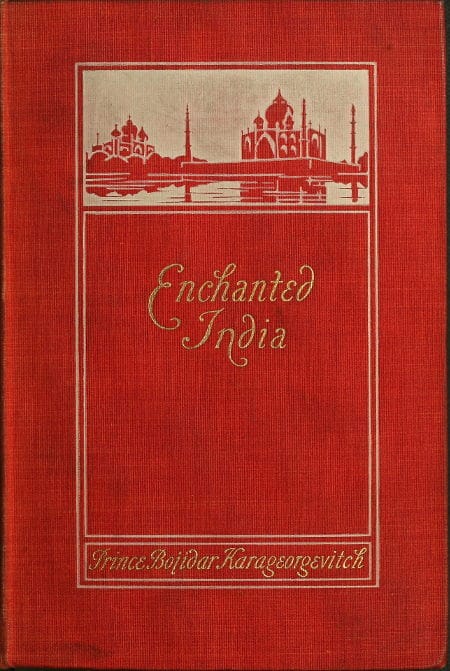
A European traveler arrives by ship at the threshold of India in 1899, and what unfolds is neither simple tourism nor scholarly observation but something more immediate: a collision of senses and assumptions. Bozidar Karadordevic records his passage from the Arabian Sea into Bombay Harbor, where the air itself transforms, thick with unfamiliar perfumes and carrying the first assault of tropical heat. The customs house becomes theater: chaos of coolies, officials demanding declarations of watches and scarf-pins, the overwhelming density of bodies Parsees in white, Hindus in bright silk, English soldiers in white helmets all pressing against the dock's whitewashed railings. From Bombay, the journey extends inland to Ellora's carved temples, each city offering new permutations of color, sound, and social order. The prose bristles with the particular details only a outsider would notice and record: the shape of a boat's sail resembling a gull's wings, the absurd formalities of empire, the sensory overload of white Asia. This is travel writing as it existed before tourism, when crossing oceans still meant encountering the world entire.
Editions
Link to this book
Add a free, dofollow link to Lex on your blog, forum, syllabus, or reading list.

<a href="https://lex-books.com/book/enchanted-india-4ebd9e62-5bf7-4478-bd23-4d4e4bbf35ef"><img src="https://lex-books.com/badges/read-on-lex.svg" alt="Read Enchanted India by Bozidar Karadordevic free on Lex" width="160" height="40"></a>[](https://lex-books.com/book/enchanted-india-4ebd9e62-5bf7-4478-bd23-4d4e4bbf35ef)[url=https://lex-books.com/book/enchanted-india-4ebd9e62-5bf7-4478-bd23-4d4e4bbf35ef][img]https://lex-books.com/badges/read-on-lex.svg[/img][/url]Read Enchanted India by Bozidar Karadordevic free on Lex: https://lex-books.com/book/enchanted-india-4ebd9e62-5bf7-4478-bd23-4d4e4bbf35efCite this book
Reading this edition for a paper or guide? Copy a citation.
Karadordevic, Bozidar. Enchanted India. Lex, lex-books.com/book/enchanted-india-4ebd9e62-5bf7-4478-bd23-4d4e4bbf35ef.Karadordevic, B. (1899). Enchanted India. Lex. https://lex-books.com/book/enchanted-india-4ebd9e62-5bf7-4478-bd23-4d4e4bbf35efKaradordevic, Bozidar. Enchanted India. Lex. https://lex-books.com/book/enchanted-india-4ebd9e62-5bf7-4478-bd23-4d4e4bbf35ef.