Die Metalle Bei Den Naturvölkern: Mit Berücksichtigung Prähistorischer Verhältnisse
1884
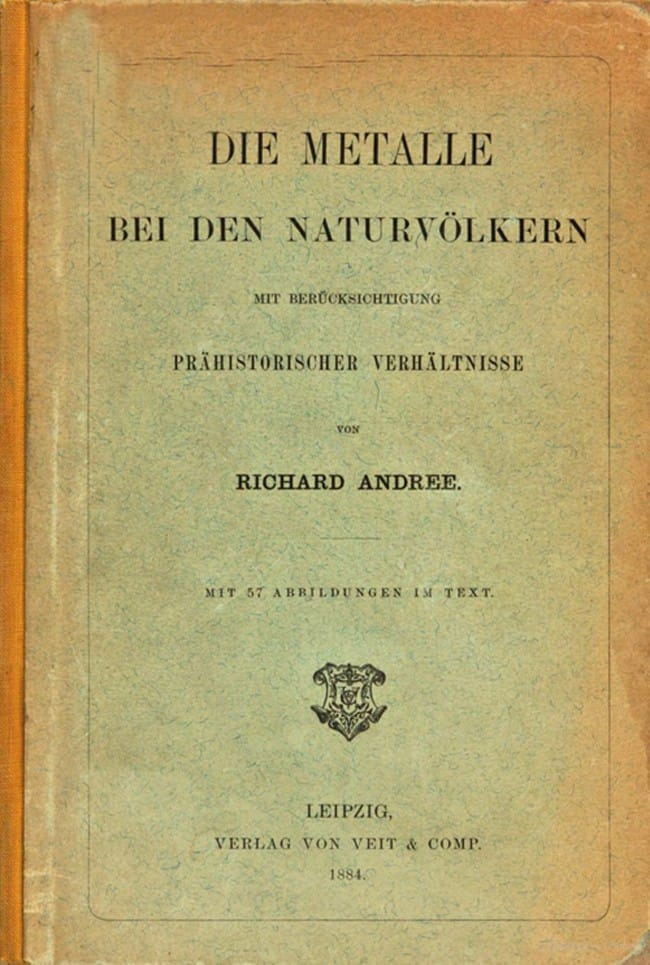
Die Metalle Bei Den Naturvölkern: Mit Berücksichtigung Prähistorischer Verhältnisse
1884
A scientific publication written in the late 19th century. This work examines the use and development of metals among so-called ''primitive peoples,'' with a strong focus on the ethnographic and cultural-historical aspects, and pays particular attention to prehistorical questions surrounding metallurgy. The book appears to offer a comparative study across different regions outside the European and Semitic cultural spheres, investigating how various societies independently discovered, processed, and valued metals such as iron, copper, tin, and bronze. The opening of the book presents a detailed preface and introduction in which the author outlines the motivation behind the work: the need to collect and preserve rapidly vanishing traditional knowledge on indigenous metallurgy in the face of growing European influence and industrialization. Andree acknowledges the complexity of the topic—requiring input from geology, geography, ethnography, chemistry, prehistory, and linguistics—and explains his comparative approach, covering Africa, Asia, and the Americas while excluding well-studied European and Semitic contexts. He previews major themes, such as the independent or borrowed nature of metalworking knowledge, the variability in the sequence of the Stone, Copper, Bronze, and Iron Ages across cultures, and the methodological issues in tracing the spread and development of metallurgy. The initial chapter then begins with a close look at ironworking among the peoples of Africa, particularly its presence in Ancient Egypt and its spread throughout the continent, supported by archaeological finds and early ethnographic reports.
Editions
Link to this book
Add a free, dofollow link to Lex on your blog, forum, syllabus, or reading list.

<a href="https://lex-books.com/book/die-metalle-bei-den-naturv-lkern-mit-ber-cksichtigung-pr-historischer-verh-ltnis-5a8dbfe5-db2c-49fd-b498-20e6bfb7e02d"><img src="https://lex-books.com/badges/read-on-lex.svg" alt="Read Die Metalle Bei Den Naturvölkern: Mit Berücksichtigung Prähistorischer Verhältnisse by Richard Andree free on Lex" width="160" height="40"></a>[](https://lex-books.com/book/die-metalle-bei-den-naturv-lkern-mit-ber-cksichtigung-pr-historischer-verh-ltnis-5a8dbfe5-db2c-49fd-b498-20e6bfb7e02d)[url=https://lex-books.com/book/die-metalle-bei-den-naturv-lkern-mit-ber-cksichtigung-pr-historischer-verh-ltnis-5a8dbfe5-db2c-49fd-b498-20e6bfb7e02d][img]https://lex-books.com/badges/read-on-lex.svg[/img][/url]Read Die Metalle Bei Den Naturvölkern: Mit Berücksichtigung Prähistorischer Verhältnisse by Richard Andree free on Lex: https://lex-books.com/book/die-metalle-bei-den-naturv-lkern-mit-ber-cksichtigung-pr-historischer-verh-ltnis-5a8dbfe5-db2c-49fd-b498-20e6bfb7e02dCite this book
Reading this edition for a paper or guide? Copy a citation.
Andree, Richard. Die Metalle Bei Den Naturvölkern: Mit Berücksichtigung Prähistorischer Verhältnisse. Lex, lex-books.com/book/die-metalle-bei-den-naturv-lkern-mit-ber-cksichtigung-pr-historischer-verh-ltnis-5a8dbfe5-db2c-49fd-b498-20e6bfb7e02d.Andree, R. (1884). Die Metalle Bei Den Naturvölkern: Mit Berücksichtigung Prähistorischer Verhältnisse. Lex. https://lex-books.com/book/die-metalle-bei-den-naturv-lkern-mit-ber-cksichtigung-pr-historischer-verh-ltnis-5a8dbfe5-db2c-49fd-b498-20e6bfb7e02dAndree, Richard. Die Metalle Bei Den Naturvölkern: Mit Berücksichtigung Prähistorischer Verhältnisse. Lex. https://lex-books.com/book/die-metalle-bei-den-naturv-lkern-mit-ber-cksichtigung-pr-historischer-verh-ltnis-5a8dbfe5-db2c-49fd-b498-20e6bfb7e02d.