De Reis Om De Wereld
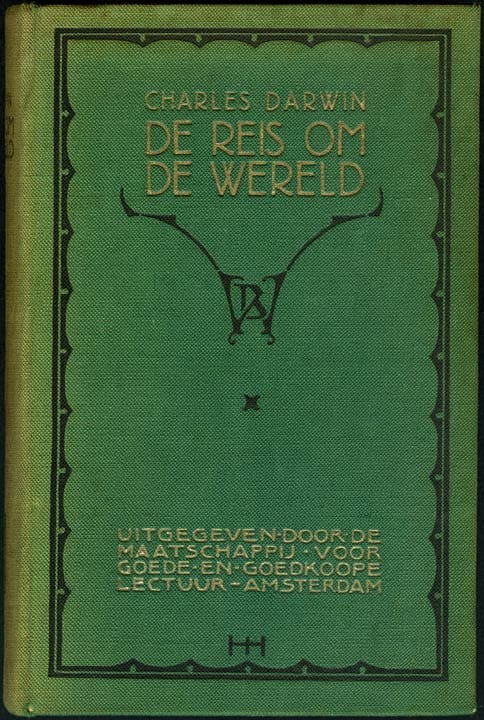
De Reis Om De Wereld
Translated by Brandt J.
De Reis Om De Wereld is Charles Darwin's account of his five-year voyage on the HMS Beagle, which began on December 27, 1831. This early 19th-century work details his observations of natural history and geology across various regions, including South America and the Cape Verde Islands. The expedition significantly influenced Darwin's later theories on evolution and natural selection, making this narrative a crucial scientific exploration and personal memoir. The book includes vivid descriptions of landscapes, flora, and fauna, alongside insights into the socio-political contexts of the places he visited.
Editions
X-Ray
“If the misery of the poor be caused not by the laws of nature, but by our institutions, great is our sin.””
— Charles Darwin
“Among the scenes which are deeply impressed on my mind, none exceed in sublimity the primeval forests undefaced by the hand of man; whether those of Brazil, where the powers of Life are predominant, or those of Tierra del Fuego, where Death and decay prevail. Both are temples filled with the varied productions of the God of Nature: -- no one can stand in these solitudes unmoved, and not feel that there is more in man than the mere breath of his body.””
— Charles Darwin
“In conclusion, it appears that nothing can be more improving to a young naturalist, than a journey in distant countries.””
— Charles Darwin
“There are several other sources of enjoyment in a long voyage, which are of a more reasonable nature. The map of the world ceases to be a blank; it becomes a picture full of the most varied and animated figures. Each part assumes its proper dimensions: continents are not looked at in the light of islands, or islands considered as mere specks, which are, in truth, larger than many kingdoms of Europe. Africa, or North and South America, are well-sounding names, and easily pronounced; but it is not until having sailed for weeks along small portions of their shores, that one is thoroughly convinced what vast spaces on our immense world these names imply.””
— Charles Darwin
“It is often attempted to palliate slavery by comparing the state of slaves with our poorer countrymen: if the misery of our poor be caused not by the laws of nature, but by our institutions, great is our sin; but how this bears on slavery, I cannot see; as well might the use of the thumb-screw be defended in one land, by showing that men in another land suffered from some dreadful disease. Those who look tenderly at the slave owner, and with a cold heart at the slave, never seem to put themselves into the position of the latter; what a cheerless prospect, with not even a hope of change! picture to yourself the chance, ever hanging over you, of your wife and your little children”
— Charles Darwin
“One hand has surely worked throughout the universe.””
— Charles Darwin
“The earthquake, however, must be to every one a most impressive event: the earth, considered from our earliest childhood as the type of solidity, has oscillated like a thin crust beneath our feet; and in seeing the laboured works of man in a moment overthrown, we feel the insignificance of his boasted power.””
— Charles Darwin
“I have stated, that in the thirteen species of ground-finches, a nearly perfect gradation may be traced, from a beak extraordinarily thick, to one so fine, that it may be compared to that of a warbler.””
— Charles Darwin
“It is necessary to look forward to a harvest, however distant that may be, when some fruit will be reaped, some good effected.””
— Charles Darwin
Link to this book
Add a free, dofollow link to Lex on your blog, forum, syllabus, or reading list.

<a href="https://lex-books.com/book/de-reis-om-de-wereld-bef8579e-f221-4c40-af0f-52489f4384a8"><img src="https://lex-books.com/badges/read-on-lex.svg" alt="Read De Reis Om De Wereld by Charles Darwin free on Lex" width="160" height="40"></a>[](https://lex-books.com/book/de-reis-om-de-wereld-bef8579e-f221-4c40-af0f-52489f4384a8)[url=https://lex-books.com/book/de-reis-om-de-wereld-bef8579e-f221-4c40-af0f-52489f4384a8][img]https://lex-books.com/badges/read-on-lex.svg[/img][/url]Read De Reis Om De Wereld by Charles Darwin free on Lex: https://lex-books.com/book/de-reis-om-de-wereld-bef8579e-f221-4c40-af0f-52489f4384a8Cite this book
Reading this edition for a paper or guide? Copy a citation.
Darwin, Charles. De Reis Om De Wereld. Lex, lex-books.com/book/de-reis-om-de-wereld-bef8579e-f221-4c40-af0f-52489f4384a8.Darwin, C. (n.d.). De Reis Om De Wereld. Lex. https://lex-books.com/book/de-reis-om-de-wereld-bef8579e-f221-4c40-af0f-52489f4384a8Darwin, Charles. De Reis Om De Wereld. Lex. https://lex-books.com/book/de-reis-om-de-wereld-bef8579e-f221-4c40-af0f-52489f4384a8.