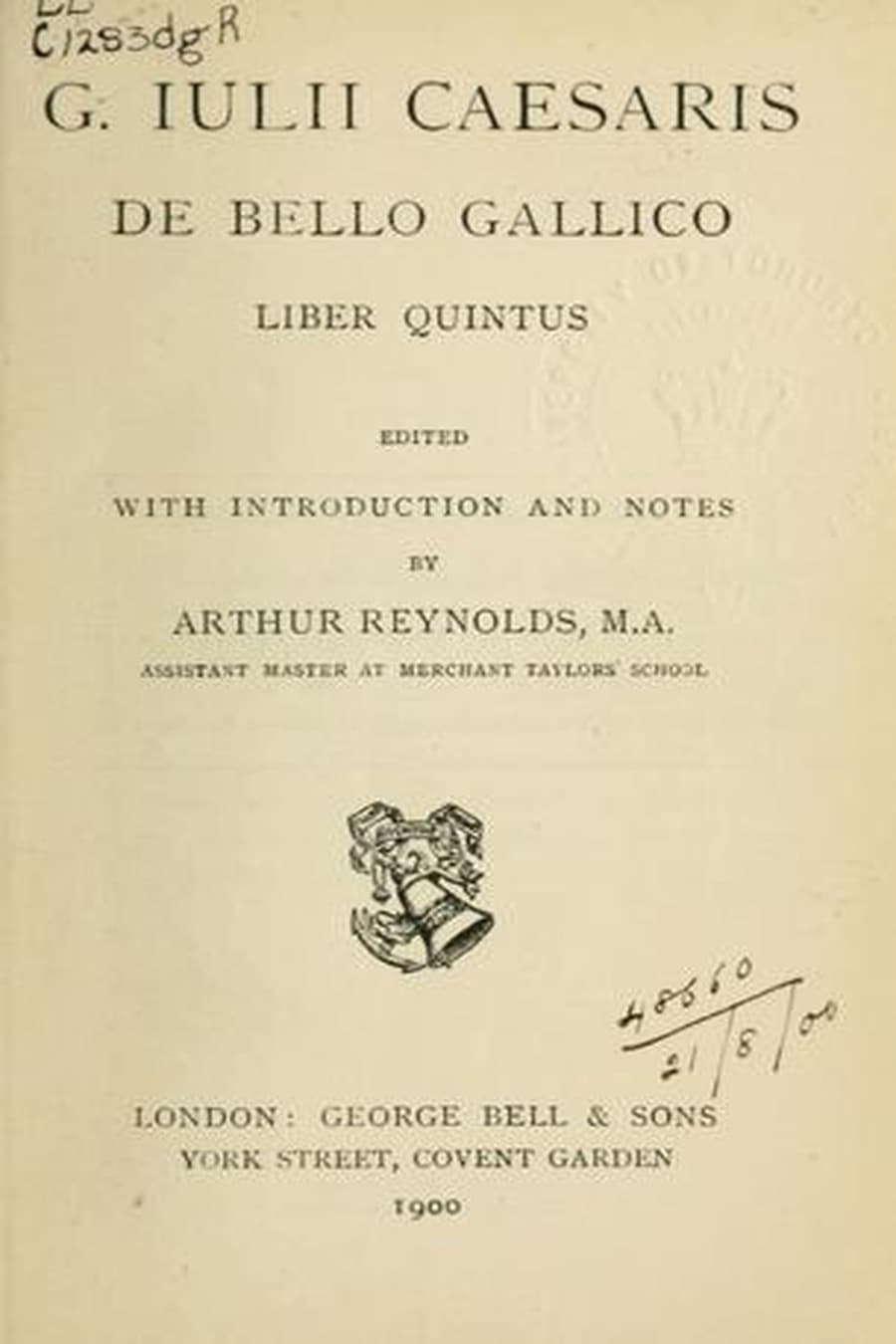
de Bello Gallico" and Other Commentaries
de Bello Gallico" and Other Commentaries
Translated by W. A. (William Alexander) McDevitte
The surviving words of the man who conquered Gaul and broke the Roman Republic, preserved in prose so precise it was used for centuries as a model of clear Latin. Caesar's Commentaries are not merely history written by its author - they are the calculated autobiography of a general who understood that victory means nothing if you cannot narrate it. Here is the Gallic War in its brutal entirety: the campaigns against the Helvetii, the sieges of Vercingetorix at Alesia, the expeditions into Britain and Germany - each account stripped of rhetoric, every maneuver rendered in language as sharp as a gladius. And then the Civil War, where former ally becomes enemy and Caesar crosses the Rubicon with his legion. The result is among history's most dangerous books: a first-person record of conquest that shaped military thinking for two millennia, written by a man who wielded both sword and pen with equal mastery. For anyone seeking to understand how Rome became an empire, or how power writes its own history, there is no substitute for hearing it from Caesar himself.
Editions
X-Ray
“that there was no doubt that the Helvetii were the most powerful of the whole of Gaul;””
— Julius Caesar
“THE COMMENTARIES OF Gaius JULIUS CAESAR””
— Julius Caesar
About de Bello Gallico" and Other Commentaries
Chapter Summaries
- I.1-30
- The Helvetii, led by Orgetorix, plan to migrate through Roman territory. Caesar prevents their passage and defeats them in battle, forcing their return home.
- I.31-54
- Caesar confronts the German king Ariovistus, who had established himself in Gaul. After negotiations fail, Caesar defeats Ariovistus in battle and drives him back across the Rhine.
- II.1-35
- Caesar campaigns against the Belgian tribes, defeating the Belgae in a series of battles and sieges, including the dramatic siege of the Nervii.
Key Themes
- Imperialism and Conquest
- The work chronicles Rome's expansion into Gaul, presenting Caesar's campaigns as both civilizing missions and strategic necessities. The narrative reveals the complex dynamics of imperial conquest and cultural collision.
- Leadership and Command
- Caesar presents himself as the ideal military commander, emphasizing decisive action, strategic thinking, and the ability to inspire loyalty. The work serves as a manual on effective leadership in crisis situations.
- Civilization versus Barbarism
- The text contrasts Roman order and discipline with Gallic and Germanic 'barbarism,' though it also acknowledges the courage and nobility of Caesar's enemies, particularly Vercingetorix.
Characters
- Julius Caesar(protagonist)
- Roman general and proconsul of Gaul, the narrator and central figure of the Commentaries. A skilled military strategist and politician who conquers Gaul through a series of campaigns from 58-50 BCE.
- Vercingetorix(antagonist)
- Arvernian chieftain who becomes the unified leader of Gallic resistance against Rome. A charismatic and strategic leader who nearly defeats Caesar before his final surrender at Alesia.
- Titus Labienus(major)
- Caesar's most trusted lieutenant and military commander. He leads independent operations and serves as Caesar's second-in-command throughout the Gallic campaigns.
- Divitiacus(major)
- Aeduan druid and political leader who serves as Caesar's primary Gallic ally. He represents the pro-Roman faction among the Gauls and provides crucial intelligence and support.
- Dumnorix(major)
- Aeduan nobleman and brother of Divitiacus who opposes Roman rule. He represents anti-Roman sentiment among Caesar's supposed allies and is eventually killed while attempting to flee.
- Ariovistus(major)
- German king who had established himself in Gaul before Caesar's arrival. He represents the Germanic threat to both Gauls and Romans and is defeated in Caesar's first major campaign.
Link to this book
Add a free, dofollow link to Lex on your blog, forum, syllabus, or reading list.

<a href="https://lex-books.com/book/de-bello-gallico-and-other-commentaries-38d8376a-0be0-410f-bde1-f6c8a4109cdb"><img src="https://lex-books.com/badges/read-on-lex.svg" alt="Read de Bello Gallico" and Other Commentaries by Julius Caesar free on Lex" width="160" height="40"></a>[](https://lex-books.com/book/de-bello-gallico-and-other-commentaries-38d8376a-0be0-410f-bde1-f6c8a4109cdb)[url=https://lex-books.com/book/de-bello-gallico-and-other-commentaries-38d8376a-0be0-410f-bde1-f6c8a4109cdb][img]https://lex-books.com/badges/read-on-lex.svg[/img][/url]Read de Bello Gallico" and Other Commentaries by Julius Caesar free on Lex: https://lex-books.com/book/de-bello-gallico-and-other-commentaries-38d8376a-0be0-410f-bde1-f6c8a4109cdbCite this book
Reading this edition for a paper or guide? Copy a citation.
Caesar, Julius. de Bello Gallico" and Other Commentaries. Lex, lex-books.com/book/de-bello-gallico-and-other-commentaries-38d8376a-0be0-410f-bde1-f6c8a4109cdb.Caesar, J. (n.d.). de Bello Gallico" and Other Commentaries. Lex. https://lex-books.com/book/de-bello-gallico-and-other-commentaries-38d8376a-0be0-410f-bde1-f6c8a4109cdbCaesar, Julius. de Bello Gallico" and Other Commentaries. Lex. https://lex-books.com/book/de-bello-gallico-and-other-commentaries-38d8376a-0be0-410f-bde1-f6c8a4109cdb.